Zero Trust Security Model Explained Simply: A Guide to Implementation
Introduction
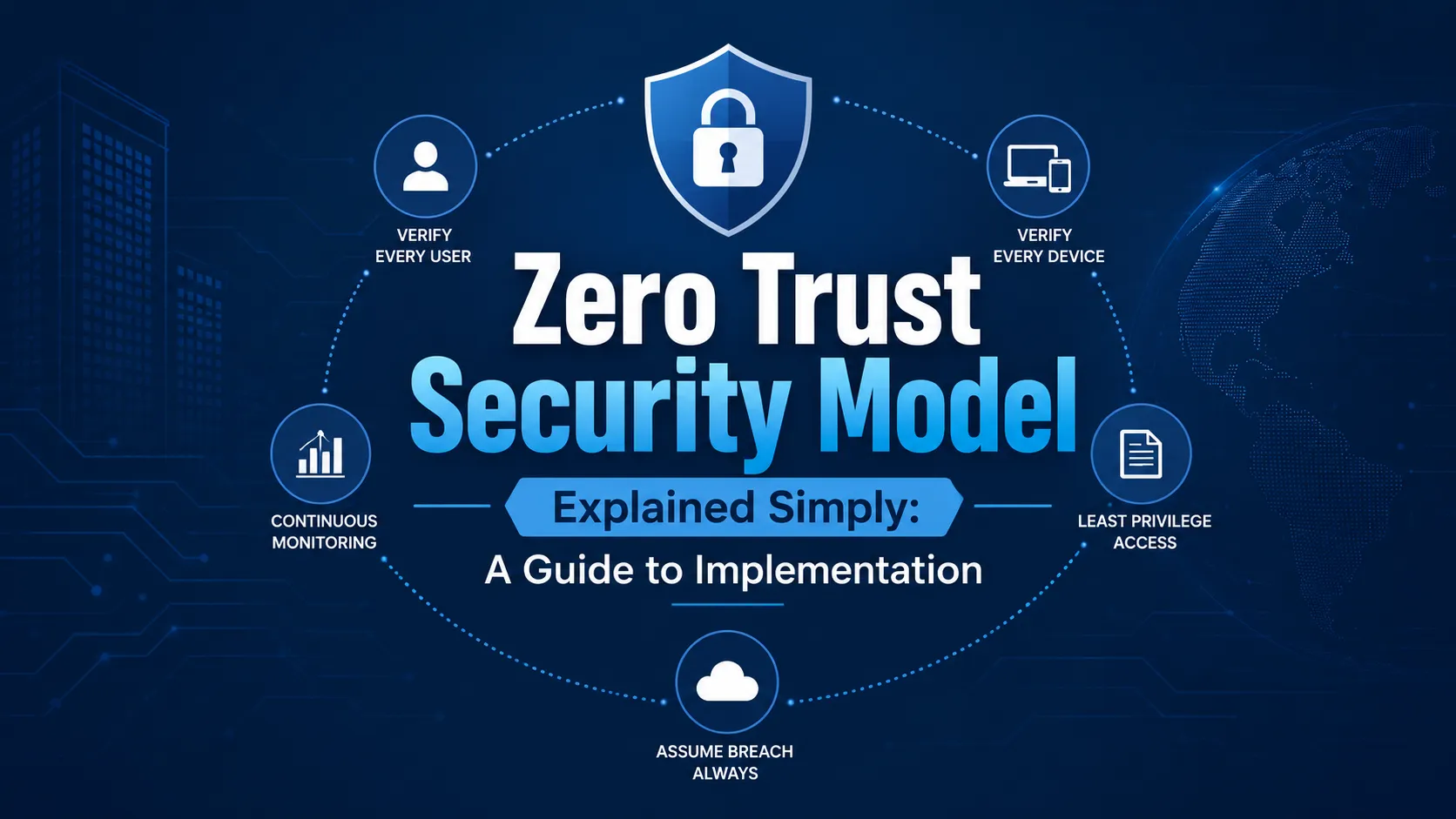
Castle-and-moat security is dead. It worked when employees sat in the same building and data lived behind a company firewall. That world no longer exists. In its place, the Zero Trust Security Model, explained simply, starts with one rule: trust nothing, verify everything. The Zero Trust Security Model abandons the idea that “inside a network” equals “safe.” Every access request, regardless of origin, must prove itself continuously. This Zero Trust Security Model has shifted from optional best practice to baseline operational necessity for any organization operating across cloud, remote work, and hybrid infrastructure.
What the Zero Trust Security Model Actually Is
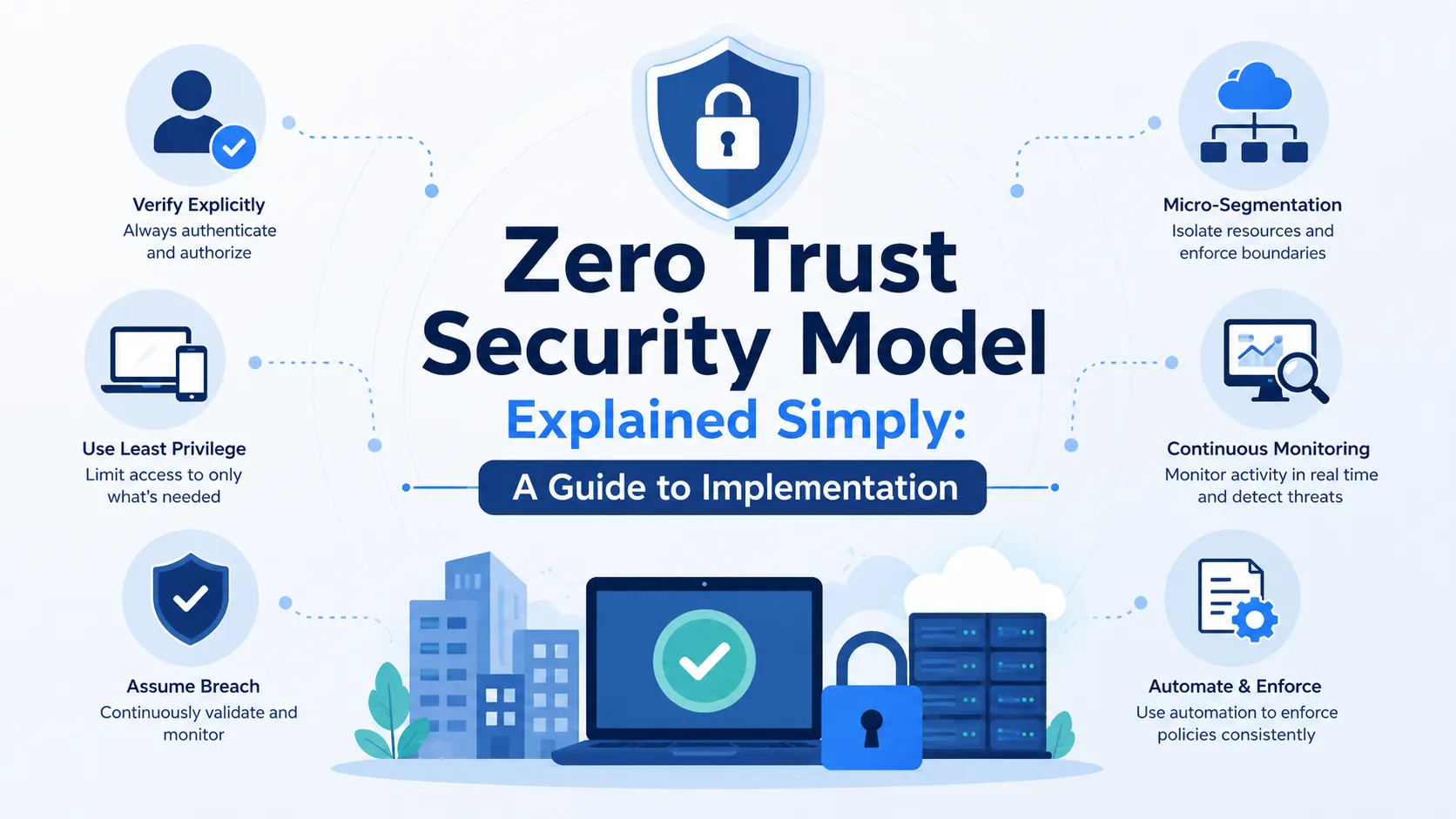
The zero trust security model is a cybersecurity framework built on three demanding principles: verify explicitly, apply least privilege, and assume breach. It is not a product you buy off a shelf. It is an architectural and cultural shift in how organizations think about access, risk, and trust across every layer of the environment. The core logic is simple but unforgiving: no user, device, workload, or service is implicitly trusted, regardless of network location. Authentication and authorization are discrete functions performed before every session, not just at login.
Zero Trust Security Model Explained Simply: A Guide to Implementation
Why the Perimeter Mindset Fails
Traditional security assumed a clear boundary between trusted inside and untrusted outside. That perimeter has evaporated. Employees work from home networks, coffee shops, and client sites. Data lives across multiple clouds, SaaS platforms, and on-premises systems. Attackers no longer break through firewalls. They log in. Credential theft, phishing, and token compromise are now the most successful forms of attack. Once inside the perimeter, lateral movement across the network often goes undetected for weeks. The Verizon Data Breach Investigations Report found that 68% of breaches involve a human element, primarily compromised credentials. The zero trust security model directly addresses this by eliminating implicit trust at every layer.
Three Core Principles (And How They Work)
The zero trust security model rests on three operational principles, each with a distinct mechanism and impact.
Verify explicitly. Every access request is authenticated and authorized using all available data points: user identity, device posture, location, time, and behavioral patterns. This is not a one-time gate. The system re-evaluates trust continuously throughout each session. An employee who authenticates from the office in the morning but attempts an unusual data export from a coffee shop at midnight triggers a fresh verification.
Apply least privilege. Users and services receive only the minimum access necessary to perform their specific task, for only as long as they need it. Just-in-time and just-enough-access policies eliminate standing privileges. A finance analyst does not need access to engineering source code. A contractor does not retain access after project completion.
Assume breach. The entire architecture is designed as if an attacker has already gained entry. This principle drives microsegmentation, encryption, and continuous monitoring. When a breach is assumed, every design decision prioritizes containment and detection over implicit trust.
Microsegmentation: The Enforcement Mechanism
Microsegmentation is how the zero trust security model prevents lateral movement. It divides the network into small, isolated segments, each with its own granular security policies. In a flat network, a compromised application server can pivot to adjacent systems, escalate privileges, and exfiltrate data. With microsegmentation, that compromised server cannot communicate outside its designated segment. The blast radius of a breach is contained to a single workload. Microsegmentation enforces least privilege at the network level, ensuring that even if credentials are stolen, the attacker cannot move freely.
Identity as the New Perimeter
In the zero trust security model, network location is no longer a meaningful trust signal. Identity has become the primary control plane. Every access request asks one question: who or what is making this request, and can that identity be verified? A mature identity fabric includes an identity provider for lifecycle management, multi-factor authentication as the minimum bar, and attribute-based access control for fine-grained decisions. But identity controls cannot stop at human users. Non-human identities—service accounts, APIs, microservices, and AI agents—often outnumber people dozens to one and carry broader entitlements. If they sit outside zero trust logic, the attack surface remains largely ungoverned.
The Technology Pillars That Support the Architecture
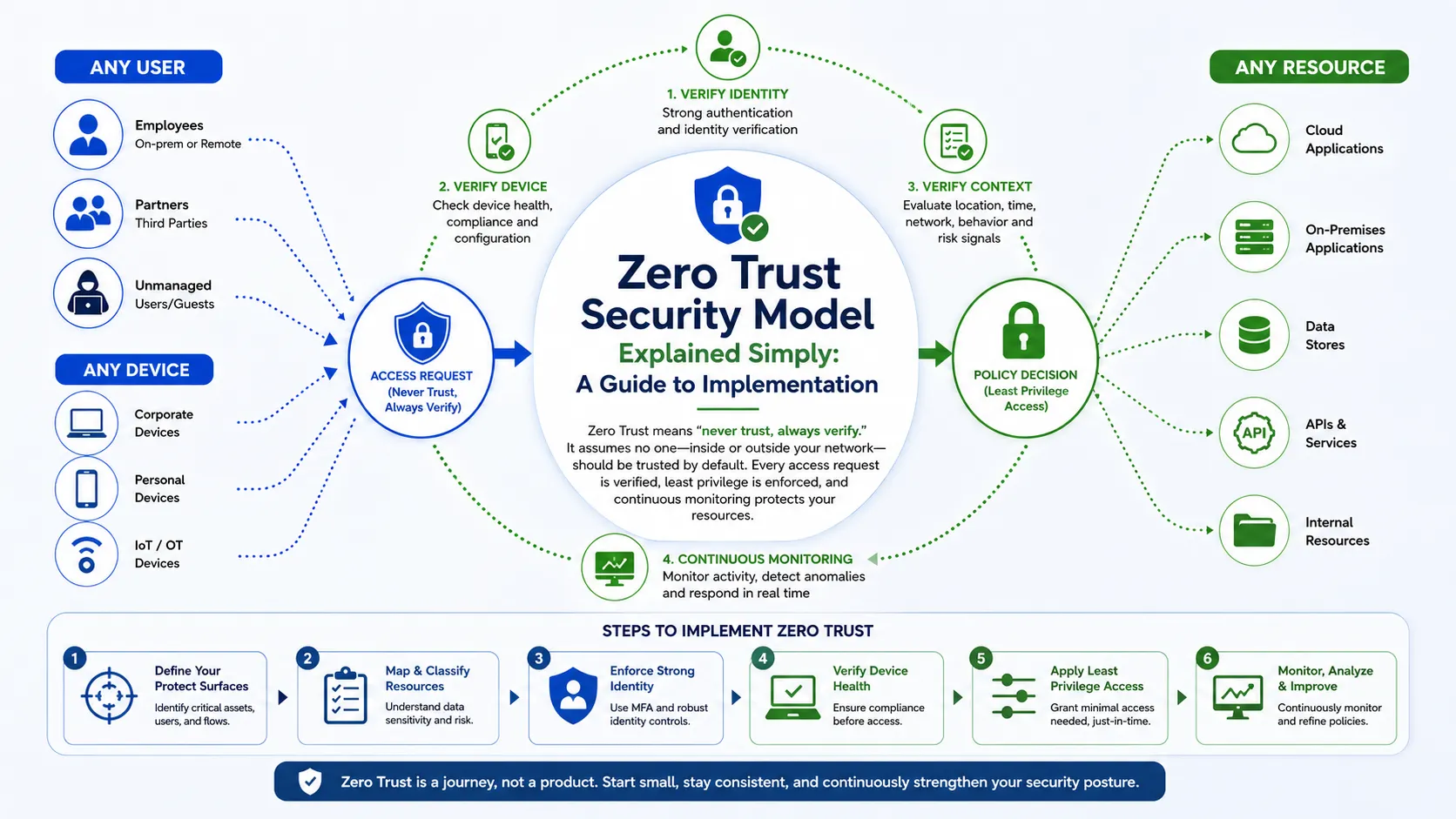
NIST SP 800-207 provides the formal blueprint for zero trust architecture. It separates the system into two planes: the control plane, where policy decisions are made, and the data plane, where traffic flows. The control plane contains three core components. The Policy Decision Point (PDP) evaluates access requests against defined policy using identity, device posture, behavioral signals, and threat intelligence. The Policy Enforcement Point (PEP) sits between the requestor and the resource, enforcing the PDP’s decision. The Policy Administration Point (PAP) is where security teams create and manage policies, ideally using policy-as-code for version control and auditability. No traffic should flow without passing through the control plane. If it does, you have a gap.
A Phased Roadmap for Implementation
The zero trust security model cannot be deployed all at once. It requires a phased, architecture-first approach.
Phase 1: Foundational controls. Enforce multi-factor authentication across all users. Clean up privileged access. Centralize identity management. Map all identities, including service accounts and APIs.
Phase 2: Policy and segmentation. Implement just-in-time access for privileged accounts. Begin microsegmentation on a protected surface—critical data, high-value applications, or sensitive workloads. Define explicit access policies that incorporate device posture and behavioral context.
Phase 3: Continuous verification. Move from static to dynamic trust decisions. Automate policy enforcement. Integrate threat intelligence into the PDP. Assume breach continuously and design all changes around containment.
The CISA Zero Trust Maturity Model provides a structured way to assess progress across five pillars: identity, devices, networks, applications and workloads, and data. Each pillar is assessed independently across four stages from traditional to optimal, allowing organizations to prioritize based on risk rather than trying to advance everything at once.
Has your organization identified every identity requesting access, including every service account and API key?
The Most Common Implementation Mistakes
Three mistakes consistently undermine zero trust implementations.
Treating zero trust as a checklist. Deploying MFA, rolling out endpoint agents, and replacing the VPN is not zero trust. If users authenticate once and retain broad access all day without ongoing evaluation, you have strong perimeter controls, not zero trust.
Focusing only on human identities. Service accounts, APIs, and workloads are often left ungoverned. A compromised service account can move across multiple systems with no MFA, no session timeout, and minimal monitoring.
Using binary, context-free policies. Access decisions must incorporate device posture, location, behavioral anomalies, and resource sensitivity. Without these signals, policies cannot tighten when risk increases or ease friction when conditions are normal.
Zero Trust Security Model Explained Simply: A Guide to Implementation
Conclusion
The zero trust security model is not a product you finish installing. It is an ongoing operational discipline that treats every access request as a potential threat. Organizations that adopt zero trust as an architectural philosophy rather than a checklist purchase consistently reduce breach impact, lower operational costs, and improve security agility. The model does not promise perfect security. It acknowledges a hard truth: attackers will eventually gain access to something. The goal is to ensure that every breach remains contained, detectable, and recoverable. The question is no longer whether to adopt zero trust. It is how quickly you can begin. Start with clear visibility into every identity and access request. Then verify everything, every time.
FAQs
Is zero trust just multi-factor authentication?
No. MFA is one component of identity verification. Zero trust also requires least privilege access, micro-segmentation, continuous monitoring, and the assumption of breach across all environments.
Does zero trust replace existing firewalls?
Not immediately. But mature zero trust architecture shifts security away from network location as a primary trust signal, often reducing reliance on traditional firewalls and VPNs.
How long does zero trust implementation take?
Full maturity typically takes two to five years. But foundational improvements like MFA enforcement and just-in-time privileged access can reduce risk within weeks.