Generative AI vs Traditional AI: A Technical Comparison
Introduction
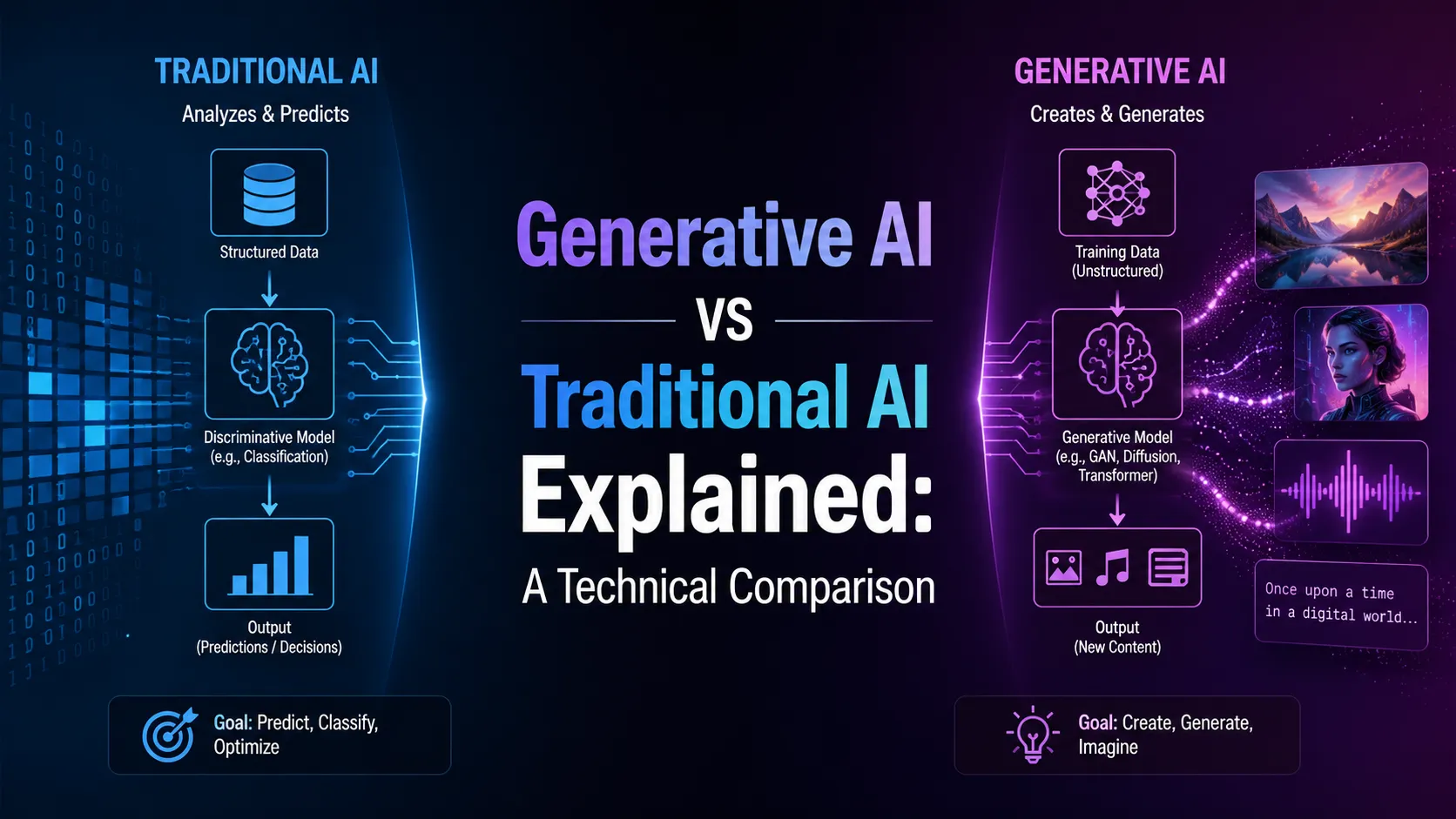
Artificial intelligence is not a single technology. It is an umbrella term covering systems that behave very differently under the hood. Two broad categories dominate enterprise and consumer applications today: traditional AI and generative AI. A clear Generative AI vs. Traditional AI framework helps cut through the confusion. Understanding the difference between Generative AI vs. Traditional AI properly is not an academic exercise. It determines whether you deploy the right tool for the right problem. Traditional AI analyzes data, identifies patterns, and makes predictions. Generative AI creates new content based on the patterns it has learned. This Generative AI vs. Traditional AI guide walks through the fundamental differences, the mechanisms behind each, and the practical trade-offs you need to know.
What Traditional AI Actually Does
Traditional AI refers to systems designed to analyze data, recognize patterns, and make decisions or predictions within well-defined parameters. These models are typically rule-based or trained on labeled data to perform specific functions. They do not create anything new. Instead, they interpret existing information and produce outputs like classifications, scores, or recommendations.
Common examples include fraud detection systems in banking, spam filters, recommendation engines on e-commerce platforms, and predictive maintenance in manufacturing. Traditional AI excels at structured problem-solving where the rules are clear and the outcomes are predictable. It is ideal for environments that demand consistency, repeatability, and interpretability.
What Generative AI Actually Does
Generative AI is a subset of artificial intelligence that creates new content: text, images, code, audio, video, or even synthetic data. Instead of simply analyzing or classifying data, generative models learn the underlying patterns and structures from vast datasets and then use those patterns to produce original outputs.
The output is not pre-existing. The system predicts what should come next—the next word in a sentence, the next pixel in an image, the next note in a melody—until the request feels complete. Tools like ChatGPT, DALL·E, GitHub Copilot, and MidJourney are all examples of generative AI in action. Generative AI is suited for tasks that require creativity, contextual understanding, and human-like output.
The Core Difference in One Sentence
Traditional AI tells you what is. Generative AI creates what could be. One system analyzes the world. The other describes, depicts, or programs new versions of it. Traditional AI is like a smart librarian who can find exactly the book you need. Generative AI is like an author who can write you an entirely new book on the spot. Both have their place. Both serve fundamentally different purposes.
Generative AI vs Traditional AI: A Technical Comparison
How Traditional AI Works Under the Hood
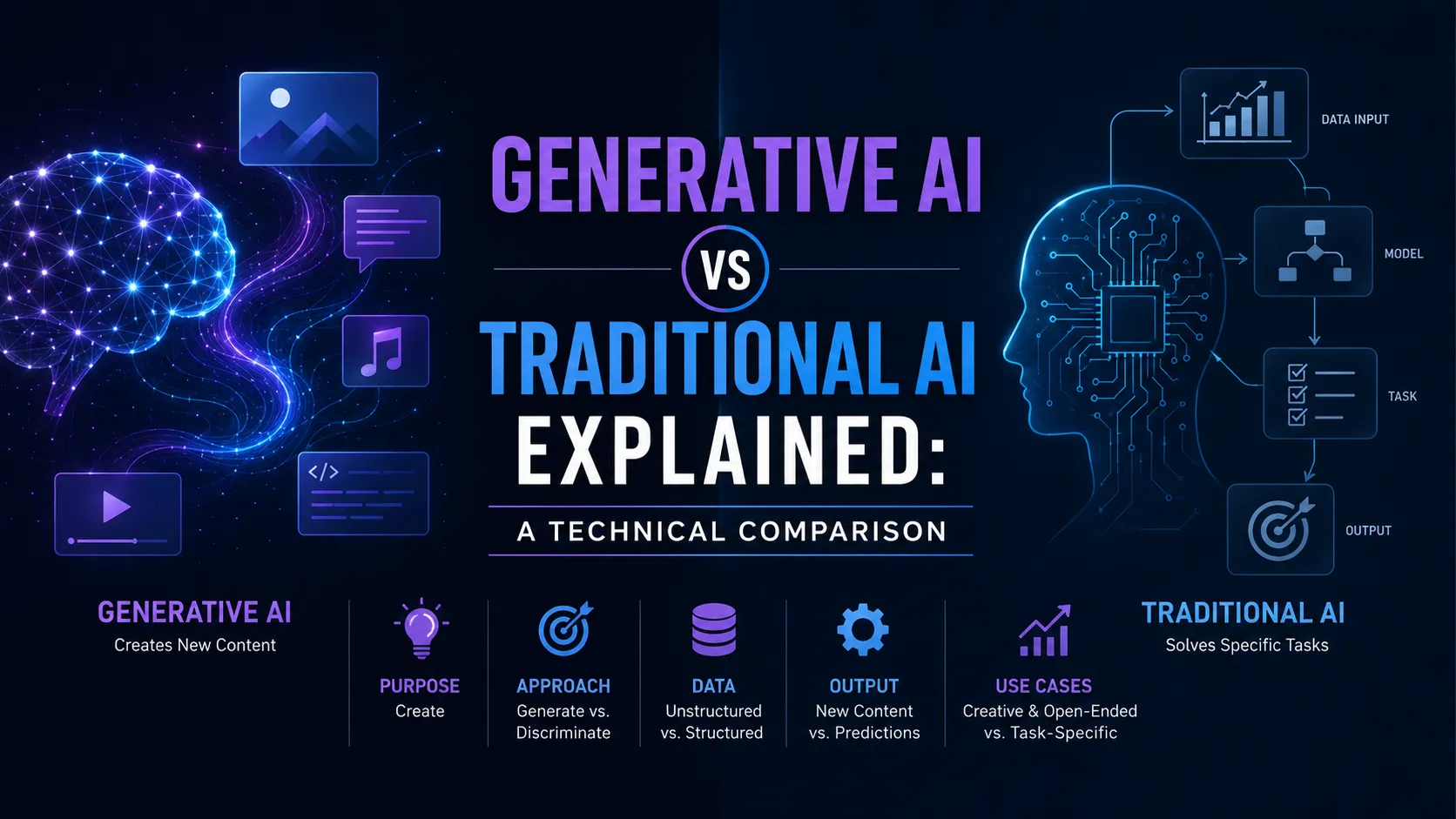
Traditional AI relies on supervised learning, decision trees, logistic regression, and neural networks configured for classification or regression tasks. The model is trained on labeled, structured data. A human provides examples of inputs and their correct outputs.
Once trained, the system operates within fixed boundaries. If you train a model to detect fraudulent credit card transactions, it will not suddenly learn to recommend movies. Each application requires its own training data, its own model, and its own deployment. Traditional AI models are narrow by design.
How Generative AI Works Under the Hood
Generative AI uses deep learning architectures such as transformers, generative adversarial networks (GANs), and diffusion models. Transformers, which power large language models like GPT, use attention mechanisms to understand context across long passages of text. GANs pit two neural networks against each other: a generator creates content, and a discriminator evaluates it, driving increasingly realistic outputs over time.
Diffusion models gradually transform random noise into coherent images. This is the technology behind systems like DALL·E and Stable Diffusion. Generative models require massive amounts of unstructured data and significant computational power. The complexity reflects the challenge of not just understanding patterns but producing novel, coherent content from them.
Structured vs. Unstructured Data
The data requirements distinguish these two categories sharply. Traditional AI thrives on structured data: spreadsheets, databases, and labeled rows and columns with clear relationships. This is why traditional AI excels in domains like finance, logistics, and quality control.
Generative AI consumes unstructured data: text, images, audio, and video. It does not need labels or predefined schemas. It finds patterns in raw, messy, human-generated content. This capability allows it to process and generate natural language, interpret visual scenes, and compose music. But it also introduces unpredictability.
Outputs: Classification vs. Creation
The output difference is the most visible distinction. Traditional AI produces decisions, labels, or numerical predictions. It tells you whether an email is spam, recommends a product, or forecasts next quarter’s demand. The output is a discrete, actionable insight derived from existing data.
Generative AI produces creative artifacts: paragraphs, images, lines of code, and musical compositions. The output is designed to be consumed, used, or adapted. It mimics human creativity while remaining machine-generated. A traditional AI might flag a transaction as suspicious. A generative AI might draft the email explaining the flag to the customer.
When to Use Traditional AI
Use traditional AI for tasks that require accuracy, consistency, and explainability. Fraud detection, predictive maintenance, demand forecasting, and quality control in manufacturing are classic fits. Traditional AI also works well in regulated industries where decisions must be auditable and defensible.
Traditional AI is also more resource-efficient. Models require less data and less compute power than their generative counterparts. If your problem involves structured data and clear outcomes, traditional AI is likely the right choice.
When to Use Generative AI
Use generative AI for tasks that involve unstructured data, natural language, or creative output. Content creation, code generation, customer support summarization, and design mockups are all strong fits. Generative AI also excels at personalization at scale: tailored marketing copy, individualized learning materials, or adaptive user interfaces.
However, generative AI is not a replacement for traditional AI. A finance firm might use traditional AI to flag risky transactions and generative AI to write customer alerts. The two work best in combination.
Risks and Limitations of Each
Traditional AI can misclassify data or reflect biases present in training sets. If the historical data contains bias, the model will perpetuate it. Traditional AI also struggles with novel scenarios that fall outside its training distribution.
Generative AI amplifies these risks and introduces new ones. Hallucinations occur when the model confidently produces false information. Copyright violations are possible when generated content inadvertently replicates training data. Generative AI can also be misused to create misinformation, deepfakes, or deceptive content at scale.
The NIST AI Risk Management Framework specifically highlights information integrity and human-AI interaction as critical risk areas for generative systems.
A Practical Framework for Decision-Making
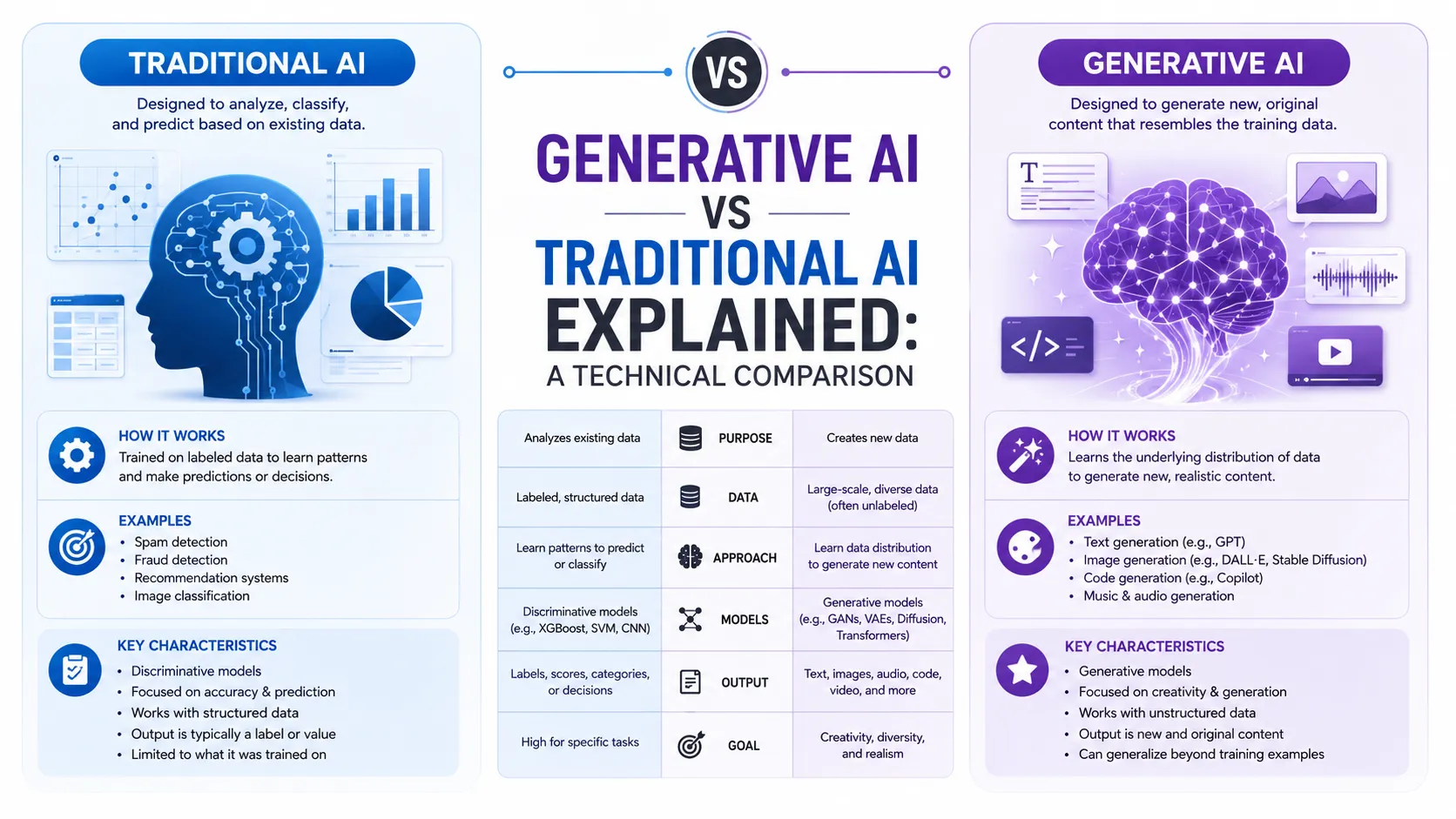
Before choosing between traditional and generative AI, ask three questions. First, what type of data do you have? Structured data points toward traditional AI. Unstructured text, images, or audio points toward generative AI.
Second, what output do you need? A prediction or classification suggests traditional AI. New content or natural language suggests generative AI.
Third, what is your tolerance for unpredictability? Traditional AI outputs are deterministic. Generative AI outputs are probabilistic and variable. The same input can yield different results each time.
Generative AI vs Traditional AI: A Technical Comparison
Conclusion
The distinction between generative AI and traditional AI is not about which is better. It is about which is appropriate for the problem at hand. Traditional AI remains the workhorse for structured, high-stakes decisions where accuracy and explainability matter. Generative AI opens new possibilities for creativity, personalization, and natural language interaction at scale.
Organizations that treat AI as a single monolithic technology will waste resources. Those that understand the differences between these categories will deploy the right tool for each job. The goal is not to choose one or the other. The goal is to know which one to reach for and why. Start with your data, your desired output, and your tolerance for unpredictability. The right choice will follow.
FAQs
Is generative AI replacing traditional AI?
No. Generative AI complements traditional AI. Each solves different problems. Most mature organizations use both.
Which one is more accurate?
Traditional AI is generally more accurate and predictable for defined tasks. Generative AI trades some accuracy for flexibility and creativity.
Do I need both types of AI?
Not necessarily. If your problem involves only structured data and classification, traditional AI may suffice. If you need content creation or natural language understanding, generative AI becomes relevant.