Introduction
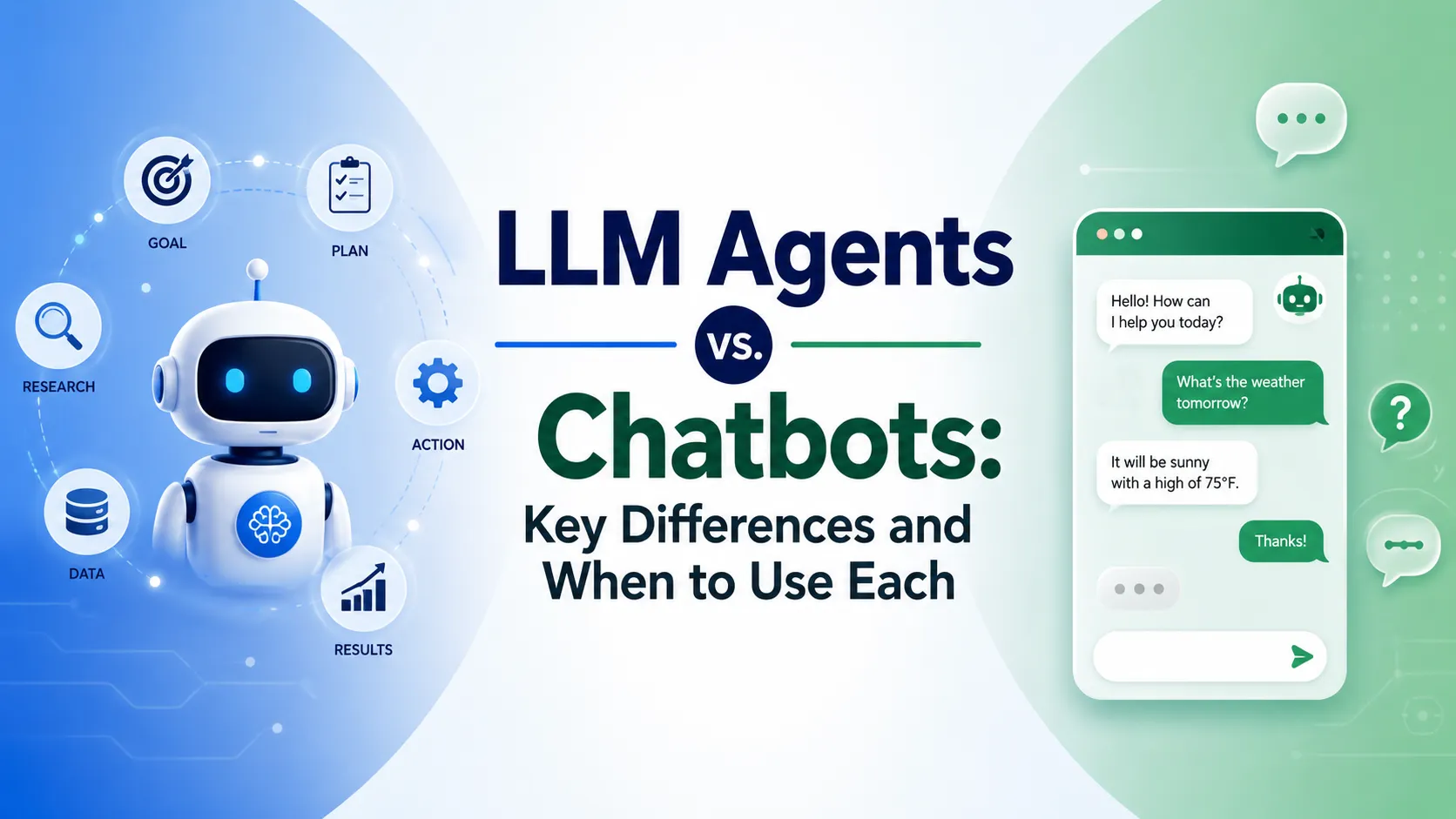
The line between conversational AI and autonomous execution has blurred. Many organizations now face a practical decision: deploy a standard chatbot or build an LLM agent. Understanding LLM Agents vs. Chatbots starts with recognizing that both rely on large language models, but their architectures serve fundamentally different purposes. A chatbot responds. An agent acts. This distinction between LLM agents vs. chatbots shapes everything from system design to business outcomes. Knowing when to use LLM agents vs. chatbots separates effective AI implementation from expensive disappointment.
What Makes Them Different
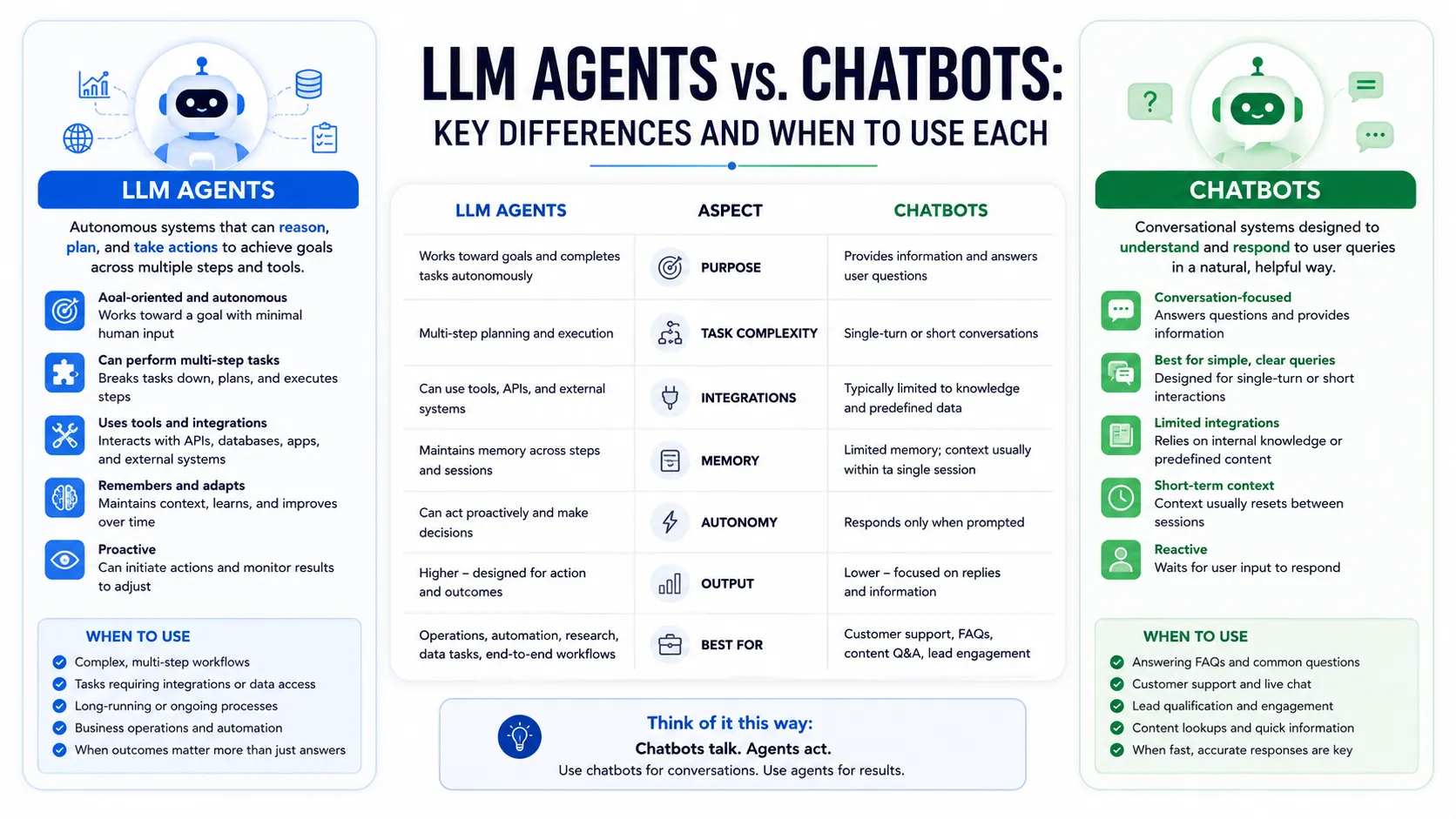
The divergence between a large language model-powered chatbot and an LLM agent comes down to architectural purpose. A chatbot is built to answer questions. An LLM agent is built to achieve goals. While many modern chatbots have become more sophisticated, their primary function remains conversational within predefined or dynamically understood bounds. An LLM agent, by contrast, operates with a degree of independence. It uses the large language model as its central cognitive “brain” to perceive its environment, devise plans, and execute complex tasks across multiple steps.
The term “autonomy” is the heavy artillery in this discussion. Chatbots wait for prompts; agents pursue objectives. When you tell a pure chatbot to “plan a team offsite,” it will likely generate a list of suggestions. When you assign the same task to an LLM agent, it can check calendars, poll availabilities, query travel APIs, book a venue, confirm catering, and send calendar invites without you holding its hand through each sub-action.
The Agent Loop vs. The Single Pass
To appreciate the difference, you need to look under the hood. A standard chatbot interaction follows a simple single-pass pattern: the user asks a question, the model generates a response, and that’s done. This works for queries requiring no persistent state or chained actions. However, it falls apart the moment you need the model to act on the real world across multiple stages.
An agent runs on an agent loop. At each iteration, the system assembles context, invokes an LLM to reason and select an action, executes that action (often via APIs or tools), observes the outcome, and feeds the result back into the next iteration. This loop repeats until the objective is met or a stopping condition triggers. That persistent, iterative execution cycle transforms a language model from a text generator into a system capable of reasoning and doing.
Tool Use and Multi-Step Planning
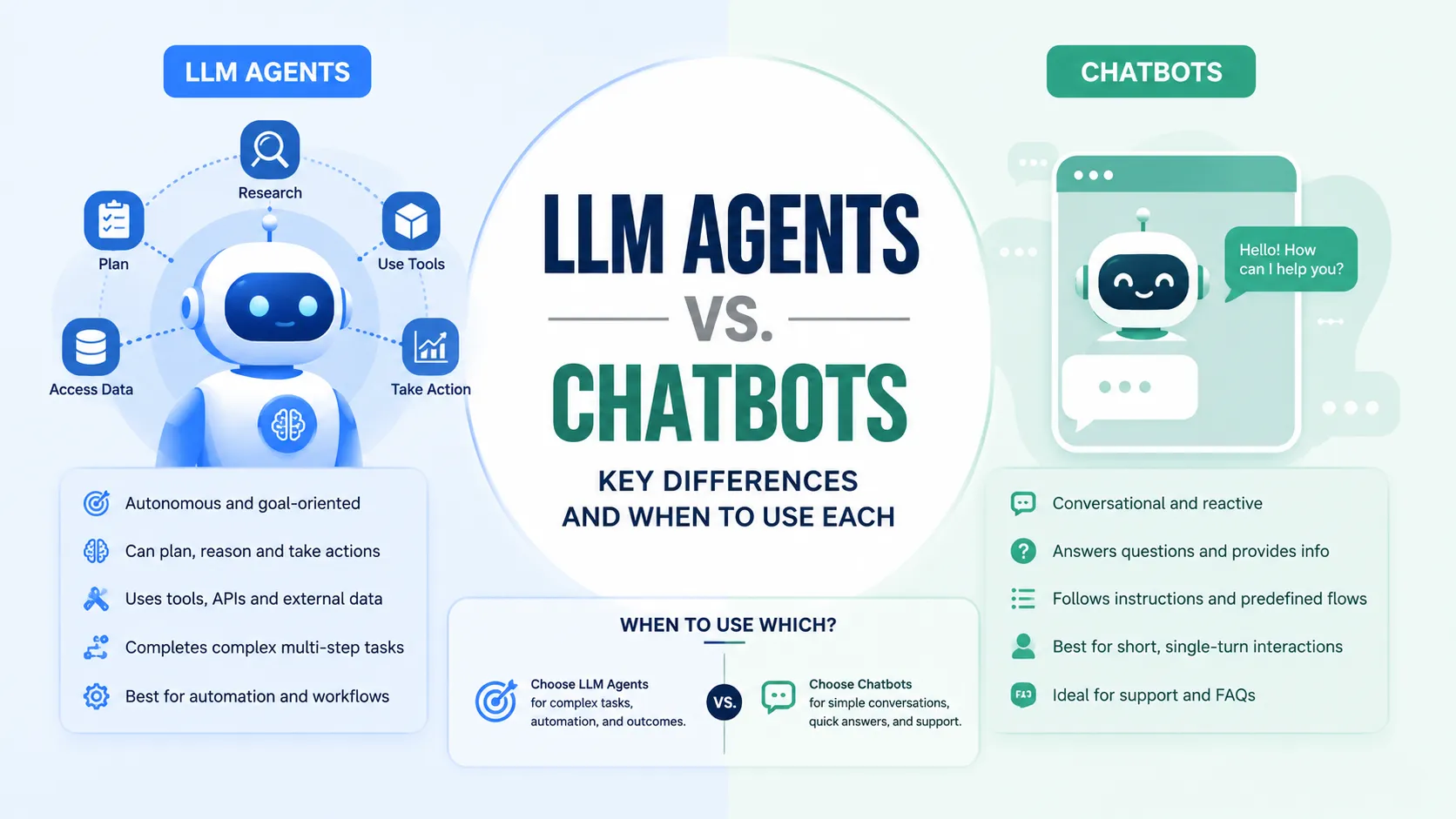
The single most functional distinction lies in tool use. Standard chatbots access information. They might query a database or invoke a simple API, but their reach is shallow. An LLM agent is equipped to call external tools—search engines, calculators, CRMs, code interpreters, and file systems—and then act on the responses.
This capacity enables multi-step planning. A traditional chatbot follows decision trees or intent-matching flows. An agent decomposes a high-level goal into sub-tasks, orchestrates tools, and adapts its plan based on intermediate results. Frameworks like ReAct (Reasoning + Acting) operationalize this by having the agent explicitly reason about the current situation, decide which tool to use, execute it, and observe the result before determining the next action.
Memory, Context, and State
Short-term memory is the rule for most chatbots. Context resets each session, limiting the system’s ability to recall past interactions unless explicitly engineered with workarounds. An LLM agent can maintain both short-term memory (the history of recent messages and actions) and long-term memory stored in external vector databases for semantic retrieval.
For enterprises, this matters directly. A chatbot asked to resolve a multi-ticket customer issue might treat each ticket as a fresh case. An agent can retain knowledge of previous interactions, preferences, and historical resolutions, then apply that accumulated intelligence to subsequent tasks.
Where Chatbots Still Excel
Do not discard the chatbot. For high-volume, predictable, low-risk workflows, it remains the right answer. Chatbots are faster to deploy and lighter to govern. They handle FAQs, simple form-filling, basic routing, and repetitive front-line customer queries without the overhead of agent orchestration.
The metric for success here is containment rate: how many interactions resolve without human escalation. A well-designed chatbot can deflect 60-80 percent of tier-one support requests, freeing humans for complex judgmental work.
Where LLM Agents Deliver
The LLM agent is for the messy, cross-system, multi-step work that chatbots cannot touch. Consider automated HR support. An agent can review new employee data, configure laptop requests, create personalized onboarding programs in a learning management system, and schedule introductory meetings without human intervention. In customer support, an agent does not simply provide a returns link; it verifies purchase dates, initiates replacement shipments, and sends confirmation emails.
Agents also handle ticket routing based on intent, customer sentiment, and business rules, then execute follow-up actions across disconnected systems.
Enterprise Considerations and Guardrails
For technical decision-makers, deploying an LLM agent requires more than plugging in an API key. Agents introduce execution risk. They can change data, trigger workflows, and escalate permissions. Governance is different: agents need approval mechanisms, audit logs, role-based access control, and runtime monitoring. Chatbots typically require lighter controls.
The cost structure also changes. Standard chat interactions are token-based. Agent loops can consume approximately four times more tokens than standard interactions and up to fifteen times in multi-agent systems. Factor in API calls to external tools, and your per-resolution cost must be calculated differently than per-response cost.
The Hybrid Pattern
Most production systems use both. A front-facing chatbot handles initial user interaction. When the conversation reveals a need for multi-step action, the chatbot hands off to an agent. The agent executes the workflow and returns results to the chatbot for presentation.
This separation keeps user-facing interactions safe and predictable while enabling complex backend automation. It also simplifies compliance. The chatbot logs everything. The agent operates in a constrained environment with clear boundaries.
Failure Modes and Risk
Chatbots fail by giving wrong answers. Annoying but rarely catastrophic. They do not delete records or send unauthorized emails.
LLM agents fail by taking wrong actions. They can delete files, make incorrect API calls, or enter infinite loops consuming resources. Mitigations include human-in-the-loop checkpoints, action confirmation for high-stakes operations, strict tool permissions, and execution timeouts.
Trust requires different approaches. For chatbots, trust means answer accuracy. For agents, trust means behavioural safety and alignment with intended outcomes.
Conclusion
The shift from chatbots to LLM agents is not a simple upgrade path. It is a rethinking of what automation can do. As models become more capable and tooling matures, the distinction will blur, but the core principle remains: chatbots serve conversation, and agents serve completion. Evaluate honestly, deploy intentionally, and keep both tools in your kit. The right question is not which is better, but which fits the job.
FAQs
Are LLM agents more difficult to evaluate than standard chatbots?
Yes. Chatbot accuracy is measured per response. Agent success depends on entire multi-step trajectories, requiring evaluation frameworks that assess planning, tool selection, and outcome quality.
Do LLM agents require more computational resources than chatbots?
Significantly more. Agent loops multiply token usage through iterative reasoning, tool calls, and feedback loops. Production systems require observability and cost controls.
Will LLM agents replace all chatbots?
No. Chatbots remain optimal for bounded, predictable, low-risk interactions. Agents extend into complex workflows but introduce governance overhead not justified for simple Q&A.