How AI Predicting Apps Actually Work: Technology, Accuracy, and Privacy Risks
Introduction
The intersection of ancient divination and modern machine learning is no longer theoretical. AI-predicting app technology has moved from research papers into mainstream app stores, offering personality analysis through a smartphone camera. Understanding the capabilities of an AI predicting app requires examining the computer vision systems that detect palm lines, the machine learning models that map those features to personality traits, and the market forces driving adoption across the UK and the US. This guide provides a technical yet accessible breakdown of AI predicting app mechanics, their real-world performance, and the critical privacy considerations every informed user should understand.
What Do These Apps Actually Do?
An AI-predicting application scans a photograph of a user’s palm, typically captured through a smartphone camera. The software applies computer vision models to identify key features—primarily the life line, headline, heart line, and fate line. Once those lines are mapped and measured, the system compares them against a labeled dataset of palm features paired with traditional palmistry interpretations. The output is a structured reading that comments on personality traits, emotional tendencies, intellectual strengths, and sometimes career or relationship patterns.
This is fundamentally a pattern-recognition exercise. The AI does not “see” the future. It identifies geometric features—line length, curvature, intersection points—and matches those characteristics to predefined symbolic meanings drawn from palmistry traditions. The entire process takes seconds, requires no human interpreter, and produces consistent results from the same input image every time.
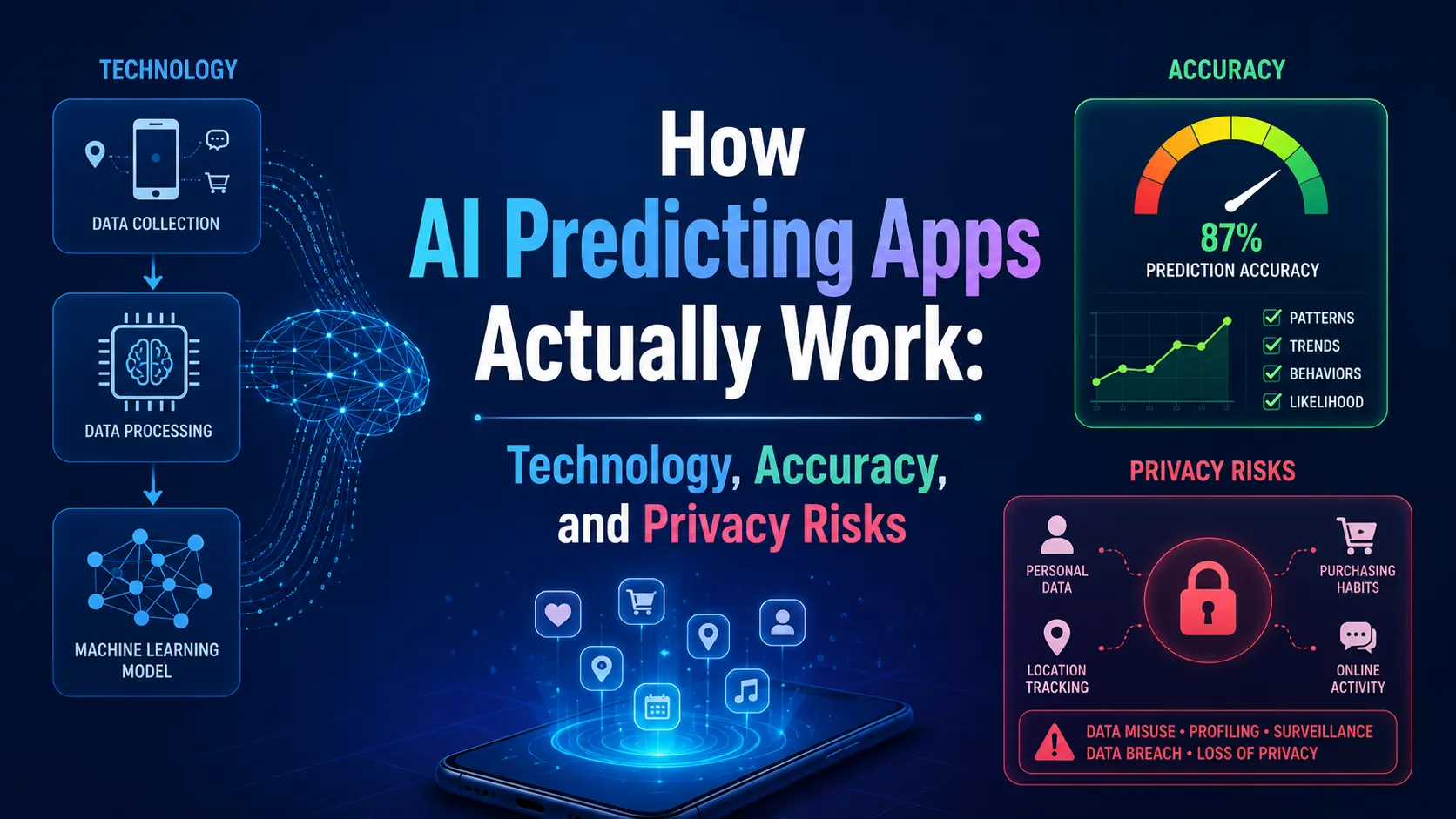
How AI Predicting Apps Actually Work: Technology, Accuracy, and Privacy Risks
Computer Vision and Machine Learning Mechanisms
The technical backbone of these apps consists of three integrated layers. First, image preprocessing normalizes the uploaded photo by adjusting contrast, removing noise, and standardizing lighting conditions to improve line visibility. Second, a segmentation model isolates the palm from the background and classifies each pixel into categories such as background, life line, head line, or heart line. Third, geometric feature extraction calculates quantifiable metrics: arc lengths of each line, tortuosity ratios (curvature), orientation angles, and the count of line intersection points.
These geometric values become input features for classification algorithms. A rule-based system might determine which line is dominant based on relative lengths. A machine learning classifier—random forest or support vector machine—maps feature combinations to personality labels derived from a training dataset. The entire pipeline operates without human oversight after deployment.
Some implementations use deep neural networks, specifically U-Net architectures with ResNet encoders, to achieve pixel-level segmentation accuracy. These models require hundreds of annotated palm images for training, with each image accompanied by a mask file that labels every pixel’s line category.
Market Context and Audience Behavior
The market for AI-driven spiritual and divination applications is expanding rapidly. The global astrology app market, which includes palm reading and related services, was valued at approximately USD 3 billion in 2024 and is projected to reach USD 9 billion by 2030, representing a compound annual growth rate of 20 percent. This growth is driven by increasing smartphone penetration, rising demand for personalized wellness content, and the integration of AI into digital spirituality platforms.
Individual platforms demonstrate the scale of adoption. One Indian astrology platform reports over 80 million downloads, 1.5 million daily active users, and 20 percent month-over-month AI revenue growth over 18 consecutive months. Its AI astrologers have answered more than 250 million questions and carry user ratings of 4.6, compared to 4.3 for human astrologers on the same platform.
For users in the UK and US, the appeal often centers on curiosity, entertainment, and self-reflection rather than literal belief in predictive accuracy. The frictionless nature of app-based readings—no appointment, no fee in many cases, no social awkwardness—makes palmistry accessible to demographics that would never visit a traditional palm reader.
Accuracy Claims and Real-World Performance
The word “accuracy” means something different in AI palm reading than it does in conventional prediction tasks. A weather model is accurate if its forecast matches observed conditions. A palm reading app has no verifiable ground truth. What users typically mean when they call a reading “accurate” is that the description felt subjectively relevant to their life circumstances.
This is the Barnum effect: personality descriptions that are sufficiently vague and generally positive will be accepted as personally tailored by most individuals. AI readings amplify this effect through language modeling that adapts phrasing to the detected line features, creating an illusion of specificity.
From a technical perspective, the measurable accuracy of these systems is limited to line detection. Under ideal conditions—a well-lit, flat hand and a high-resolution image—a segmentation model can correctly identify the major palm lines in 80 to 90 percent of cases. However, image quality issues such as blur, shadow, improper hand positioning, or non-uniform background cause detection failures that produce incomplete or misleading readings.
Most applications include disclaimers stating that readings are provided for entertainment purposes only and should not be used for medical, financial, or legal decisions. These disclaimers are not legal formalities; they reflect the genuine absence of validated predictive capability.
Privacy and Biometric Data Considerations
These applications request access to a smartphone camera and ask users to upload photographs of their palm. A palm image is biometric data. It contains unique ridge patterns, line structures, and geometric measurements that, in principle, could be used for identification. Unlike a password, biometric data cannot be changed if compromised.
Data handling practices vary significantly across applications. Some apps store images locally on the device and process readings on-device, transmitting no data to external servers. Others upload images to cloud-based AI services for processing. Users should examine privacy policies before uploading images and pay attention to whether the app requests additional permissions beyond camera access, such as contacts, location, or storage.
A thoughtful user might ask: If the reading is just for entertainment, why does the app need to store my palm image on its servers indefinitely?
The safest approach is to treat these applications as disposable entertainment. Use them on a device that does not contain sensitive personal information. Avoid platforms that require account creation with a real name and email. Do not upload palm images to any website or app that lacks a clear, verifiable data deletion policy.
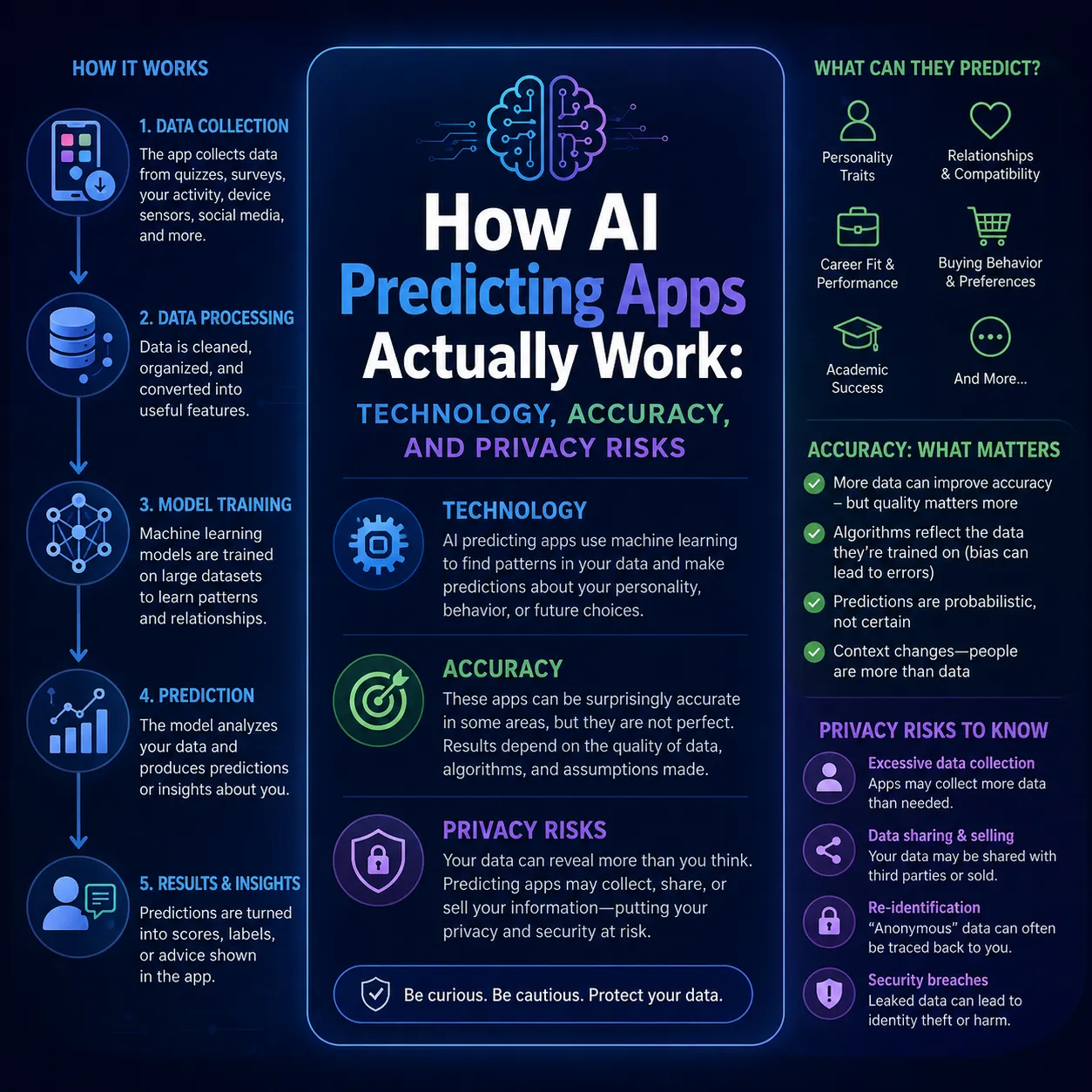
How AI Predicting Apps Actually Work: Technology, Accuracy, and Privacy Risks
Conclusion
AI predicting app technology represents an interesting convergence of computer vision, pattern recognition, and cultural tradition. The underlying machine learning models successfully detect and measure palm lines from photographs. The personality interpretations that follow are built on palmistry’s symbolic framework, not empirical psychology. The commercial success of these apps points to a genuine user appetite for digital self-reflection tools, even when they lack scientific grounding. For professionals in SEO, content strategy, and digital product development, the key takeaway is that accuracy in this domain is defined by user experience, not predictive precision.
Frequently Asked Questions
Do AI prediction apps actually work?
They detect palm lines with reasonable accuracy under good imaging conditions, but the personality predictions are based on traditional palmistry symbolism, not scientific validation. The experience is entertainment, not diagnosis.
Are these apps safe to use regarding my data?
Safety depends entirely on the specific app. Check privacy policies for data retention terms, camera-only permissions, and whether image processing happens on-device or on external servers. Avoid apps that require extensive personal information.
Can these apps predict real future events like job changes or marriage?
No. No AI system has demonstrated the ability to predict specific life events from palm images. Any such claim is promotional and unsupported by evidence.