ChatGPT Use Cases for Business: A Practical Authority Guide
Introduction
Business leaders now face a critical question: how to deploy ChatGPT use cases for business operations without falling for hype. The landscape shifted from experimental chatbots to legitimate productivity tools. Understanding real ChatGPT use cases for business requires separating what actually works from what sounds impressive. This article examines proven ChatGPT use cases for business across departments, with a frank assessment of limitations and trade-offs.
The technology is not magic. It is a pattern-matching engine. When applied correctly, it handles specific cognitive tasks faster than humans. When misapplied, it creates more work.
What ChatGPT Actually Does Well in Business Contexts
Large language models excel at transformation tasks. Input A becomes Output B. Text summarization, tone adjustment, format conversion, and first-pass drafting all sit firmly in the capability zone.
The model does not think. It predicts. This distinction matters for deployment decisions. Tasks requiring factual recall, proprietary data access, or genuine reasoning remain unsuitable.
Realistic expectation setting prevents the abandonment cycle—over-promise, under-deliver, and discard.
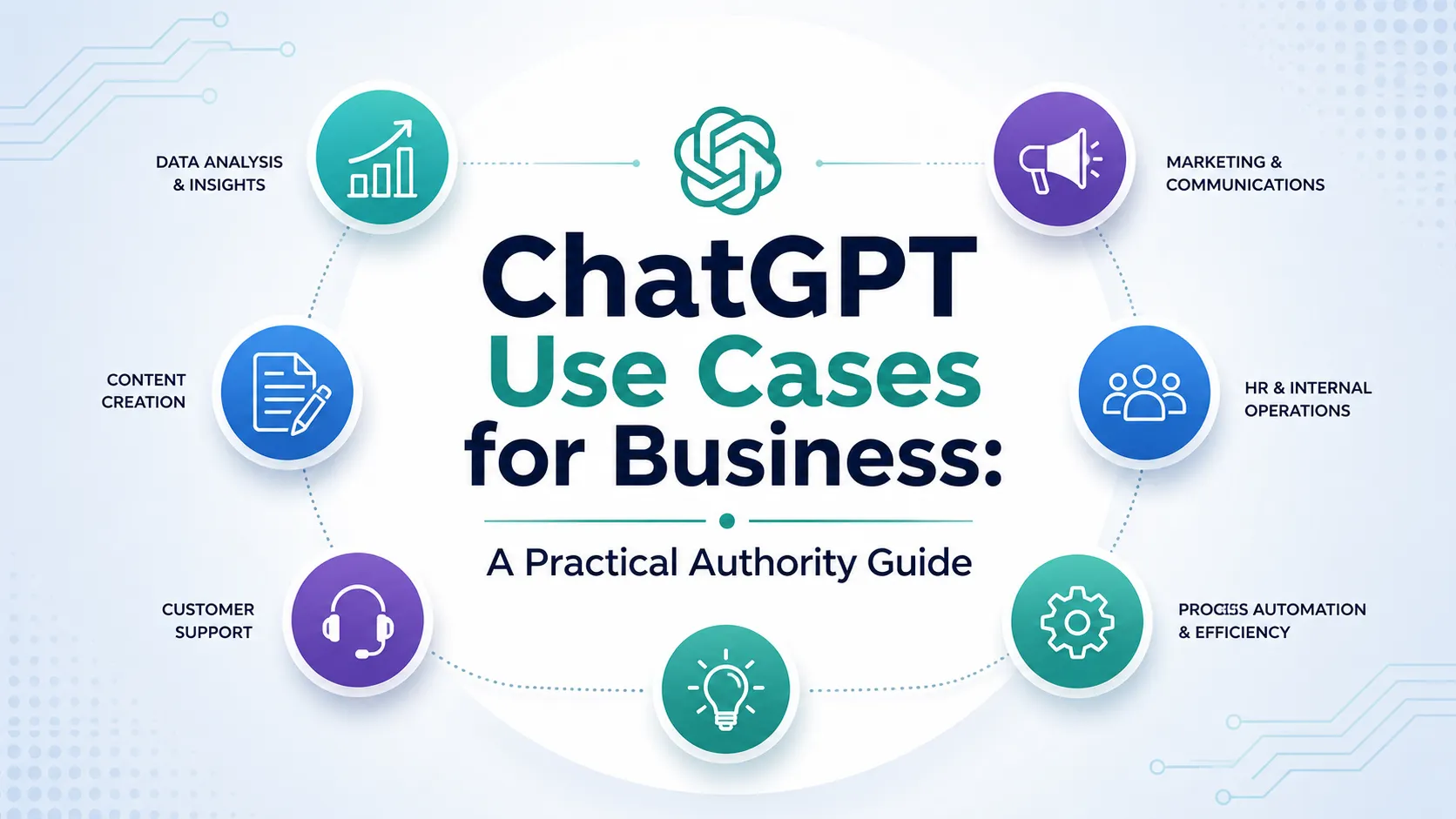
ChatGPT Use Cases for Business: A Practical Authority Guide
Knowledge Management and Internal Documentation
Customer support teams spend 20-30% of their time searching for information. ChatGPT changes this when connected to internal wikis through retrieval-augmented generation.
An employee asks, “What is our returns policy for damaged electronics?” The system pulls from the latest policy document and returns a concise answer with a source reference. No more hunting through shared drives.
The implementation cost is low. The friction reduction is immediate. Large enterprises have seen ticket deflection rates of 25-40% on routine queries.
Drafting and Refining Business Communications
Email volume consumes knowledge worker attention. Drafting initial versions of routine correspondence—follow-ups, meeting recaps, status updates—represents a straightforward win.
Upload a bullet-point list of discussion items. Request a professional meeting summary. Receive a draft in eight seconds. Edit for nuance and send.
The time-saving compounds. Ten emails per day at three minutes each become thirty minutes reclaimed. The key is treating the output as a first draft, not a final product.
Data Analysis Without Technical Skills
Marketing managers often receive CSV exports without analysis resources. ChatGPT Code Interpreter (now Advanced Data Analysis) accepts file uploads and generates Python code to find patterns.
“Here is last quarter’s campaign data. Show me which channels had the highest conversion rates by day of week.”
The system returns cleaned tables, visualizations, and explanatory text. No SQL required. No data team ticket needed.
This capability has democratized basic analytics for roles that previously waited on specialists.
Content Repurposing Across Formats
A single white paper becomes twenty LinkedIn posts. A webinar transcript becomes five blog articles. A product specification becomes a sales email sequence.
The transformation is mechanical. Change the audience. Change the length. Change the tone. Maintain the core facts.
What is the downside? Over-reliance produces generic content. Human editors must inject distinctive perspective, proprietary data, and authentic voice. The machine handles volume. People handle value.
Meeting Preparation and Follow-Through
Before a client call, paste the last three email exchanges and the company website. Request: “Generate five strategic questions I should ask based on their apparent challenges.”
After the call: upload the transcript or rough notes. Request: “Create action items with assigned owners based on our discussion.”
The system catches what humans miss. It identifies stated priorities, implied objections, and unaddressed topics. Junior team members using this approach perform like experienced operators.
Code Generation and Documentation
Development teams now use ChatGPT as an always-available junior programmer. Generate boilerplate functions. Write unit tests. Explain legacy code. Convert between languages.
The productivity gain is measurable. Studies show a 30-50% time reduction on routine coding tasks for experienced developers. For non-technical staff writing simple scripts, the gain is larger.
Critical constraint: never trust generated code without review. Security vulnerabilities and logical errors appear regularly. The model is confident and frequently wrong.
Recruitment and Candidate Screening
Job descriptions follow predictable patterns. Provide a role title and five responsibilities. Receive a complete JD with requirements, benefits, and success metrics.
For screening: define scoring criteria. Paste CVs in batches. Ask for ranked assessments against your rubric. Remove candidates below threshold before human review begins.
This does not replace hiring manager judgment. It accelerates the filtering stage. The time saved goes to deeper interviews with qualified candidates.
Have you considered how much recruiter time currently goes to reading irrelevant applications?
Customer Support Triage and Response Drafting
Incoming support tickets vary by urgency and complexity. ChatGPT categorizes, prioritizes, and drafts tier-one responses automatically.
Simple password reset? Full automation. Complex technical issue? Escalate to human with a complete problem summary already written.
Agent satisfaction improves because they focus on interesting problems rather than repetitive scripts.
Multilingual Operations Without Translation Budgets
Small businesses serving non-English markets face language barriers. ChatGPT translates business correspondence, localizes marketing copy, and interprets customer messages with reasonable accuracy.
European e-commerce operations use this for German, French, and Spanish support simultaneously without hiring three native speakers.
Warning: legal documents, medical information, and financial disclosures require professional human translation. The stakes are too high for probabilistic outputs.
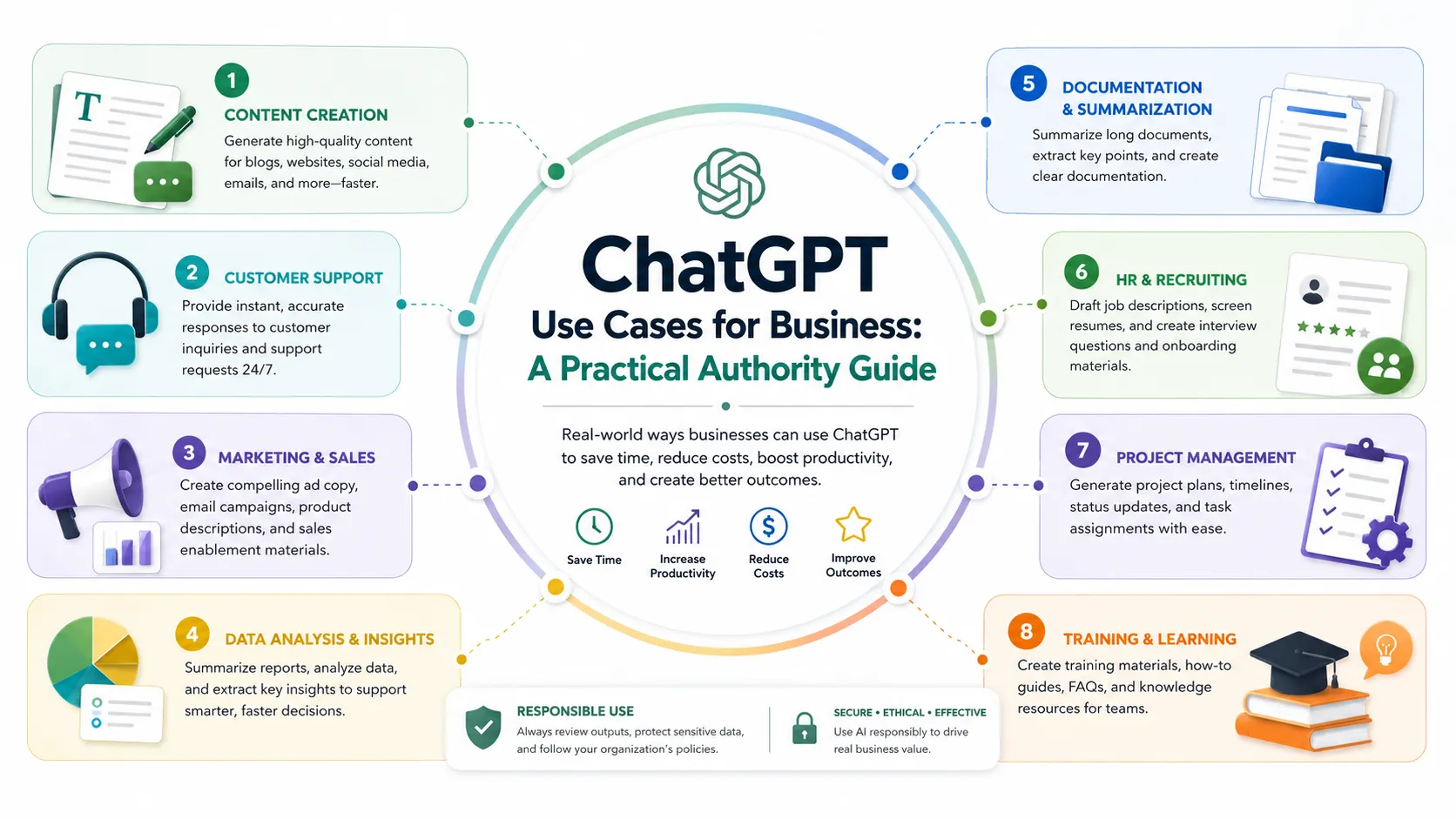
ChatGPT Use Cases for Business: A Practical Authority Guide
Conclusion
ChatGPT use cases for business have moved from speculation to standard practice across thousands of organizations. The pattern is clear: automate transformation tasks, accelerate drafting, and keep humans responsible for judgment and proprietary insight. The businesses winning today are not those with the most advanced AI strategies. They are those with the clearest understanding of what to automate and what to leave alone. Start with one department, one workflow, and one measurable outcome. Prove value. Then expand.
FAQs
Can ChatGPT handle confidential business data?
Only if you use enterprise tiers with data isolation. Free and standard versions train on inputs. Read your service agreement carefully before uploading sensitive information.
Which business departments benefit most from ChatGPT?
Customer support, marketing, and software development show the strongest measurable ROI today. Legal and finance remain riskier due to accuracy requirements.
How do I measure ChatGPT success in my business?
Track time saved per task, output quality compared to the human baseline, and error rates. Stop if quality drops below acceptable thresholds.