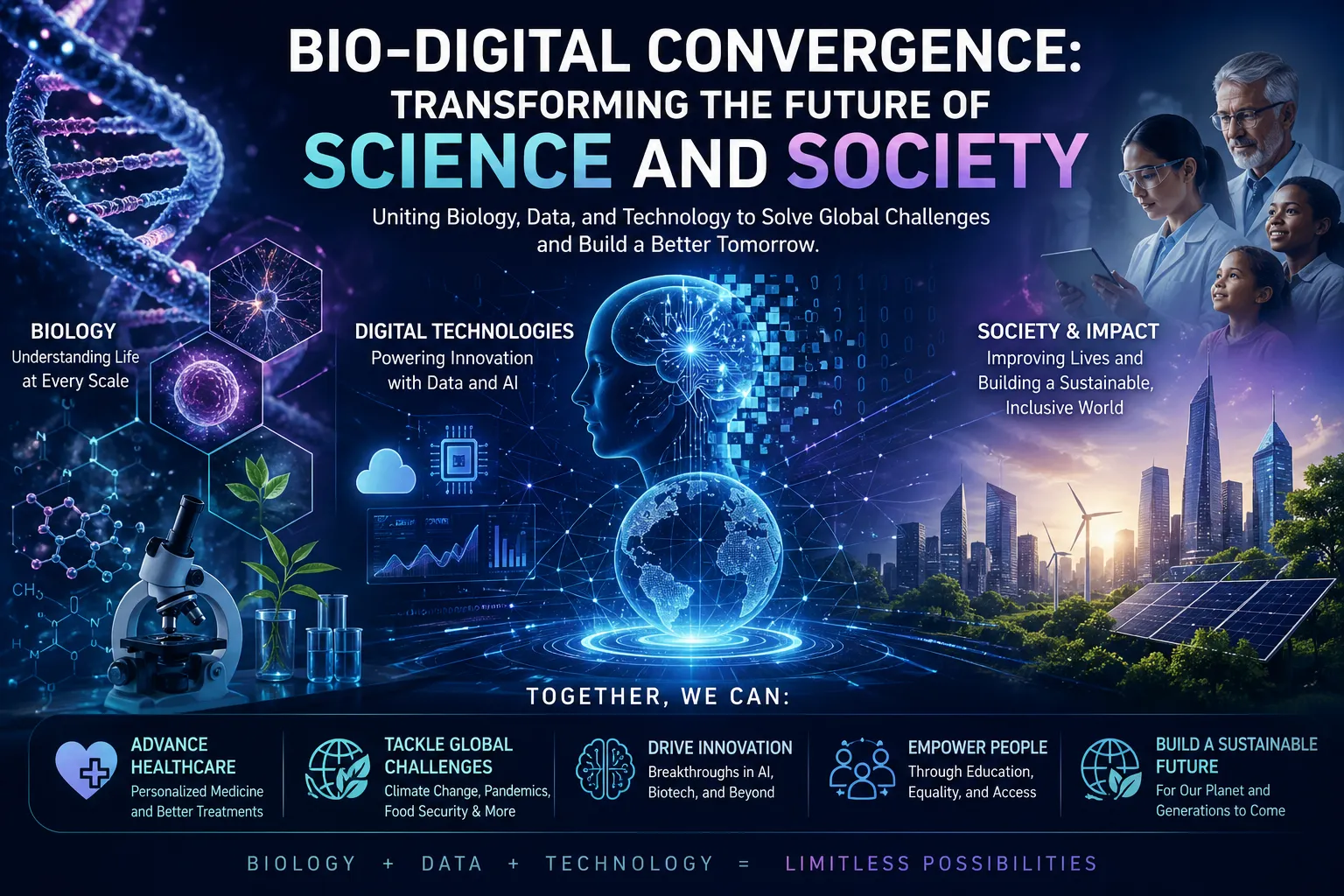
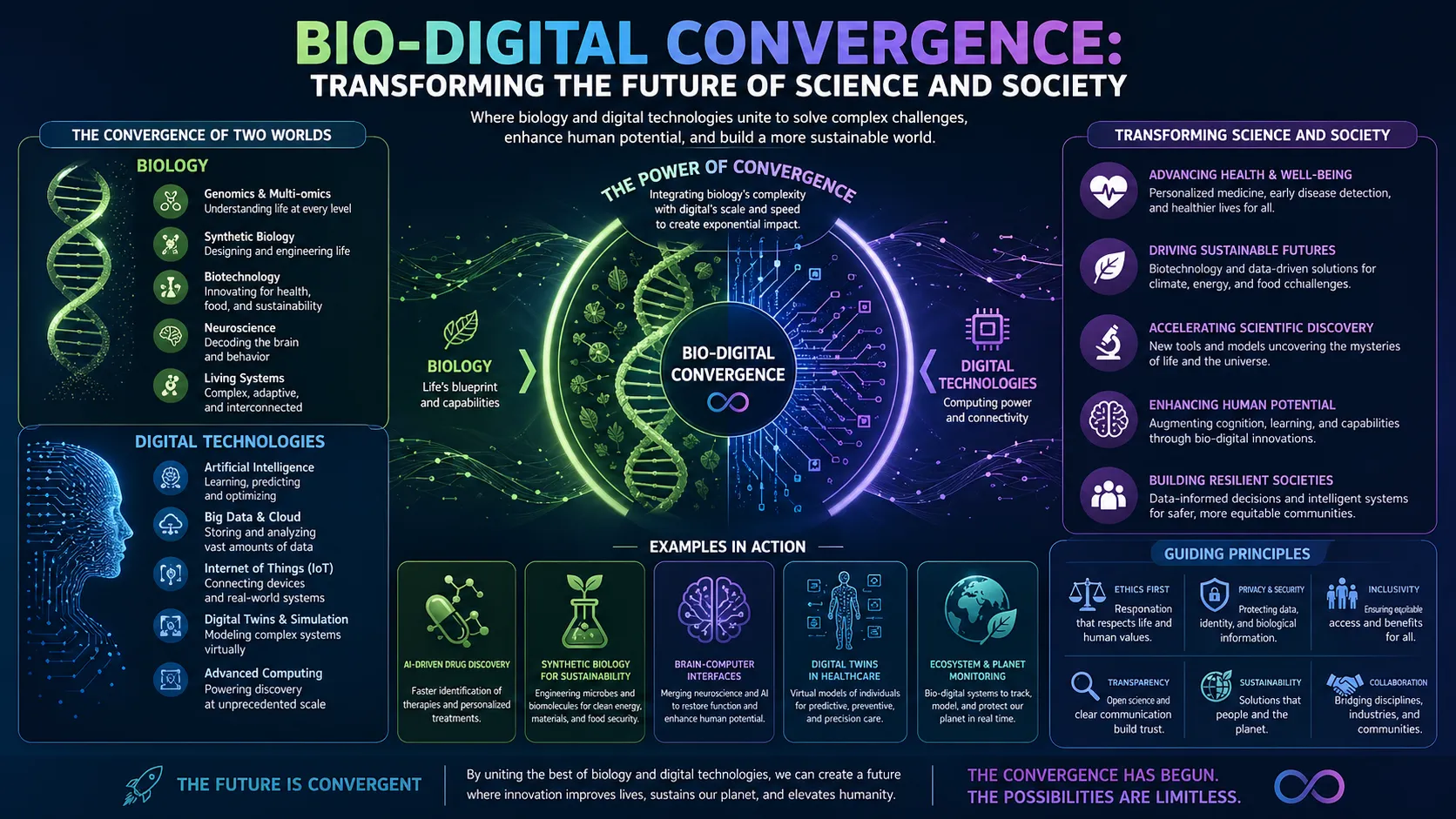
Bio-Digital Convergence: Transforming the Future of Science and Society
Introduction
Bio-digital convergence is no longer theoretical. It is happening now across medicine, agriculture, and environmental monitoring. This bio-digital convergence represents the fusion of biological systems with digital tools—where living tissue meets data streams, and where algorithms guide biological outcomes. Understanding bio-digital convergence requires examining three core pillars: bioprinting, agricultural biotech, and smart sensing. These domains do not operate in isolation. They reinforce one another, creating feedback loops between biological production and digital control. For professionals in the UK and USA, bio-digital convergence is reshaping what is possible in patient care, crop management, and real-time diagnostics.
Defining Bio-Digital Convergence with Precision
Bio-digital convergence is the integration of biological processes with digital technologies. This includes using software to design living tissues, sensors to monitor biological states, and data analytics to guide biological outcomes. It is not simply automation applied to biology. It is a structural merger where the digital layer becomes inseparable from the biological layer. A 3D bioprinter does not just deposit cells. It follows a digital blueprint. An agricultural sensor does not just measure soil moisture. It triggers irrigation algorithms. This distinction matters for anyone evaluating real-world applications.
Bioprinting: From Digital Models to Living Structures
Bioprinting uses computer-controlled deposition of living cells, growth factors, and biomaterials to construct tissue-like structures. The process begins with a digital model—often derived from medical imaging. That model guides a printer head that extrudes bio-ink, a cell-laden hydrogel. Layer by layer, the printer builds a three-dimensional structure. Over days or weeks, cells mature, proliferate, and form extracellular matrix. The outcome is living tissue with spatial organisation. Current applications include skin grafts, vascular patches, and cartilage repairs. Research labs now print liver tissue for drug testing. The critical insight: bioprinting turns biological construction into a repeatable, design-driven process.
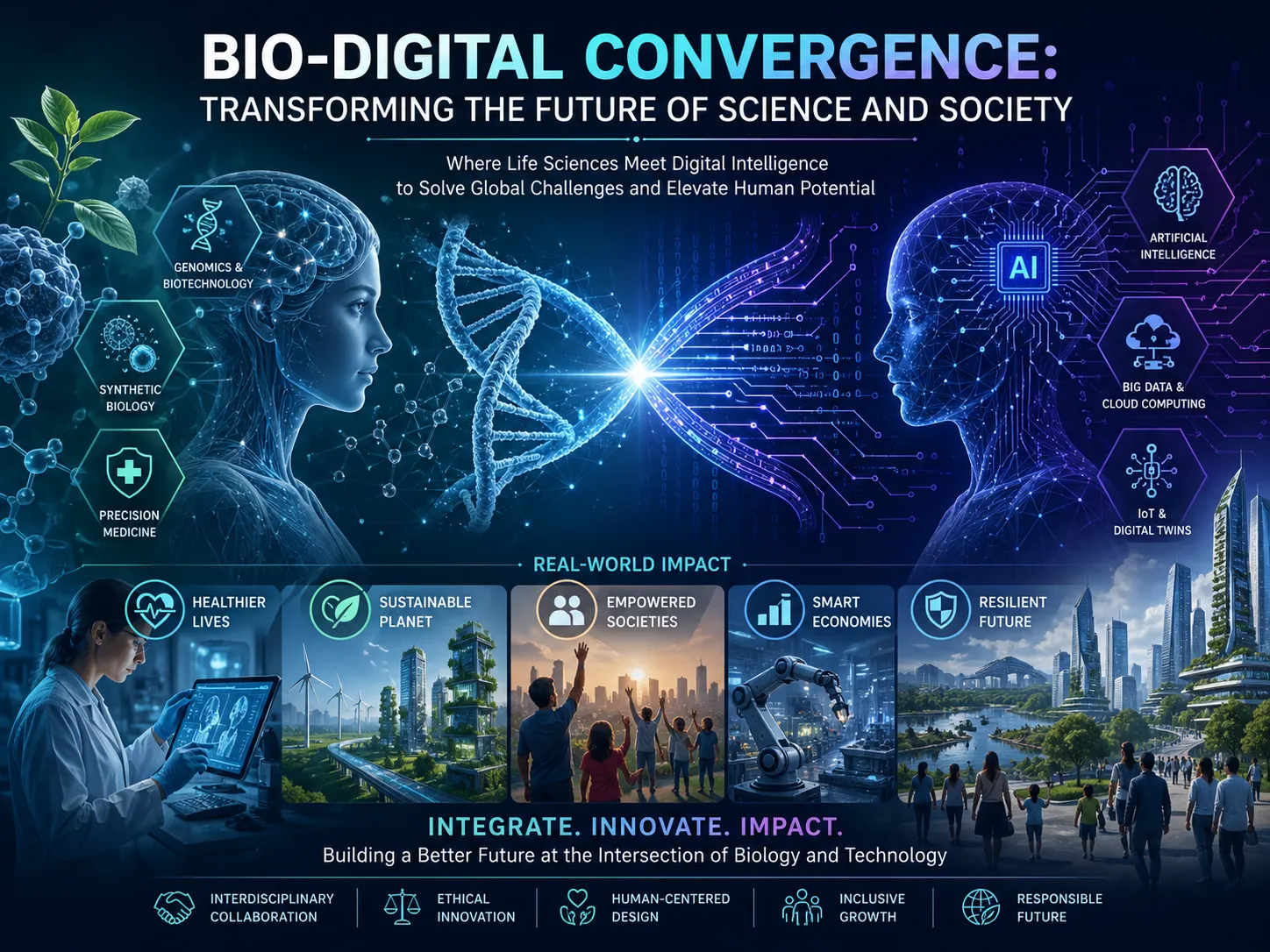
Bio-Digital Convergence: Transforming the Future of Science and Society
Tissue Engineering and Bio-Fabrication
Tissue engineering predates bioprinting but now converges with it. Traditional tissue engineering relied on seeding cells onto biodegradable scaffolds. Bioprinting offers precise cell placement within those scaffolds. Bio-fabrication extends this further by using cells as building blocks. Supporting entities here include scaffolds, bioreactors, growth factors, and extracellular matrix proteins. A bioreactor, for example, provides mechanical and chemical signals that mature printed tissues. Without these supporting systems, printed structures remain fragile. The practical implication for medical device companies: evaluating bioprinting requires assessing the entire workflow, not just the printer.
Agricultural Biotech and Digital Integration
Agricultural biotechnology has entered a digital phase. Traditional genetic modification remains important, but digital tools now guide crop development. Precision farming uses GPS, satellite imagery, and soil sensors to manage variability within fields. Biotech crops—engineered for drought tolerance, pest resistance, or enhanced nutrition—benefit from this digital layer. A farmer can now plant a biotech maize variety and use real-time data to adjust nitrogen application. The convergence appears in decision support systems that integrate genetic data, weather forecasts, and soil conditions. This is not speculative. UK and US farms already use these systems at scale.
How Precision Farming Changes Decision-Making
Precision farming shifts agriculture from reactive to predictive. Sensors collect data on moisture, temperature, nutrient levels, and pest pressure. That data feeds into models that recommend irrigation, fertilisation, or spraying. Variable rate technology applies inputs only where needed. For a farm operator, this reduces waste and improves yield predictability. The bio-digital element appears when biotech traits interact with variable application. A drought-tolerant wheat variety requires less water, but precision sensors determine exactly when and where. The outcome is resource efficiency backed by biological adaptation.
Smart Sensing: The Data Layer of Convergence
Smart sensing provides the nervous system for bio-digital convergence. Advanced IoT sensors now measure biological and environmental parameters with high granularity. In medicine, wearable biosensors track glucose, lactate, or inflammatory markers. In agriculture, in-ground sensors report soil biology and chemistry. In bioprinting, optical sensors monitor oxygen and pH within bioreactors. These sensors are not passive. They transmit data wirelessly, trigger alerts, and feed into control loops. A real-time sensing network allows a tissue engineering lab to adjust culture conditions automatically. It allows a farm to respond to a frost event within minutes.
Biosensors: From Lab to Field
Biosensors combine a biological recognition element with a transducer. The recognition element might be an enzyme, antibody, or DNA strand. The transducer converts the biological response into an electrical or optical signal. Common examples include continuous glucose monitors and lateral flow tests. In bio-digital convergence, biosensors enable closed-loop systems. Consider a bioreactor producing cell therapies. Embedded biosensors detect metabolite build-up and trigger media exchange. No human intervention required. For quality control teams, this means higher consistency and lower contamination risk.
The Mechanism of Closed-Loop Biological Control
Closed-loop control is where bio-digital convergence delivers its highest value. A sensor measures a biological state. A controller compares that state to a target. An actuator adjusts the environment. In bioprinting, closed-loop systems maintain temperature, humidity, and carbon dioxide levels during printing. In agriculture, closed-loop irrigation uses soil moisture sensors to start and stop water flow. In medicine, closed-loop insulin pumps adjust delivery based on continuous glucose readings. The common element is feedback. Digital systems learn from biological responses and adapt in real time.
Real-World Scenario: Wound Care and Smart Dressings
Consider a patient with a chronic diabetic ulcer. A smart dressing contains biosensors that measure pH, temperature, and infection markers. Data transmits to a clinician’s dashboard. When sensors detect rising protease activity—a sign of failed healing—the system recommends intervention. Meanwhile, a bioprinted skin graft, designed from the patient’s own cells, is prepared in a tissue engineering lab. The convergence is complete: sensing identifies the problem, digital systems trigger the solution, and bioprinting delivers the therapy. This is not science fiction. Multiple medical device companies are pursuing exactly this pathway.
Agricultural Scenario: Variable Rate Seeding of Biotech Crops
A farm in the UK Midlands uses historical yield data, soil maps, and satellite imagery to create seeding rate zones. A biotech oilseed rape variety with enhanced nitrogen efficiency is loaded into a variable rate seeder. The seeder plants higher rates in zones with lower soil nitrogen and lower rates where nitrogen is sufficient. Throughout the season, in-field sensors measure crop biomass and chlorophyll content. If a zone underperforms, the system adjusts nitrogen application dynamically. The outcome is optimised seed use, reduced fertiliser runoff, and consistent yield. The bio-digital element is the integration of biotech genetics with digital prescription maps.
Comparing Traditional and Converged Approaches
| Domain | Traditional Approach | Bio-Digital Converged Approach |
| Tissue repair | Autograft or random scaffold seeding | 3D bioprinted construct with precise cell placement |
| Crop management | Uniform field treatment | Variable rate based on real-time sensor data |
| Wound monitoring | Visual inspection at clinic visits | Continuous biosensor data to clinician |
| Bioprocess control | Manual sampling and adjustment | Closed-loop bioreactor with embedded sensors |
This comparison reveals the efficiency gain. Converged systems reduce waste, improve consistency, and enable personalisation that was previously impossible.
The Role of Advanced IoT in Biological Systems
Advanced IoT extends beyond simple connectivity. It includes edge computing, low-power wide-area networks, and secure data aggregation. For bio-digital convergence, IoT provides the infrastructure. A tissue engineering lab might have dozens of bioreactors, each with multiple sensors. IoT gateways collect that data and push it to cloud-based analytics. On a farm, IoT nodes in the soil report conditions every hour. The key requirement is reliability. Biological systems do not tolerate data loss. Any professional implementing these systems must prioritise network redundancy and data validation.
Real-Time Sensing in Bioprocessing
Real-time sensing transforms bioprocessing from batch to continuous. Traditional cell culture requires sampling at intervals. By the time results arrive, conditions have changed. Real-time sensors measure dissolved oxygen, glucose, lactate, and pH continuously. That data enables adaptive control. If lactate rises, the system increases perfusion. If oxygen drops, it adjusts gas flow. For manufacturers of cell therapies or biopharmaceuticals, this means higher yields and lower costs. The constraint is sensor durability. Sensors must remain sterile and functional for weeks or months.
Entity Relationships in Bio-Digital Convergence
Understanding the entity landscape helps professionals evaluate opportunities. Primary entity: bio-digital convergence. Supporting entities include:
- 3D bioprinting (the fabrication method)
- Tissue engineering (the broader discipline)
- Bio-fabrication (the production paradigm)
- Precision farming (the agricultural application)
- Biotech crops (the biological input)
- Biosensors (the measurement tool)
- Advanced IoT (the connectivity layer)
- Closed-loop control (the operational principle)
These entities connect through data. Bioprinting generates data on print fidelity. Biosensors generate data on biological state. IoT transmits that data. Closed-loop systems act on it. The convergence is the integration, not any single technology.
What Bio-Digital Convergence Is Not
This clarification prevents misunderstanding. Bio-digital convergence is not simply using a computer to record biological data. That is digitisation, not convergence. It is not replacing biologists with algorithms. Expertise remains essential. It is not synonymous with artificial intelligence, though AI amplifies its capabilities. And it is not a single product or platform. It is a paradigm that spans industries. Professionals who mistake digitisation for convergence will underestimate the integration work required.
Known Frameworks and Industry References
Several frameworks guide implementation. In bioprinting, the FRESH (Freeform Reversible Embedding of Suspended Hydrogels) method enables soft tissue printing. In agriculture, the ISO 11783 standard (ISOBUS) ensures equipment interoperability. In sensing, the IEEE 1451 standard defines smart transducer interfaces. These are not academic curiosities. Adopting established standards reduces integration risk. A precision farming operation that ignores ISOBUS will struggle with mixed equipment brands. A bioprinting lab that ignores bioreactor standards will face validation challenges.
Trade-Offs and Limitations
Honest assessment requires acknowledging constraints. Bioprinting lacks vascularisation at scale. Printed tissues thicker than a few hundred micrometres suffer core necrosis without a perfusable vessel network. Agricultural biosensors face drift and calibration challenges over a growing season. IoT in biological environments raises power and sterilisation issues. And closed-loop biological control requires redundancy. A sensor failure without fail-safe logic can destroy a culture or over-irrigate a field. These limitations do not invalidate the convergence. They define the engineering boundaries.
Decision-Support for Technology Evaluation
For organisations evaluating bio-digital technologies, use this framework. First, identify the biological process you want to control. Second, assess available sensors for that process. Third, evaluate the digital infrastructure required. Fourth, determine the actuation method (what changes when sensors trigger). Fifth, test closed-loop response. Many projects fail because they focus on the printer or the sensor without building the full loop. Start with a narrow, well-defined biological outcome. Expand only after the loop closes reliably.
Preparing Your Organisation for Convergence
Practical next steps include auditing current biological workflows for manual steps that data could replace. Identify processes where latency causes problems—delayed sampling, late intervention, batch variability. Those are candidates for sensing and automation. Invest in data infrastructure before buying hardware. A bioprinter without data logging and quality metrics delivers limited value. Train staff on control theory basics. Biological experts rarely receive formal training in feedback systems. That gap is where convergence projects stumble.
Bio-Digital Convergence: Transforming the Future of Science and Society
Conclusion
Bio-digital convergence is not a future prediction. It is an active engineering discipline with working systems in medicine and agriculture today. The convergence of bioprinting, agricultural biotech, and smart sensing creates capabilities that neither biology nor digital technology alone can achieve. For professionals in the UK and USA, the opportunity is to move from observing convergence to designing it. Start with a single biological process, add sensing, close the loop, and scale from there. The tools are available. The standards exist. The remaining constraint is integration skill, not technology readiness. Evaluate your current workflows for feedback opportunities. Then build.
FAQs
What is the difference between bioprinting and traditional tissue engineering?
Bioprinting adds precise, computer-controlled placement of cells within a three-dimensional structure. Traditional tissue engineering relies on seeding cells onto static scaffolds without spatial control over cell distribution.
Can bio-digital convergence work on small farms or only large operations?
Yes, but the entry point differs. Small farms benefit from modular sensors and smartphone-based decision support rather than full IoT infrastructure. Start with soil moisture sensing and variable rate for one input.
How close is bioprinting to producing transplantable human organs?
Clinically viable whole organs remain years away due to vascularisation and scale challenges. Simple tissues—skin, cartilage, vascular patches—are already in human trials or clinical use.