What Is Cloud Data Center? A Complete Guide to Definitive AI Era
Introduction
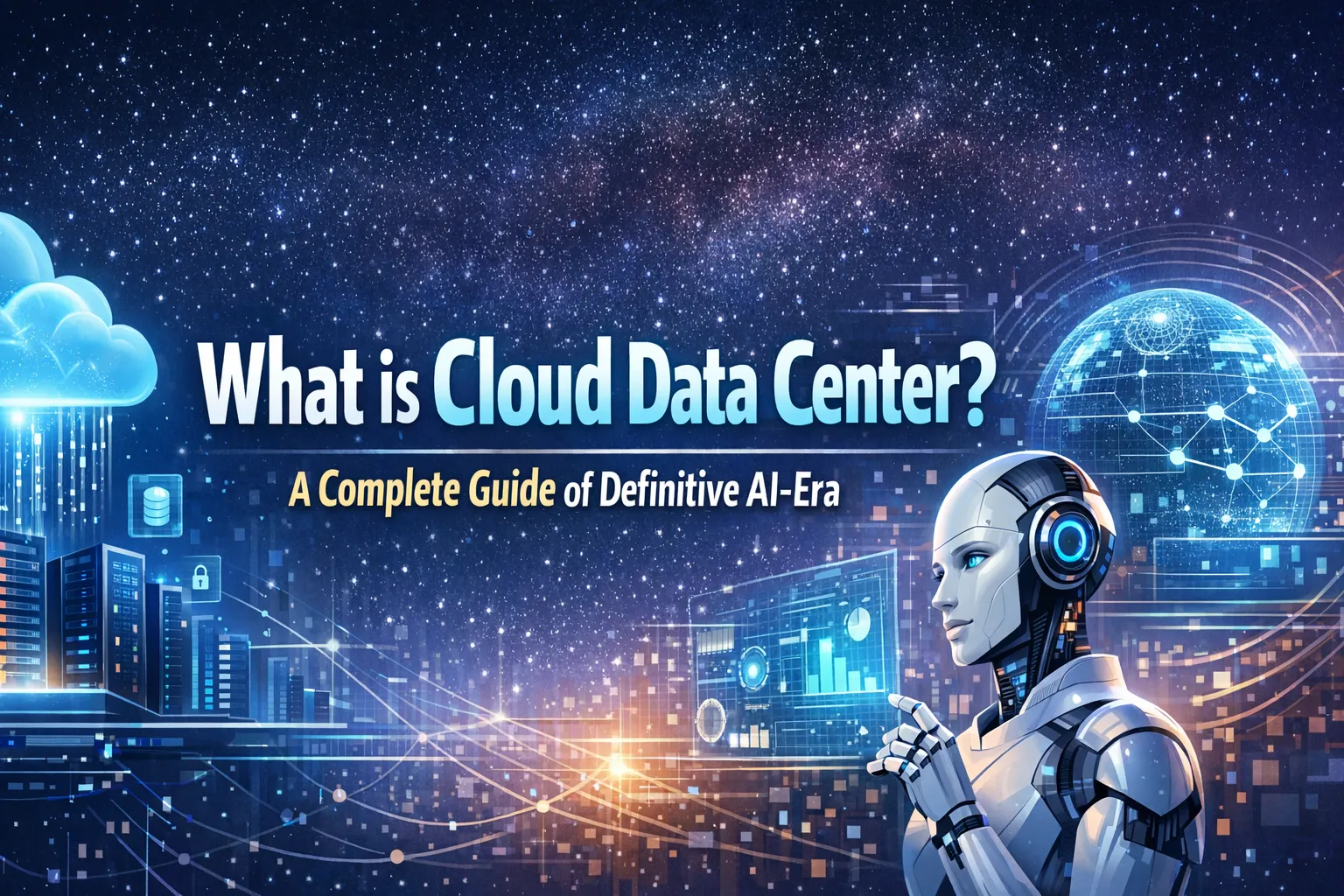
In the age of artificial intelligence, the Cloud Data Center has grown far beyond its original role as a place to store data. Today, a Cloud Data Center functions as a living digital backbone, where hardware, virtualization, and intelligent software work together to support modern businesses and online services.
This introduction explores how the Cloud Data Center is built, how it differs from traditional setups, and why the addition of AI is changing not just how it operates but also what it is capable of doing.
Understanding the Core Definition
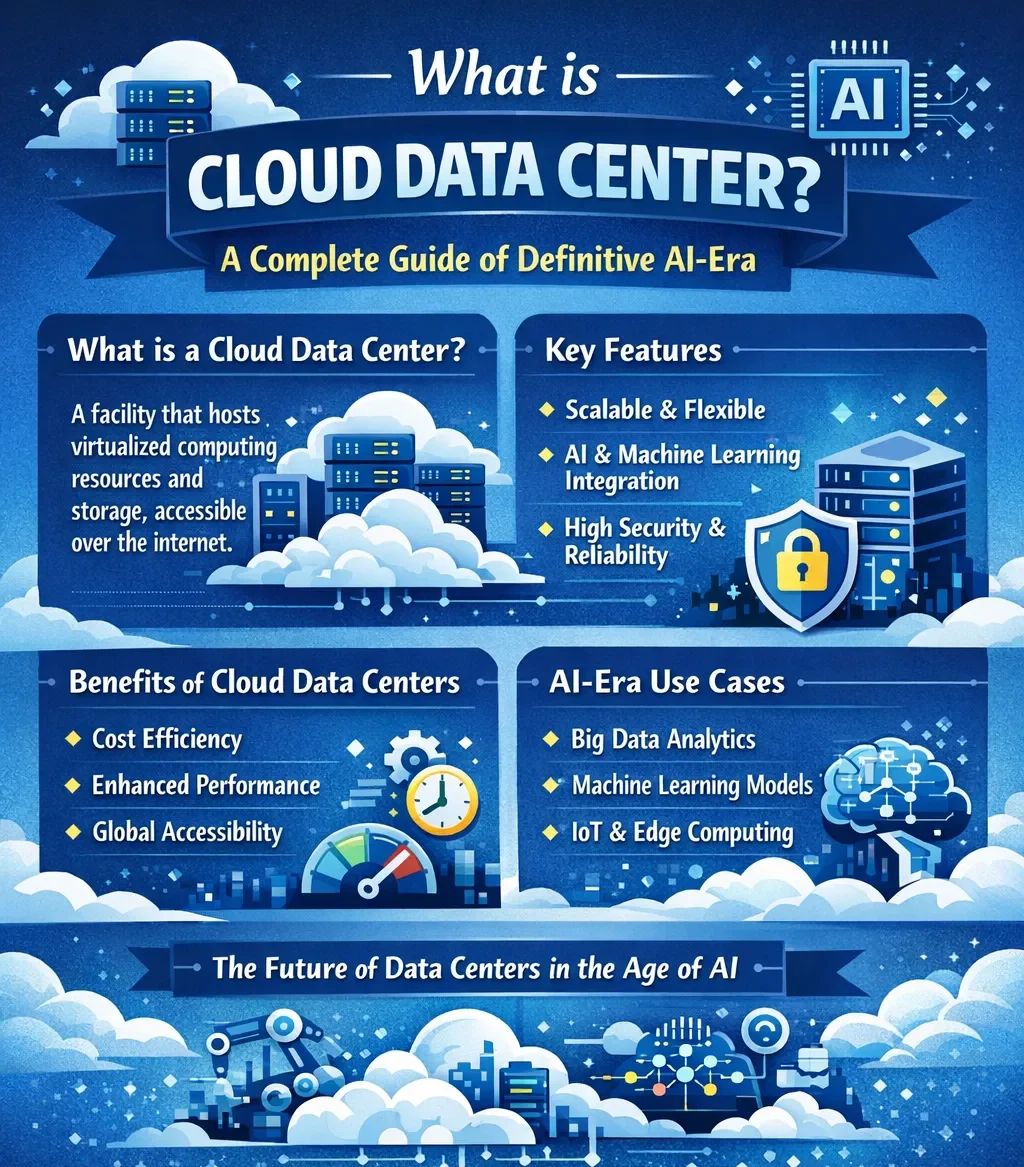
At its most basic, a cloud data center is a physical facility housing networked computer servers that provide computing resources and storage over the internet. Unlike traditional, on-premises data centers owned and operated by a single company, cloud data centers are owned and managed by third-party providers like Amazon Web Services (AWS), Microsoft Azure, and Google Cloud Platform.
The key innovation is the operational model. Users access these pooled resources on-demand, paying only for what they use, which eliminates the massive capital expenditure of building and maintaining private hardware. This shift is enabled by virtualization technology, which abstracts physical servers, storage, and networking into flexible, software-defined resources that can be provisioned instantly via code or a web interface.
Key Components and Architecture
The architecture of a cloud data center is designed for maximum efficiency, scalability, and reliability. It integrates two layers:
- Physical Infrastructure: This includes the building, power systems (with backup generators and uninterruptible power supplies), advanced cooling solutions (like liquid cooling), physical security, and the core hardware: servers, storage arrays, and networking equipment like switches and routers.
- Virtualized Resource Layer: This is the “cloud” itself. Software divides the physical hardware into virtual machines and containers, creating a shared pool of compute, storage, and network capacity that can be allocated dynamically to millions of users.
- Modern cloud data centers are often hyperscale facilities, encompassing thousands of servers across massive campuses, built to scale seamlessly with global demand.
What Is Cloud Data Center? A Complete Guide to Definitive AI Era
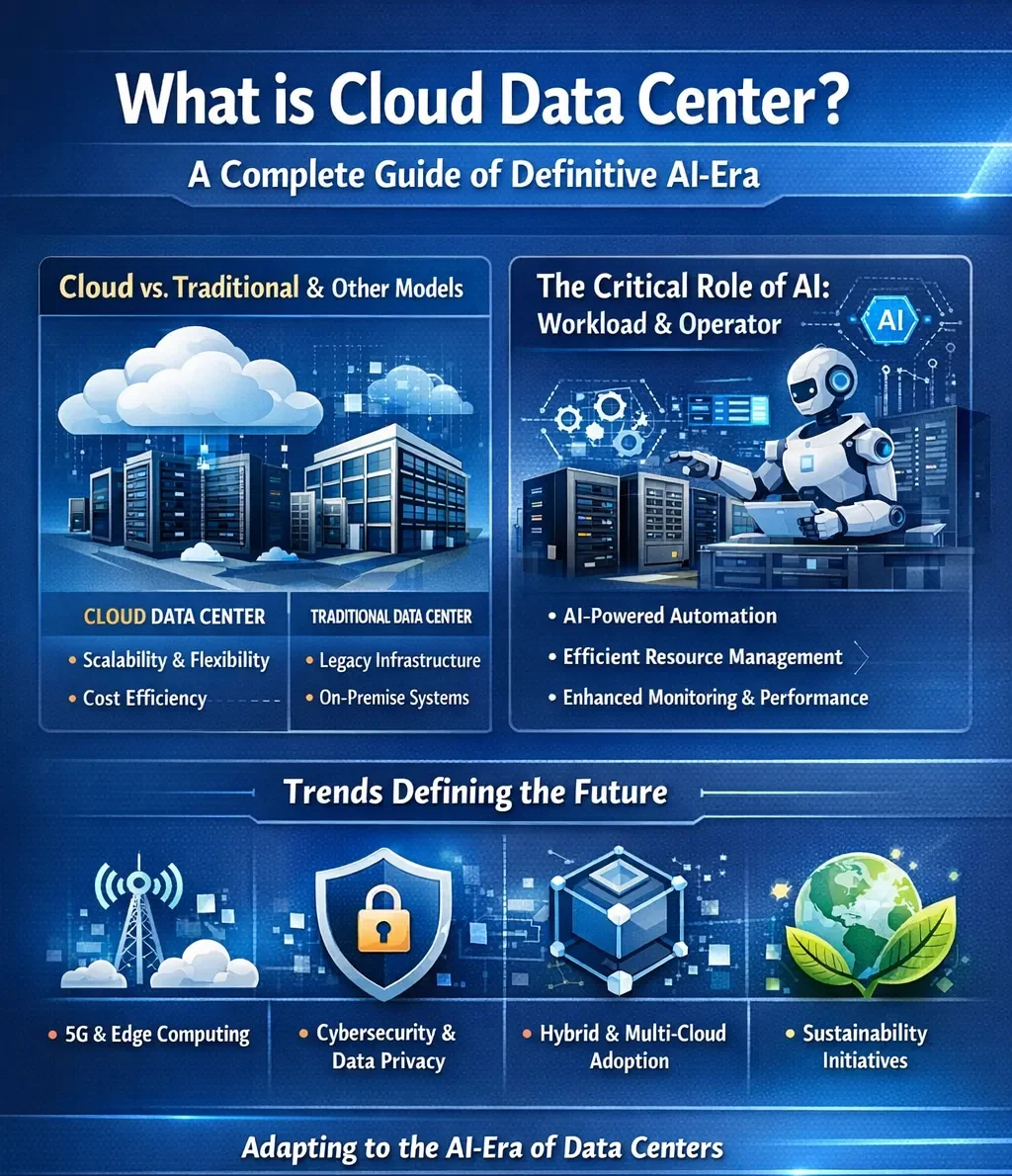
Cloud vs. Traditional and Other Models
Understanding the cloud model is best achieved through comparison. Below is a breakdown of how it contrasts with other common data center types:
| Feature | Traditional/On-Premises Data Center | Cloud Data Center | AI Data Center (A Specialized Subset) |
| Ownership & OpEx Model | Company-owned and operated. High capital expenditure (CapEx). | Leased from a third-party provider. Pay-as-you-go operational expenditure (OpEx). | Can be cloud-based, collocated, or private. Extremely high OpEx due to power and hardware costs. |
| Scalability | Limited by physical hardware, scaling is slow and expensive. | Essentially unlimited, elastic; resources scale up/down on demand. | Built for massive scale but requires specialized, high-performance hardware (GPUs). |
| Management | Full responsibility for maintenance, updates, and security falls on the company’s IT team. | Managed by the provider, the customer manages their data and applications within the cloud. | Focuses on managing extraordinarily dense, high-power infrastructure and complex AI workload orchestration. |
| Primary Workload | General business applications, databases, and legacy systems. | Everything from web apps to big data analytics. | Exclusively training and running AI models, which require parallel processing. |
| Core Hardware | Relies on Central Processing Units (CPUs). | Mix of CPUs and some accelerators, optimized for general cloud workloads. | Dominated by Graphics Processing Units (GPUs) and other AI accelerators (TPUs, NPUs) for parallel processing. |
Other notable models include Colocation (renting space/power/cooling for your own hardware in a shared facility), Hybrid Cloud (mixing private and public cloud), and Edge Data Centers (smaller facilities close to users to reduce latency).
The Critical Role of AI: Workload and Operator
AI’s relationship with the cloud data center is dual-faceted, making it the defining technology of the current era.
- AI as the Ultimate Workload: The training of large language models and AI applications is the most demanding workload ever placed on computing infrastructure. It requires data centers with specialized GPU clusters, ultra-fast storage (like NVMe SSDs), and high-bandwidth networking to handle massive data transfers. This demand is so intense it’s reshaping global infrastructure investment and energy grids.
- AI as the Intelligent Operator: Simultaneously, AI is used to manage and optimize the data center itself. AI-driven operations (AIOps) leverage machine learning for:
- Predictive Maintenance: Analyzing sensor data to forecast hardware failures before they cause downtime.
- Energy Management: Dynamically optimizing cooling and power distribution to significantly improve efficiency.
- Resource Optimization & Security: Automatically allocating workloads and monitoring for cyber threats in real-time.
This dual role creates a self-optimizing cycle where AI both powers and perfects the data center environment.
Trends Defining the Future
Several key trends are shaping the next evolution of cloud data centers:
- The Sustainability Imperative: With AI dramatically increasing power demand—forecast to rise 160% by 2030—the focus on green energy, advanced cooling (e.g., immersion cooling), and overall efficiency has never been greater.
- Rise of AI-Optimized Infrastructure: The distinction between general-purpose cloud data centers and purpose-built AI data centers is becoming more pronounced, with architecture designed around GPU racks and their unique power/cooling needs.
- Hybrid and Multi-Cloud as Standard: Enterprises are increasingly adopting strategies that use multiple cloud providers alongside private infrastructure for resilience, cost optimization, and data sovereignty.
What Is Cloud Data Center? A Complete Guide to Definitive AI Era
Conclusion
The cloud data center has evolved from a remote hosting facility into an intelligent, AI-powered engine of digital business. Its value is no longer just in rental compute cycles but in the integrated AI that ensures resilience, security, and efficiency at a scale impossible for any single enterprise. Understanding this symbiotic relationship between physical infrastructure and artificial intelligence is essential for any organization leveraging the cloud. Begin by auditing how much of your current cloud strategy actively utilizes these native AI capabilities.
Recommendations for Professionals
To leverage modern cloud data centers, prioritize skills in cloud-native technologies (Kubernetes, serverless) and data literacy. Understand the APIs and tools your provider offers for monitoring and cost management. Design applications for scalability and resilience from the start. Most importantly, develop a working knowledge of how AI and automation are applied to infrastructure—this is now core to cloud competency, not a niche specialty.
FAQs
What is the main difference between a cloud and a traditional data center?
A traditional data center is dedicated, privately owned infrastructure, while a cloud data center is a shared, multi-tenant utility operated by a third-party provider, consumed on-demand.
How does AI improve cloud data center efficiency?
AI algorithms dynamically optimize power usage, cooling systems, and hardware resource allocation, leading to significant reductions in energy consumption and operational costs.
Is data in a cloud data center secure?
Cloud providers implement rigorous physical and logical security, massively enhanced by AI-driven threat detection. Ultimate security responsibility is shared, depending on the service model used.