China Strategic Leap: The Drive for Mega Space Constellations
Introduction
China strategic leap is underscored by a record-breaking regulatory move: a single filing with the International Telecommunication Union (ITU) for spectrum to operate approximately 203,000 satellites across 14 distinct constellations. This unprecedented scale—far exceeding the long-term targets of leading global competitors—signals a fundamental change in China’s approach to securing low-Earth orbit (LEO) as a critical strategic and commercial domain.
The race to secure low Earth orbit has entered a new phase defined by industrial scale rather than individual missions. China strategic leap toward deploying sovereign mega-constellations represents a coordinated national effort to challenge existing Western dominance in space-based communications, navigation, and reconnaissance. Understanding China strategic leap requires examining the constellation programs, spectrum filings, and vertically integrated industrial base driving this expansion. The implications extend beyond commercial competition into national security, global connectivity standards, and the fundamental architecture of how space assets are built, launched, and operated. For industry observers, the question is no longer whether China will deploy mega-constellations but at what scale and with what strategic effect.
The Scale of China’s Constellation Ambitions
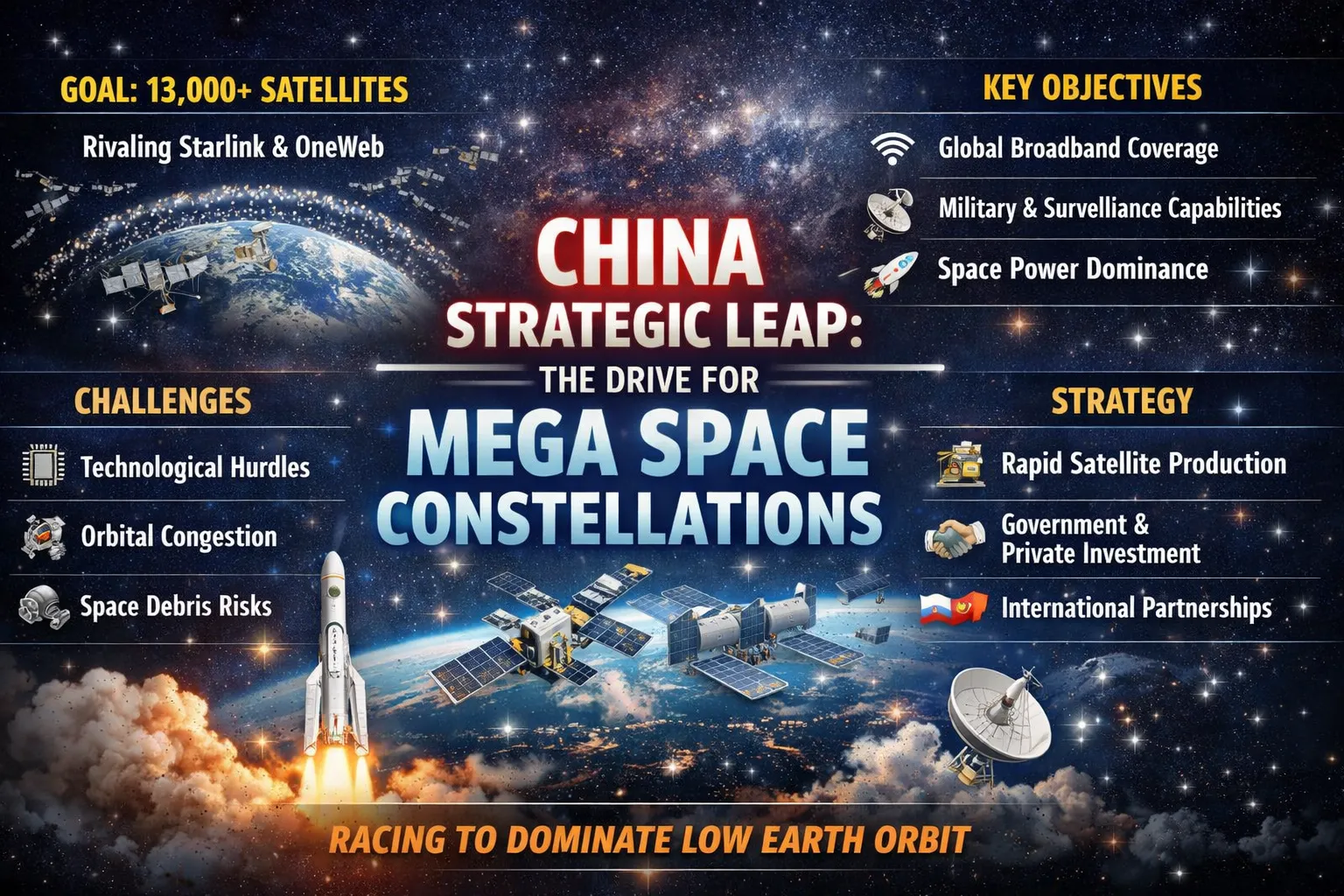
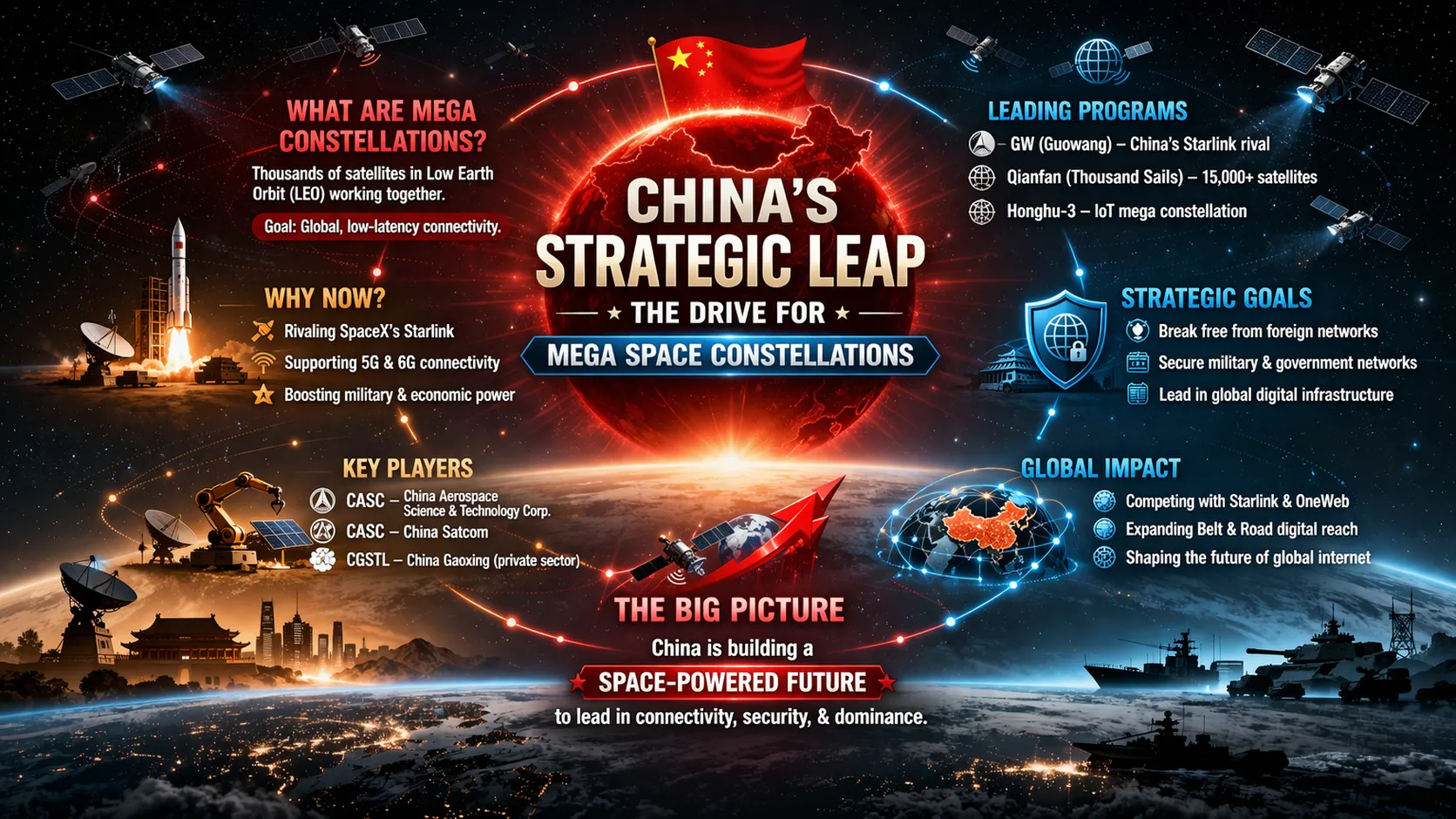
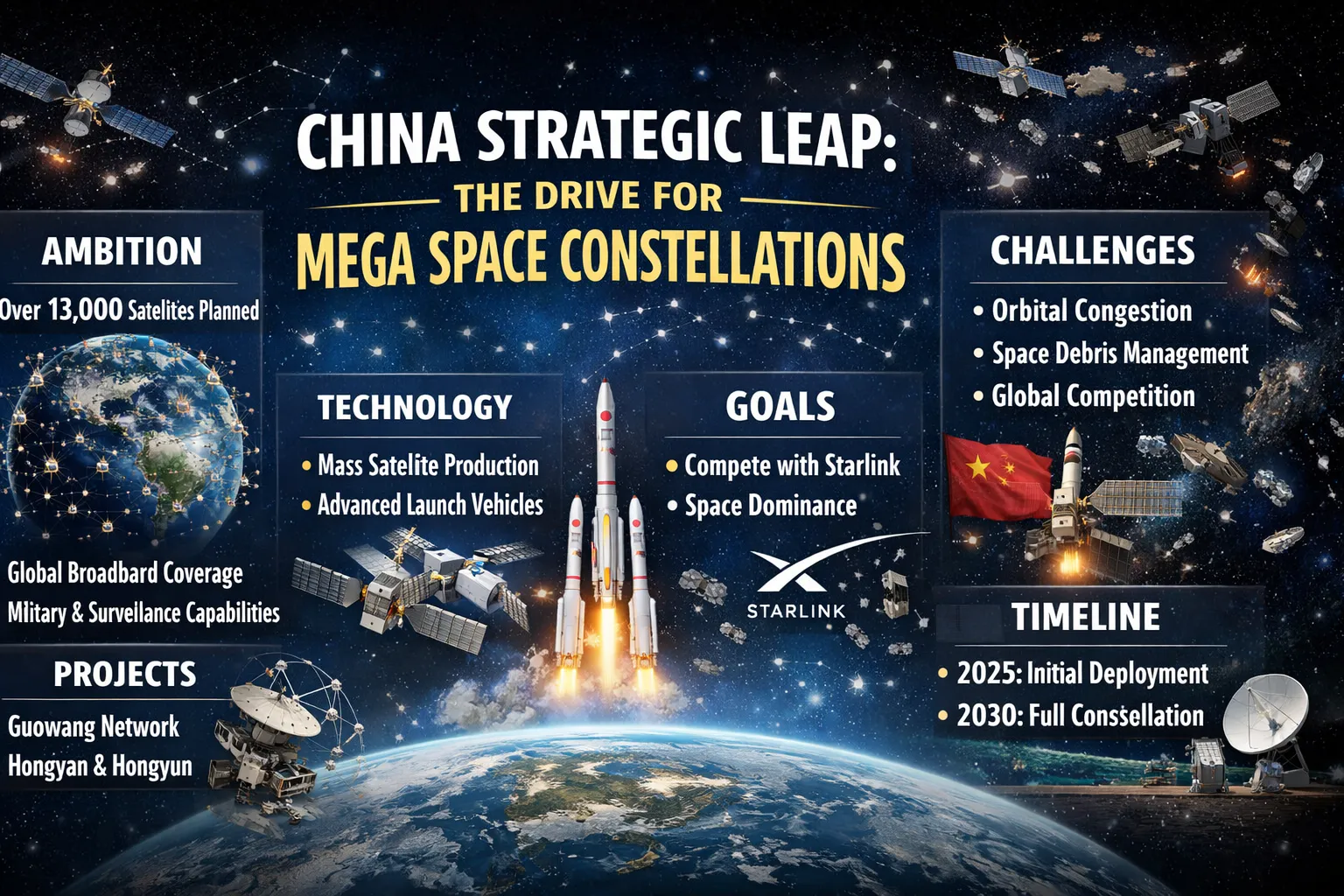
China’s strategic leap encompasses multiple constellation programs that collectively aim to deploy tens of thousands of satellites. The flagship initiatives include China Satellite Network Group’s Guowang constellation, targeting 13,000 satellites by 2035, and Spacesail’s Qianfan constellation, aiming for over 15,000 satellites by 2030. Hongqing Technology’s Honghu-3 adds another 10,000 satellites to the pipeline. In January 2026, China filed applications with the International Telecommunication Union for two additional constellations, CTC-1 and CTC-2, with a combined total approaching 200,000 satellites. These filings represent the largest coordinated submission in ITU history and signal long-term strategic intent rather than immediate deployment capability. The gap between filings and operational satellites remains substantial. As of mid-2025, China accounted for only 9.43 percent of active spacecraft globally, compared with Starlink’s 75.94 percent share.
China Strategic Leap: The Drive for Mega Space Constellations
Industrial Infrastructure and Manufacturing Capacity
The physical infrastructure supporting China’s strategic leap reveals a deliberate push toward production-line efficiency. Dedicated satellite manufacturing facilities in Shanghai, Beijing, and Hainan are designed to achieve output rates exceeding 600 satellites annually under the Shanghai Action Plan for Commercial Aerospace Development. The shift from bespoke spacecraft assembly to standardized production represents a fundamental industrial transformation. Launch infrastructure has expanded correspondingly. The Hainan Commercial Space Launch Site now supports dedicated commercial launch pads, while offshore platforms enable equatorial trajectory access previously constrained by geography. This industrial base aims to eliminate the bottleneck that historically limited Chinese space deployment. Analysts note, however, that even with expanded capacity, achieving full constellation deployment by 2030 would require launch cadence increases of three to five times current levels.
Reusable Launch Technology as an Enabler
No mega-constellation achieves economic viability without reusable launch vehicles. China’s strategic leap incorporates parallel development of reusable rockets across state-owned and commercial entities. The Long March series now includes reusable variants, while commercial providers such as LandSpace, Galactic Energy, and iSpace have demonstrated vertical takeoff and landing prototypes. The significance lies not in technical demonstration but in operational necessity. Constellation replenishment demands weekly, sometimes daily, launch operations. Current expendable rocket economics make this impossible. ABI Research estimates that deploying Guowang to its full 13,000-satellite target using existing Long March rockets would cost approximately $40 billion in launch services alone, assuming current pricing . Reusable architecture reduces this cost structure substantially but requires sustained engineering refinement.
Spectrum Strategy and Orbital Slot Competition
International coordination through the ITU operates on a use-it-or-lose-it principle. China’s strategic leap includes aggressive spectrum filings that secure priority access to orbital positions and frequency bands. The 200,000-satellite filing in January 2026 was submitted by the newly established Institute of Radio Spectrum Utilization and Technological Innovation, a national research institute focused on spectrum commercialization. Under ITU rules, satellite networks must clear technical review and meet deployment milestones—10 percent within two years, 50 percent within five years, 100 percent within seven years—before spectrum rights are formally secured. China’s filings establish priority positions that cannot be easily challenged, even if deployment timelines stretch beyond initial projections. This approach reserves strategic options while denying those same orbital slots to competitors.
Integration with Terrestrial 5G and 6G Networks
The technical architecture of China’s strategic leap emphasizes convergence rather than standalone operation. Chinese constellations are designed as extensions of terrestrial 5G and planned 6G infrastructure, enabling seamless handoff between ground-based towers and space-based relays. State-owned telecom operators China Mobile, China Telecom and China Unicom are already licensed to offer direct-to-device services using the Tiantong GEO satellite system, with plans to integrate LEO constellations as capacity expands. This integration strategy is codified in China’s 15th Five-Year Plan for the space sector, which sets a unified commercial roadmap across orbital infrastructure, edge computing platforms, and adjacent technology segments. The standardization work within 3GPP ensures that Chinese-proposed protocols become embedded in global telecommunications frameworks, creating lock-in effects for adopting countries.
Direct-to-Device and Non-Terrestrial Network Expansion
Direct-to-device connectivity represents the commercial front of China’s strategic leap. The coordinated approach between satellite operators and state-backed telecom providers enables a vertically integrated ecosystem that Western operators cannot easily replicate. Huawei smartphones already support satellite messaging via BeiDou and Tiantong systems, demonstrating native integration between consumer devices and space infrastructure. ABI Research projects D2C connections in the Asia-Pacific region will grow from 0.49 million in 2024 to 36.16 million in 2032, a compound annual growth rate of 58.3 percent. This growth is driven by land mobile applications, automotive integration, and consumer device markets. China’s non-terrestrial network strategy extends beyond connectivity to include augmented reality systems, autonomous mobility, and mass-scale IoT deployments.
Dual-Use Applications and Military Dimensions
Transparency regarding military applications remains limited, but the dual-use nature of mega-constellations is well established. China’s strategic leap incorporates features that serve both civilian and military requirements: encrypted crosslinks for resilient communications, optical inter-satellite links for data relay, and persistent surveillance capabilities. MIT analysis of China’s constellation programs emphasizes that system-of-systems integration with military objectives shapes deployment priorities. The distinction between commercial and military satellites becomes functionally meaningless in contested environments. A constellation capable of providing global broadband can, with software updates and payload configurations, serve as distributed intelligence, surveillance, and reconnaissance infrastructure. This dual-use reality shapes how allies evaluate partnership opportunities and technology transfer restrictions.
Supply Chain Independence and Technological Self-Reliance
Export controls imposed by the United States on advanced electronics and space-grade components accelerated domestic development of radiation-hardened processors, high-efficiency solar cells, and electric propulsion systems . China’s strategic leap now incorporates supply chain independence as a core design requirement rather than an optional enhancement. Domestic sourcing of satellite platforms, payloads, launch services, and network equipment reduces dependence on Western suppliers . This vertically integrated model creates export opportunities as countries seeking connectivity without Western dependency turn to Chinese-built satellites. For Western vendors, the implication is heightened competition in emerging markets across Africa, Latin America, and Asia-Pacific, where China offers an integrated satellite-to-device ecosystem.
Belt and Road Integration and Soft Power Projection
Space infrastructure has become a component of China’s broader Belt and Road Initiative. The Space Silk Road encompasses satellite communications, navigation, and positioning services delivered through partnerships with developing countries. China has signed at least 46 cooperation agreements with 19 countries and four international organizations over the past eight years, establishing ground stations and technology transfer arrangements across participating nations. The BeiDou Navigation Satellite System, with 45 operational satellites and 120 ground stations globally, provides an alternative to GPS that embeds Chinese technical standards and data protocols in partner countries. This approach creates long-term dependency relationships that extend beyond individual infrastructure projects.
Financial Realities and Economic Viability
The economics of mega-constellations remain challenging for all operators. China’s strategic leap benefits from state-backed financing that insulates programs from commercial pressures that constrain Western private operators. MIT scenario analysis suggests that Guowang achieves marginal viability only under optimistic assumptions: deployment of at least 9,000 satellites, unit costs reduced to approximately $300,000 per satellite, and expanded gateway infrastructure. Qianfan faces greater commercial risk, with pessimistic-case net present value losses exceeding $76 billion. Neither constellation meets China’s 2030 rural broadband targets under base-case conditions without terminal subsidies. The financial calculus depends not on satellite count alone but on coordinated progress in launch economics, manufacturing affordability, and international adoption rates.
Launch Capacity Constraints
Launch cadence remains the binding constraint on constellation deployment. To reach full network size by 2030, Guowang requires approximately 1,439 orbital launches over five years, assuming current mission characteristics. This volume is roughly three times the total launches conducted by China’s primary launch provider in 2024. Qianfan requires 828 launches at 18 satellites per mission. Both estimates assume 100 percent success rates and exclude replenishment launches. Amazon’s Project Kuiper, by comparison, has diversified launch contracts across multiple domestic and international providers to mitigate capacity risks. China’s reliance on domestic launch infrastructure creates capacity bottlenecks as new constellations compete for rideshare space on available rockets. Larger rockets capable of carrying bigger batches, such as Long March 9, and reusable vehicles are essential to closing the deployment gap.
Comparison with Western Constellation Models
Western mega-constellations emerged from private entrepreneurial risk-taking with later government contracts. China’s strategic leap follows a different path. State-defined objectives establish funding certainty and regulatory streamlining that private operators lack. However, this model introduces constraints. Commercial flexibility, rapid iteration cycles, and independent decision-making are traded for coordination and scale . Western D2D strategies are driven by partnerships between mobile network operators and specialized satellite operators, such as T-Mobile with Starlink and Verizon with AST Space Mobile. These partnerships are tied to 3GPP Release 17, 18, and 19 standardization to enable broader device compatibility. China’s approach treats space assets as an extension of the 5G and 6G core network, enabling tighter spectrum coordination but limiting interoperability with global device ecosystems.
Technological Advancements as Strategic Differentiators
Technological innovation is accelerating across Chinese constellation programs. Software-defined payloads, inter-satellite laser links, onboard artificial intelligence, and quantum-secure communications are becoming strategic differentiators. Spacesail’s first-generation Qianfan satellites utilize 100 gigabits of inter-satellite throughput to deliver 20 megabits download and 5 megabits upload speeds for mobile devices. These technical capabilities determine which constellations achieve commercial adoption and which remain dependent on government subsidies. China is also advancing multi-orbit NTN architecture, integrating GEO systems like Tiantong-1 for narrowband services with LEO constellations for high-throughput, low-latency applications.
China Strategic Leap: The Drive for Mega Space Constellations
Conclusion
China’s strategic leap into mega-constellations represents a fundamental shift in how space infrastructure is conceived, funded, and deployed. The industrial mobilization underway creates capabilities that will persist regardless of commercial market conditions. China’s mega-constellation ambition represents a holistic national strategy, integrating regulatory action, industrial policy, capital markets, and technological development. It transcends a simple commercial response to Starlink, embodying a broader imperative for strategic autonomy, technological self-reliance, and control over next-generation communication infrastructure. The coming 3-5 years will be critical, as the nation must translate its unprecedented regulatory filings into a weekly launch cadence and satellite production in the thousands to meet binding international deadlines.
FAQs
What distinguishes China’s mega-constellations from Starlink and Project Kuiper?
China’s constellations operate under centralized industrial planning with state-backed financing and close integration with domestic telecom operators. Western constellations emerged from private investment with partnership-based D2C models. The technical architectures share similarities, but ownership structures, supply chain strategies, and international market access differ substantially.
How many satellites will China deploy across its mega-constellations?
Filed ITU applications total approximately 203,000 satellites across 14 constellations, though not all will achieve deployment. Active programs target roughly 13,000 satellites for Guowang, 15,000 for Qianfan, and 10,000 for Honghu-3, with deployment timelines extending through 2035.
Are Chinese mega-constellations commercially viable or primarily strategic?
The constellations serve dual strategic and commercial purposes. MIT analysis indicates financial viability depends on optimistic deployment assumptions, government dual-use contracts, and international adoption. The strategic value of spectrum reservation and orbital slot occupancy exists independent of commercial returns.