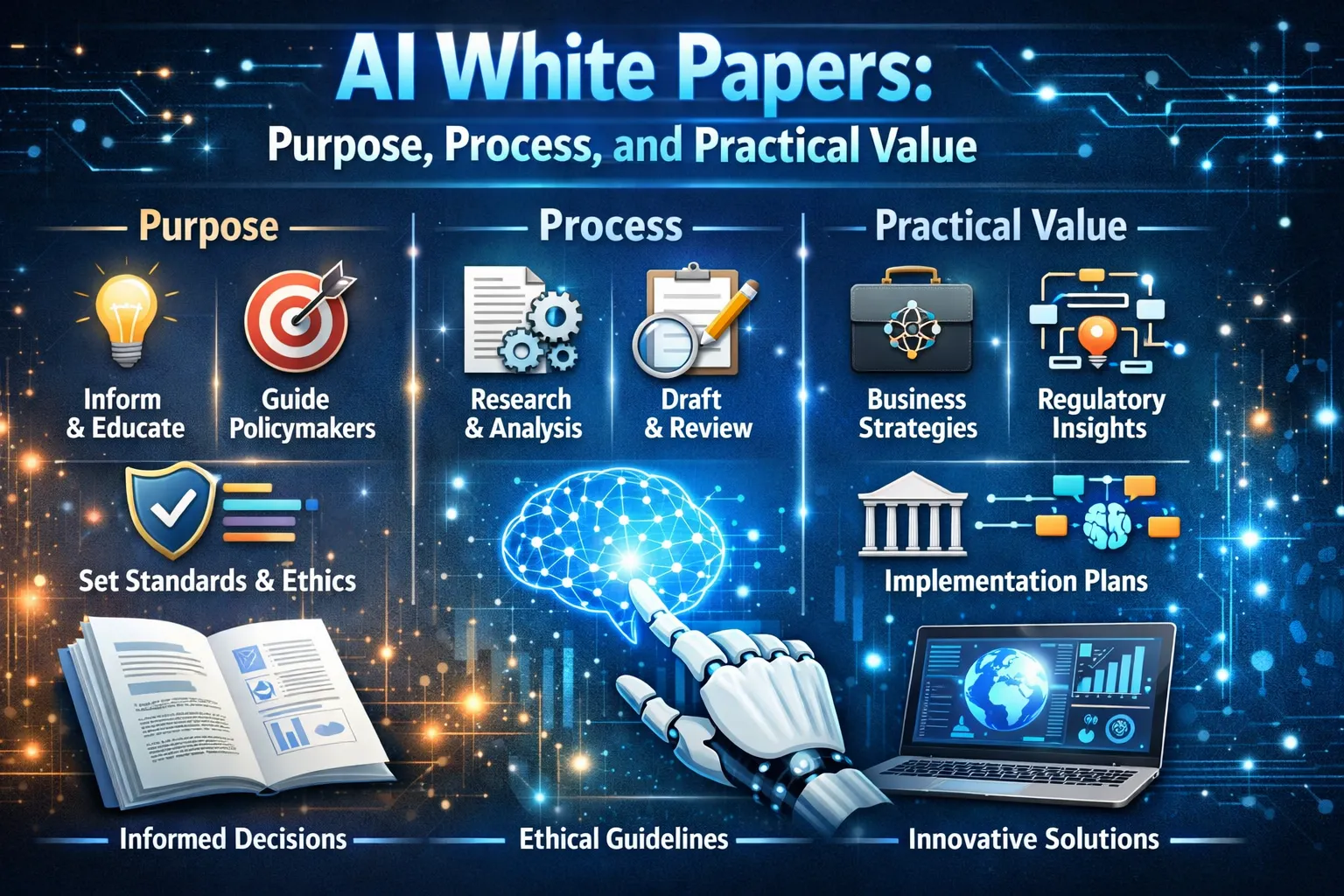
AI White Papers: Purpose, Process, and Practical Value
Introduction
The gap between artificial intelligence hype and measurable business outcomes has never been wider. Organizations pour billions into AI initiatives, yet research consistently shows that fewer than one in ten achieve enterprise-scale adoption with sustainable returns. Bridging this gap requires more than technical capability—it demands authoritative documentation that grounds innovation in practical reality. An AI white paper serves precisely this function, offering research-backed analysis that helps organizations move from experimentation to repeatable, predictable outcomes.
When properly executed, an AI white paper provides the frameworks, governance structures, and implementation guidance that separate successful AI adoption from fragmented, underperforming pilots. For decision-makers navigating technical complexity and regulatory uncertainty, the AI white paper remains the definitive format for establishing credibility and translating technological potential into strategic advantage.
What Defines an AI White Paper
An AI white paper is distinguished by its commitment to evidence-based analysis. Unlike blog posts that summarize trends or vendor materials that lead with product features, a white paper builds an argument grounded in research, methodology, and practical application . The format demands original insight—whether through proprietary data, case studies, or systematic reviews of existing literature.
The most respected AI white papers share common structural elements. They define scope precisely, acknowledge limitations transparently, and cite methodologies in sufficient detail for peer review. They serve multiple audiences simultaneously: technical evaluators seeking implementation specifics, executives assessing strategic alignment, and compliance officers verifying governance frameworks. This structural integrity is what makes the format valuable across sectors, from financial services to healthcare to public sector AI deployment.
Why AI White Papers Matter Now
The AI adoption landscape has shifted dramatically. Recent research from Accenture and Stanford reveals that while AI investments continue to rise, only 8 percent of companies are scaling AI at an enterprise level and embedding it into core business strategy . The gap between experimentation and institutionalization represents both a risk and an opportunity.
White papers address this gap by providing the frameworks organizations need to scale. The SEI’s forthcoming AI Adoption Maturity Model, developed in partnership with Accenture, outlines eight core dimensions essential for mature AI adoption: Organizational Strategy, Workforce and Culture, Workflow Re-engineering, Risk and Governance, Data, Engineering, Operations and Sustainment, and Ecosystem . Each dimension requires documented practices and repeatable processes—exactly what authoritative white papers deliver.
Core Components of Authoritative AI White Papers
Analysis of leading AI white papers from institutions like DFKI, Fraunhofer, and Stanford reveals consistent structural patterns that distinguish authoritative documents from superficial ones.
Executive Summary: States the problem, the approach, and key findings within a single page. Decision-makers should grasp the document’s value without reading further.
Problem Statement: Establishes urgency by referencing market failures, technical bottlenecks, or regulatory shifts that make the topic timely. This section answers why now.
Methodology: Separates authoritative papers from opinion pieces. Whether describing model architectures, evaluation frameworks, or governance processes, this section must include sufficient detail for replication or peer review.
Findings and Analysis: Presents evidence with supporting data, visualizations, and contextualization against existing research. The strongest papers acknowledge counterarguments and limitations.
Recommendations: Offers actionable guidance grounded in the evidence presented. Recommendations should be specific enough to inform procurement, development, or governance decisions.
Future Work: Demonstrates intellectual honesty by identifying open questions and areas requiring further investigation.
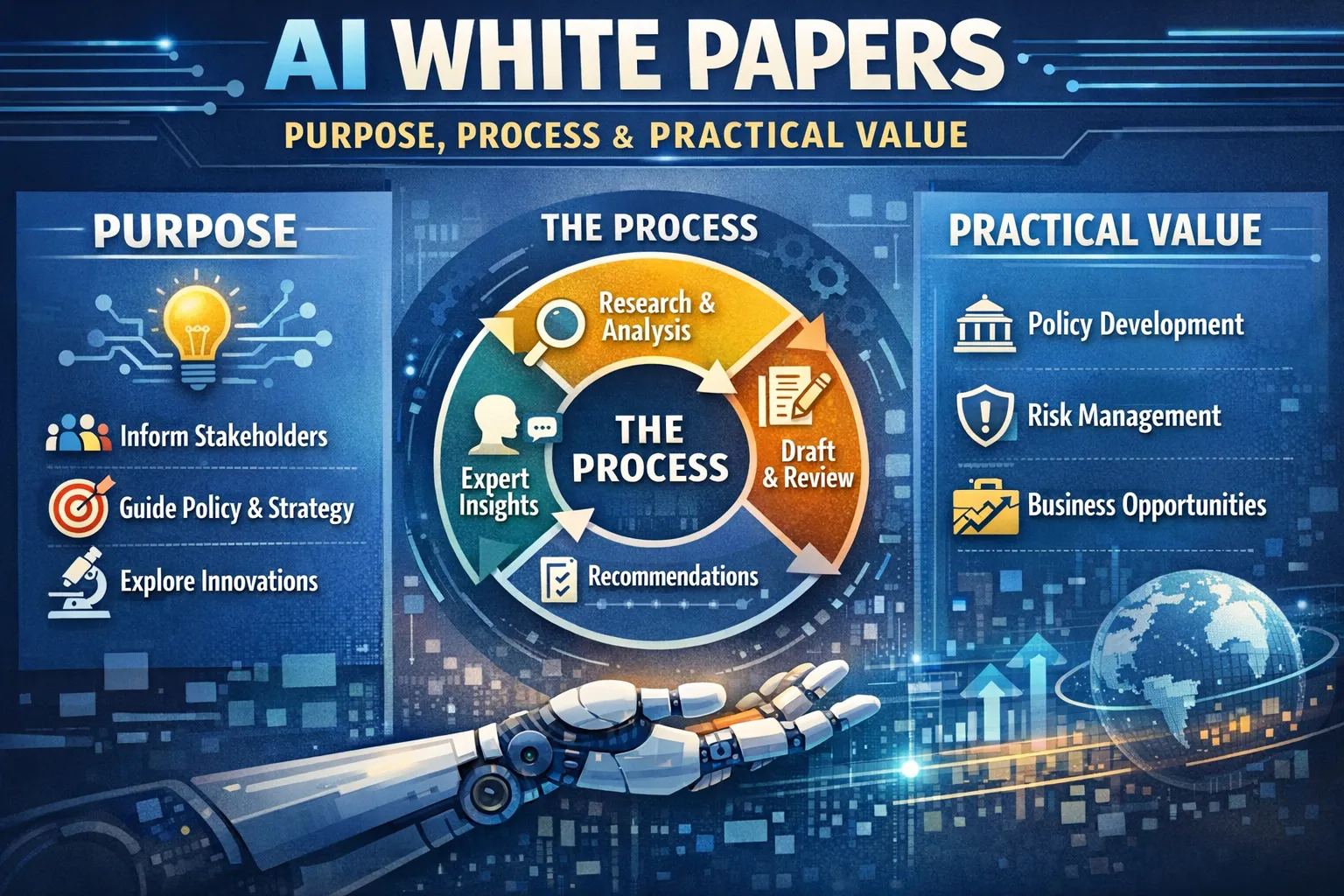
AI White Papers: Purpose, Process, and Practical Value
The Five Dimensions of Scalable AI Adoption
Contemporary AI white papers increasingly organize their analysis around frameworks that help organizations assess and improve their capabilities. The SEI-Accenture maturity model identifies five levels of AI adoption maturity: Exploratory, Implemented, Aligned, Scaled, and Future-Ready. Each level corresponds to increasing capability across eight dimensions.
Similarly, the Fraunhofer-Accenture-DFKI white paper on AI in product development identifies five dimensions essential for scaling AI in engineering: Data Quality, Interoperability, AI Platforms, Context Management, and Federated Governance. Together, these dimensions form the foundation for a sustainable AI ecosystem, ensuring that technical progress aligns with organizational and strategic goals.
Generative AI and Agentic Systems: New Frontiers
The rapid evolution of generative AI and agentic systems has fundamentally changed what organizations expect from AI white papers. Recent publications from DFKI and Accenture on generative AI in software development illustrate this shift. The paper examines the transition from first-generation AI code assistants to “agentic AI for software engineering”—autonomously operating systems capable of performing complex tasks across multiple domains and tools.
Stanford’s generative AI playbook for enterprise readiness offers a template for this new generation of white papers. Its framework covers use case development, model selection, architecture decisions, defensive moats, risk mitigation, and the critical role of UI/UX in shaping how knowledge workers interact with AI systems.
How to Evaluate AI White Paper Quality
For professionals tasked with assessing AI white papers—whether for vendor selection, internal adoption, or strategic planning—specific evaluation criteria separate authoritative resources from superficial content.
Evidence Quality: Does the paper cite specific methodologies and data sources? Are claims supported by evidence that can be independently verified? The strongest papers include references to peer-reviewed research, proprietary data with collection methodologies disclosed, or case studies with sufficient detail for replication.
Scope Discipline: Does the paper attempt to cover too much ground, or does it maintain a focused scope that enables depth? White papers that try to address architecture, governance, ethics, and market trends simultaneously typically lack sufficient depth on any single topic.
Limitations Transparency: Does the author acknowledge uncertainties, constraints, and areas where evidence is incomplete? Intellectual humility signals confidence and credibility.
Actionability: Does the paper conclude with guidance that readers can apply? The best white papers translate analysis into frameworks, checklists, or decision criteria that inform real-world action.
AI White Papers Across Sectors
The application of AI white papers varies significantly by sector, reflecting different regulatory requirements, risk profiles, and implementation contexts.
Financial Services: White papers document model validation processes, fairness assessments, and compliance with regulatory expectations. They serve as public records of governance approaches, particularly for high-risk applications like credit scoring and fraud detection.
Healthcare: Clinical evaluation protocols for AI-assisted diagnostics require documented evidence of performance across diverse populations. White papers provide the transparency that clinicians and regulators demand.
Public Sector: Algorithmic transparency frameworks and citizen impact assessments are increasingly published as white papers, establishing accountability for AI systems deployed in government contexts.
Manufacturing and Engineering: White papers detail how AI integrates with existing engineering workflows, addressing interoperability, data quality, and the Digital Thread concept that connects product data from concept to production.
Common Pitfalls in AI White Paper Development
Organizations new to white paper development often make predictable mistakes that undermine credibility and utility.
Scope Creep: Attempting to address too many topics within a single document. A white paper that tries to cover architecture, governance, ethics, and market trends simultaneously typically fails to provide sufficient depth on any.
Inadequate Review: White papers should be reviewed by subject-matter experts, technical peers, and legal and compliance teams. Errors in methodology or overstatements of capability create long-term credibility issues.
Marketing Tone: The most common failure mode is writing that reads as promotional material rather than objective analysis. A true white paper does not lead with a product. It may reference specific solutions within case studies, but the primary focus remains on the problem domain and the evidence base.
Weak Methodology: Papers that assert conclusions without explaining how those conclusions were reached fail to establish trust. Methodology sections should include sufficient detail for critical evaluation.
Relationship Between White Papers & Technical Documentation
White papers and technical documentation serve complementary but distinct purposes. Technical documentation explains how a system works. White papers explain why it was built that way, what trade-offs were made, and how performance was evaluated.
For complex AI systems, both are necessary. Documentation supports implementation and troubleshooting. White papers support procurement, governance, and strategic alignment. Organizations that maintain both documentation types benefit from clearer internal communication and more effective stakeholder engagement.
When white papers reference supporting documentation, they create a knowledge ecosystem that serves diverse audiences with different information needs. Technical evaluators can drill into specifics; executives can grasp strategic rationale; compliance officers can verify governance claims.
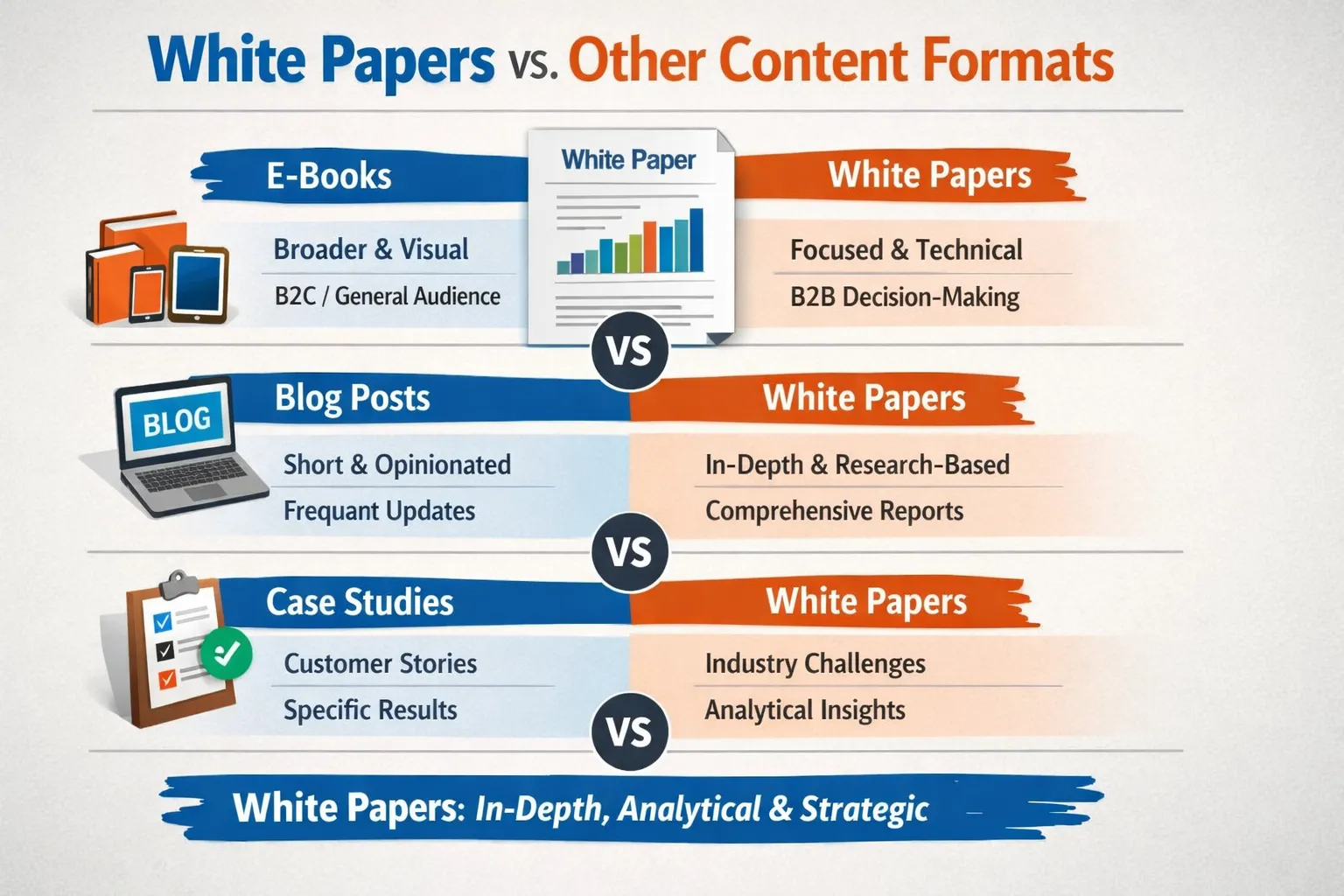
White Papers vs. Other Content Formats
It’s crucial to distinguish white papers from adjacent content types.
- E-books:White papers are more focused, technical, and aimed at B2B decision-making. E-books are typically broader, more visual, and designed for a wider B2C or general audience.
- Blog Posts:Blogs are shorter, more frequent, and opinion-driven. White papers are comprehensive, standalone reference documents built on sustained research.
- Case Studies:Case studies are retrospective, focusing on a single customer’s story and results. White papers are prospective and analytical, discussing industry-wide challenges and generalized solutions.
AI White Papers: Purpose, Process, and Practical Value
Critical Evaluation: Assessing Quality and Bias
Not all white papers are created equal. A discerning reader must ask: Does this document lead with genuine insight, or is it a thin veil for a sales brochure? The most credible papers prioritize evidence over assertion, acknowledge limitations or alternative viewpoints, and clearly disclose their institutional authorship and any potential conflicts of interest.
Conclusion
AI white papers are indispensable instruments for navigating the complexities of artificial intelligence. They transform opaque technology and regulatory landscapes into clear, actionable intelligence. For professionals committed to informed strategy—whether adopting a new AI platform, shaping corporate policy, or understanding global regulatory shifts—mastering the ability to find, evaluate, and utilize these documents is not just an advantage; it is a core competency for operating in an AI-driven world. Begin your next strategic inquiry by seeking out the authoritative white papers on the subject.
FAQs
What is the main goal of an AI white paper?
The primary goal is to educate a target audience on a complex AI topic, establish the author’s authority, and guide informed decision-making, often within a business or policy context.
Who are the typical authors of AI white papers?
They are authored by a wide range of entities, including technology companies, consulting firms, academic research institutions, government departments, and international policy organizations.
How long should a comprehensive AI white paper be?
While length varies by topic, effective white papers are substantive documents, typically exceeding 2,500 words to allow for thorough analysis and are often structured as reports of 10-30 pages.