Wi-Fi vs Bluetooth: Which One Fits Your Needs?
Introduction
In today’s interconnected world, Wi-Fi vs Bluetooth represent the fundamental pillars of wireless communication, each serving distinct but complementary roles in our digital ecosystem. The ongoing discussion around Wi-Fi vs Bluetooth is more than a surface-level comparison—while both technologies eliminate the need for physical cables and operate within similar radio frequency spectrums, their design philosophies and implementation architectures differ significantly. Understanding these differences is crucial for professionals, developers, and informed consumers evaluating Wi-Fi vs Bluetooth for real-world connectivity decisions.
The choice extends far beyond simple preference, involving careful consideration of power requirements, bandwidth demands, range limitations, and specific application contexts. This analysis delivers a detailed comparison grounded in technical specifications, practical use cases, and implementation insights to help you confidently navigate the evolving landscape of wireless connectivity.
Wi-Fi vs Bluetooth: Which One Fits Your Needs?
Core Design and Architecture
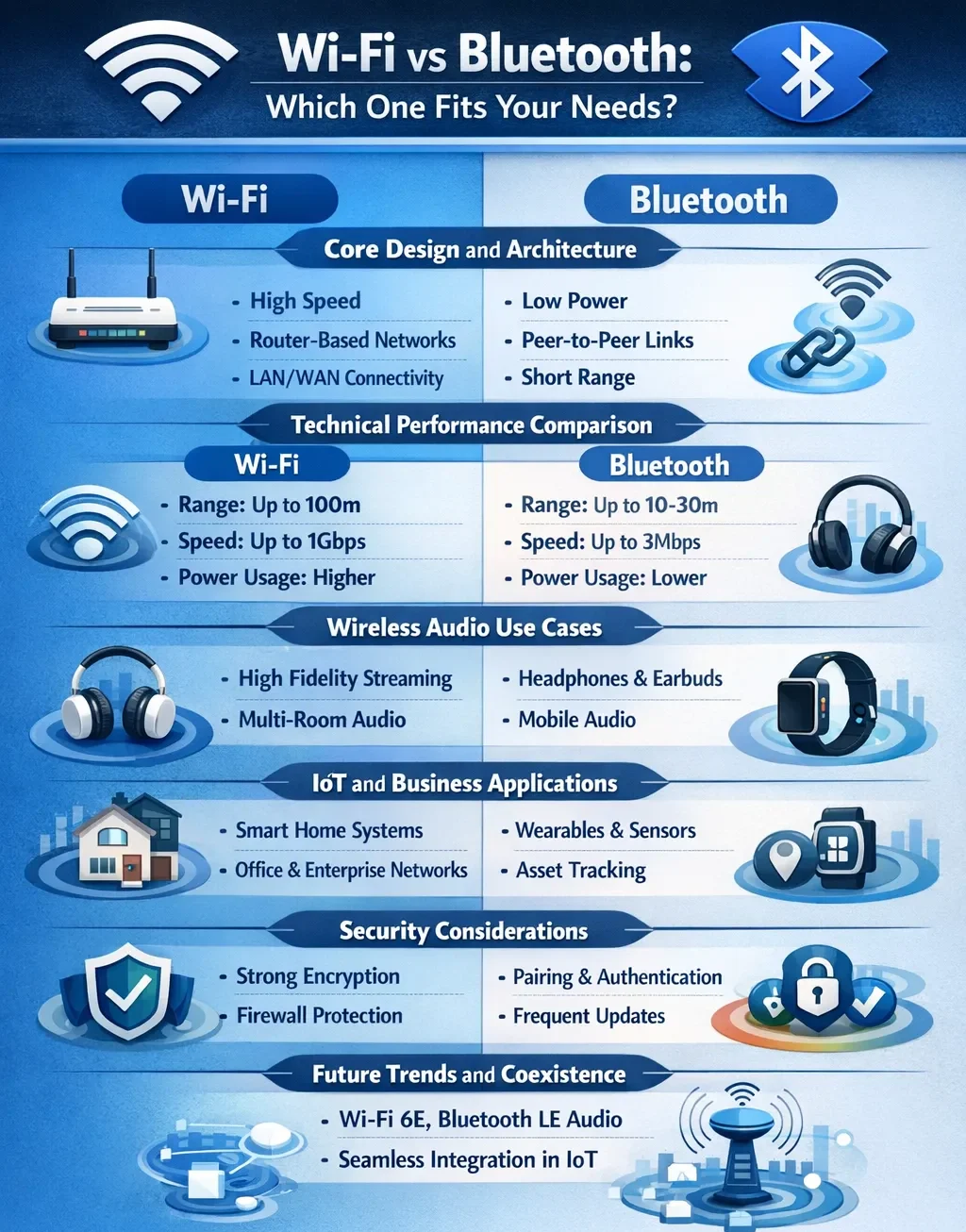
Wi-Fi, standardized under IEEE 802.11, is built for high-speed networking and internet access. It uses an infrastructure-based model where multiple devices connect through a central access point or router. This design supports many simultaneous connections and prioritizes high throughput, low latency, and efficient performance in dense environments. Modern standards such as Wi-Fi 6 and emerging Wi-Fi 7 deliver multi-gigabit speeds and improved spectrum efficiency.
Bluetooth, governed by the Bluetooth Special Interest Group (SIG), was designed as a cable-replacement technology for short-range personal area networks. It emphasizes simplicity, low power consumption, and direct device-to-device communication. Traditional Bluetooth uses a master-slave (piconet) model, while Bluetooth Low Energy (BLE) supports mesh networking, enabling thousands of low-power devices to communicate—an essential feature for IoT deployments.
Technical Performance Comparison
Wi-Fi and Bluetooth differ most noticeably in speed, power usage, and scale:
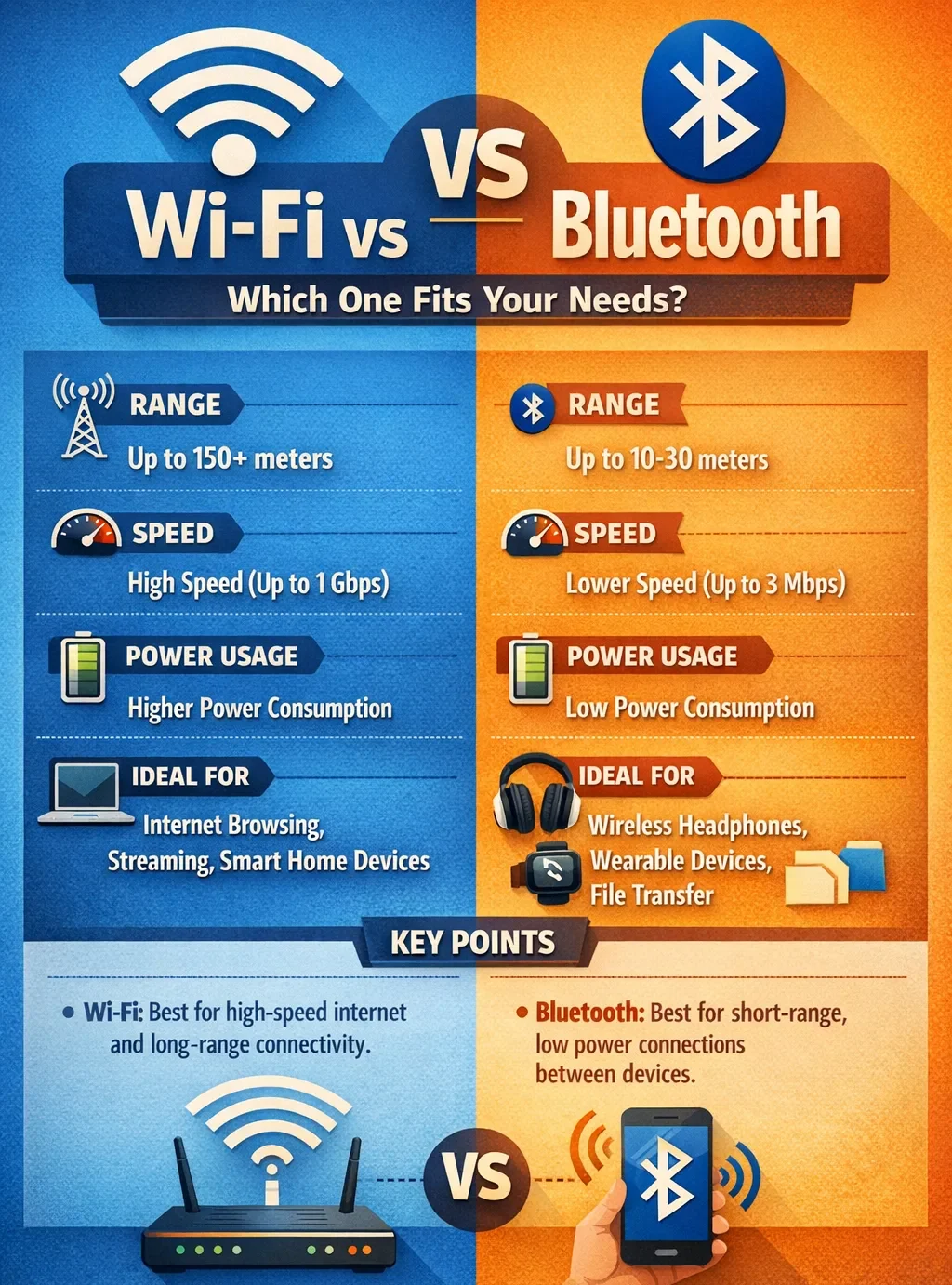
- Data rates: Wi-Fi supports extremely high speeds (up to 9.6 Gbps with Wi-Fi 6), making it suitable for video streaming, cloud computing, and large file transfers. Bluetooth is optimized for smaller, intermittent data packets, with typical speeds around 2 Mbps.
- Range: Wi-Fi generally covers 50–100 meters indoors and can be extended using mesh networks or repeaters. Bluetooth typically operates within 10–100 meters depending on device class and version.
- Power consumption: Bluetooth, especially BLE, is designed for ultra-low power use, allowing devices to run for months or years on small batteries. Wi-Fi consumes significantly more power and is best suited for mains-powered or frequently charged devices.
- Connectivity scale: Wi-Fi access points can support dozens to hundreds of devices, while classic Bluetooth supports only a handful of active connections, with BLE mesh enabling much larger networks.
Wireless Audio Use Cases
Wireless audio highlights the strengths of both technologies. Bluetooth dominates personal audio—headphones, earbuds, and portable speakers—because of its low power consumption, universal compatibility, and simple pairing process. However, Bluetooth audio typically relies on compression, which can reduce sound fidelity.
Wi-Fi audio excels in stationary and high-fidelity environments. Its higher bandwidth supports lossless audio streaming and synchronized playback across multiple speakers, making it ideal for whole-home and multi-room audio systems. Increasingly, manufacturers combine both technologies in a single device, using Bluetooth for portability and Wi-Fi for premium home listening.
IoT and Business Applications
In IoT ecosystems, Bluetooth and Wi-Fi often play complementary roles. BLE is widely used for battery-powered sensors, wearables, asset tracking, and smart building applications due to its efficiency and low cost. BLE mesh networking enables large-scale deployments while maintaining long battery life.
Wi-Fi is preferred for IoT devices that require high data throughput or continuous internet access, such as security cameras, smart displays, and voice assistants. In enterprise environments, Wi-Fi also enables analytics, user tracking, and centralized device management. Many organizations adopt hybrid architectures, using BLE for data collection and Wi-Fi gateways for cloud connectivity.
Security Considerations
Wi-Fi typically offers robust security through WPA2 and WPA3 encryption, making it suitable for transmitting sensitive data. However, secure Wi-Fi deployments require careful configuration and ongoing management.
Bluetooth security has improved substantially, now incorporating AES-128 encryption and secure pairing mechanisms. Its shorter range reduces exposure, though proximity-based attacks remain possible. Both technologies can be secured effectively, but each requires different expertise and implementation strategies.
Future Trends and Coexistence
Bluetooth continues to evolve toward greater efficiency and scalability, with innovations such as LE Audio and expanded mesh networking. Wi-Fi focuses on higher capacity, lower latency, and better performance in crowded environments, with Wi-Fi 6E and Wi-Fi 7 expanding spectrum use and real-time capabilities.
Rather than competing, Wi-Fi and Bluetooth increasingly coexist within unified systems. Smart homes, offices, and personal devices commonly use Bluetooth for low-power sensing and peripherals while relying on Wi-Fi for high-bandwidth tasks and internet access.
Wi-Fi vs Bluetooth: Which One Fits Your Needs?
Conclusion
Wi-Fi and Bluetooth are not rivals but complementary technologies. Wi-Fi is best for high-speed, high-capacity, internet-connected applications, while Bluetooth excels in low-power, short-range, and device-to-device communication. The most effective wireless solutions are those that strategically combine both technologies based on specific application requirements, delivering optimal performance, efficiency, and user experience.
Frequently Asked Questions
Can Bluetooth and Wi-Fi interfere with each other?
Yes. Both often use the 2.4 GHz band, but modern devices reduce interference using adaptive frequency hopping (Bluetooth) and dynamic channel selection (Wi-Fi).
Which is better for real-time applications?
Bluetooth usually has lower latency, making it ideal for audio and peripherals, while Wi-Fi offers more stable bandwidth for internet-based real-time tasks.
Can Bluetooth provide internet access?
Bluetooth cannot directly provide internet access, but it can share an existing connection through tethering from another device.