What Is AI Objective: A Complete Guide
Introduction
Artificial intelligence is no longer an experimental technology; it is a core business driver for automating operations, personalizing experiences, and improving decision-making. Yet, as AI adoption surges, so does the failure rate of poorly conceived projects. The AI Objective is the precise, business-centric problem that an AI system is engineered to solve. Establishing a clear AI Objective before a single line of code is written is not optional—it is the single most important determinant of an AI initiative’s success or failure.
This checklist will arm you with the methodology to define, validate, and execute against a robust AI objective, ensuring your investment drives measurable value. The concept of AI Objective frames what success looks like when building intelligent systems, giving direction to developers, stakeholders, and users alike.
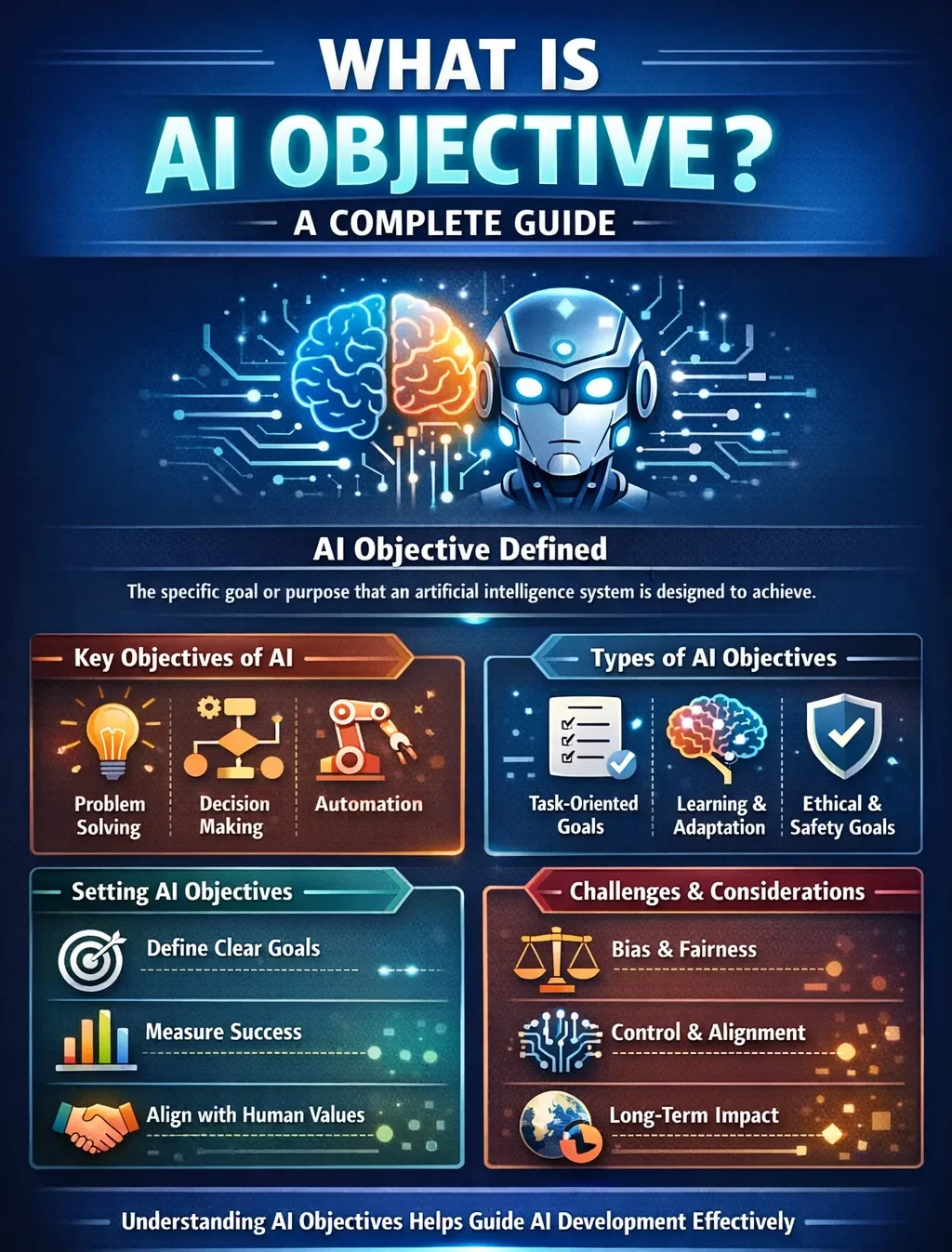
What Is an AI Objective?
An AI objective describes the intended goal or outcome that an artificial intelligence system strives to achieve. It serves as a guiding metric or mission for model behavior, aligning system actions to desired results.
In simple terms, it answers, “What should the AI do?”
Key roles of an AI Objective:
- Defines clear expectations.
- Guides model training and evaluation.
- Prevents unintended or harmful outputs.
- Ensures measurable and transparent progress.
What Is AI Objective: A Complete Guide
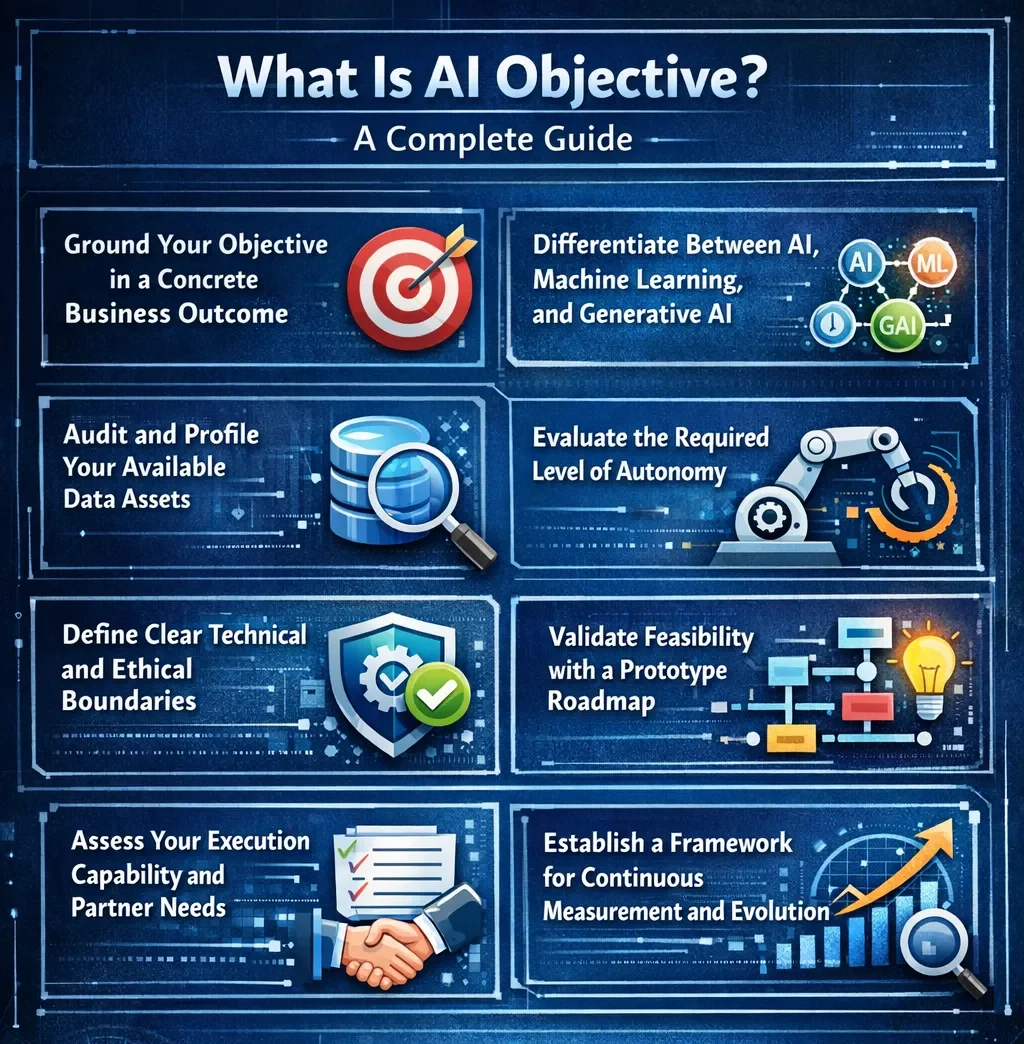
Ground Your Objective in a Concrete Business Outcome
An AI objective must begin with a tangible business need, not a fascination with technology.
- Identify the Core Business Pain Point: Is it reducing customer service resolution time by 30%, cutting manufacturing defect rates by 15%, or predicting inventory demand with 95% accuracy? The objective must solve a specific problem.
- Quantify the Target Metric: Attach a key performance indicator (KPI) to your objective. Goals such as ‘improve service’ lack specificity, making outcomes hard to measure. A clear target provides a benchmark for success.
- Connect to a Strategic Goal: The objective should align with broader business priorities, such as increasing market share, boosting operational efficiency, or enhancing product innovation.
Differentiate Between AI, Machine Learning, and Generative AI
Applying the wrong technology to your objective guarantees failure; Understand the hierarchy and application of each.
- Artificial Intelligence (AI): The overarching field of creating systems that can perform tasks requiring human-like intelligence, such as reasoning or decision-making.
- Machine Learning (ML): A dominant subset of AI where systems learn patterns from data to make predictions or decisions without explicit programming for every rule. Use ML for predictive analytics (e.g., churn risk, sales forecasting).
- Generative AI (Gen AI): A powerful subset powered by deep learning that creates original content (text, images, and code). Use Gen AI for content creation, product design ideation, or conversational agents. Do not use generative AI for high-stakes, deterministic numerical predictions.
Audit and Profile Your Available Data Assets
AI is fundamentally a data technology. The feasibility of your objective depends entirely on the quality and quantity of your data.
- Data Existence: Do you have historical, relevant data related to the problem? An objective to predict machine failure requires sensor data; one to personalize marketing requires customer interaction data.
- Data Structure and Volume: Assess if your data is structured (database tables) or unstructured (text, images). Deep learning excels with massive volumes of unstructured data, while classic ML can often work with smaller, structured datasets.
- Data Quality and Bias: Plan for data cleansing. AI models will inherit and amplify biases and errors present in the training data, which can derail objectives and create significant risk.
Evaluate the Required Level of Autonomy
Your objective dictates the system’s autonomy, ranging from full automation to human-led decision support.
- Full Autonomy: The AI acts independently. Objectives here are suited for repetitive, high-volume tasks like real-time fraud detection in transactions or controlling robotic assembly lines.
- Decision Support: The AI provides insights and recommendations, but a human makes the final call. This is critical for high-consequence domains like medical diagnosis or strategic planning, where human judgment and accountability are paramount.
- Human-in-the-Loop: The system’s outputs are continuously evaluated by humans to provide feedback for improvement, a process known as Reinforcement Learning from Human Feedback (RLHF), which is common in tuning sophisticated models.
Define Clear Technical and Ethical Boundaries
A well-scoped objective includes clear constraints to ensure safety, fairness, and compliance.
- Technical Constraints: Specify required accuracy thresholds (e.g., 99.9% for certain tasks), acceptable latency (real-time vs. batch processing), and integration requirements with existing IT systems.
- Ethical and Compliance Guardrails: For objectives involving personal data, define how the system will adhere to regulations like GDPR or HIPAA. Proactively plan for model transparency and explainability to audit decisions, a practice now central to responsible AI development.
Validate Feasibility with a Prototype Roadmap
Before committing major resources, de-risk your objective with a phased approach.
- Proof of Concept (PoC): Develop a minimal model on a small, clean dataset to test the core hypothesis. Can the AI system detect the pattern or make the prediction you need?
- Pilot Project: Deploy the model in a controlled, real-world environment (e.g., one product line, one regional office). Measure its performance against your KPIs under live conditions.
- Scale and Integration: Only after a successful pilot should you plan for full-scale deployment, integrating the model into business workflows and establishing ongoing monitoring and maintenance (MLOps).
Assess Your Execution Capability and Partner Needs
Be honest about your internal capacity. Most businesses require expert partners to execute complex AI objectives.
- Build Internally: Requires a mature team of data scientists, ML engineers, and domain experts. Suitable for highly proprietary, core-competency objectives.
- Partner with an AI Development Firm: Ideal for most enterprises. Look for partners with proven expertise in your specific industry and a track record of delivering end-to-end solutions, not just strategy.
- Key Partner Evaluation Criteria: Assess potential partners on their technical depth, real-world project portfolio, client testimonials, and commitment to security and responsible AI practices.
Establish a Framework for Continuous Measurement and Evolution
An AI objective is not a static target. The market and your data will change.
- Implement Monitoring: Continuously track the model’s performance against your KPIs. Monitor for “model drift,” where the model’s accuracy degrades as real-world data evolves.
- Plan for Retraining: Budget and schedule for periodic model retraining with new data to maintain relevance and accuracy.
- Review and Pivot: Regularly reassess if the original business objective is still valid. Be prepared to refine or pivot the AI’s purpose based on new insights or shifting business goals.
What Is AI Objective: A Complete Guide
Conclusion: From Ambition to Execution
The transformative potential of artificial intelligence is unlocked not by the sophistication of the algorithms but by the clarity and rigor of the human-defined objective guiding them. This checklist moves the conversation from technological ambition to disciplined execution. In 2026, competitive advantage will belong to those who master the art of framing the AI problem with precision. By anchoring your initiative in a concrete business outcome, respecting the hierarchy of AI capabilities, and validating your path through phased prototyping, you convert the promise of AI into a reliable driver of growth and innovation. The next step is to apply this framework to your most pressing business challenge.
Frequently Asked Questions
What’s the difference between an AI objective and a business goal?
Business Goal: A high-level outcome (e.g., increase customer satisfaction).
AI Objective: A specific, measurable task an AI system performs to support that goal (e.g., route 95% of customer emails correctly within 2 seconds).
How specific does an AI objective need to be?
Extremely specific “Use AI to improve marketing” is destined to fail. Clear, measurable objectives succeed.
Can one AI system have multiple objectives?
Avoid them. Start with one well-defined objective; complexity can be added later with multi-agent or agentic approaches.