
Web vs. Internet: Understanding the Key Differences
Introduction
The terms Web and Internet are often used interchangeably, yet they represent distinct layers of digital communication. The Internet is the foundational global network that enables data exchange, while the Web operates on top of it, delivering interconnected content through browsers. Understanding Web vs Internet reflects core concepts of accuracy, clarity, and technical literacy in the digital age.
As online ecosystems evolve, distinguishing Web vs Internet supports informed decision-making, better system design, and responsible use of technology. This article explores Web vs Internet with precision and authority for tech-aware readers in the UK and USA.
Defining the Internet: The Global Network Backbone
The Internet is a vast network connecting millions of private, public, academic, business, and government devices globally. Its foundation consists of protocols such as TCP/IP that govern data packet transmission. This network enables diverse services including email, file transfer, and the Web. The Internet’s importance lies in its role as the infrastructure supporting digital communication and information exchange. For example, when sending an email or streaming video, the Internet routes data packets between source and destination devices. The Internet is the physical and logical medium underlying the Web and many other online services.
Understanding the Web: The Information Layer
The Web is a service operating over the Internet, designed for accessing and linking documents and multimedia via web browsers. It uses protocols like HTTP/HTTPS and technologies such as HTML, CSS, and JavaScript to render content. The Web enables websites, online applications, and interactive media. Its introduction transformed the Internet from a data network into a user-friendly information space. A practical scenario is accessing a news website or an online shop, which relies on the Web’s hypertext system. The Web depends on the Internet but is only one part of the broader digital ecosystem.
Web vs Internet: Understanding the Key Differences
Key Differences: Infrastructure vs Service
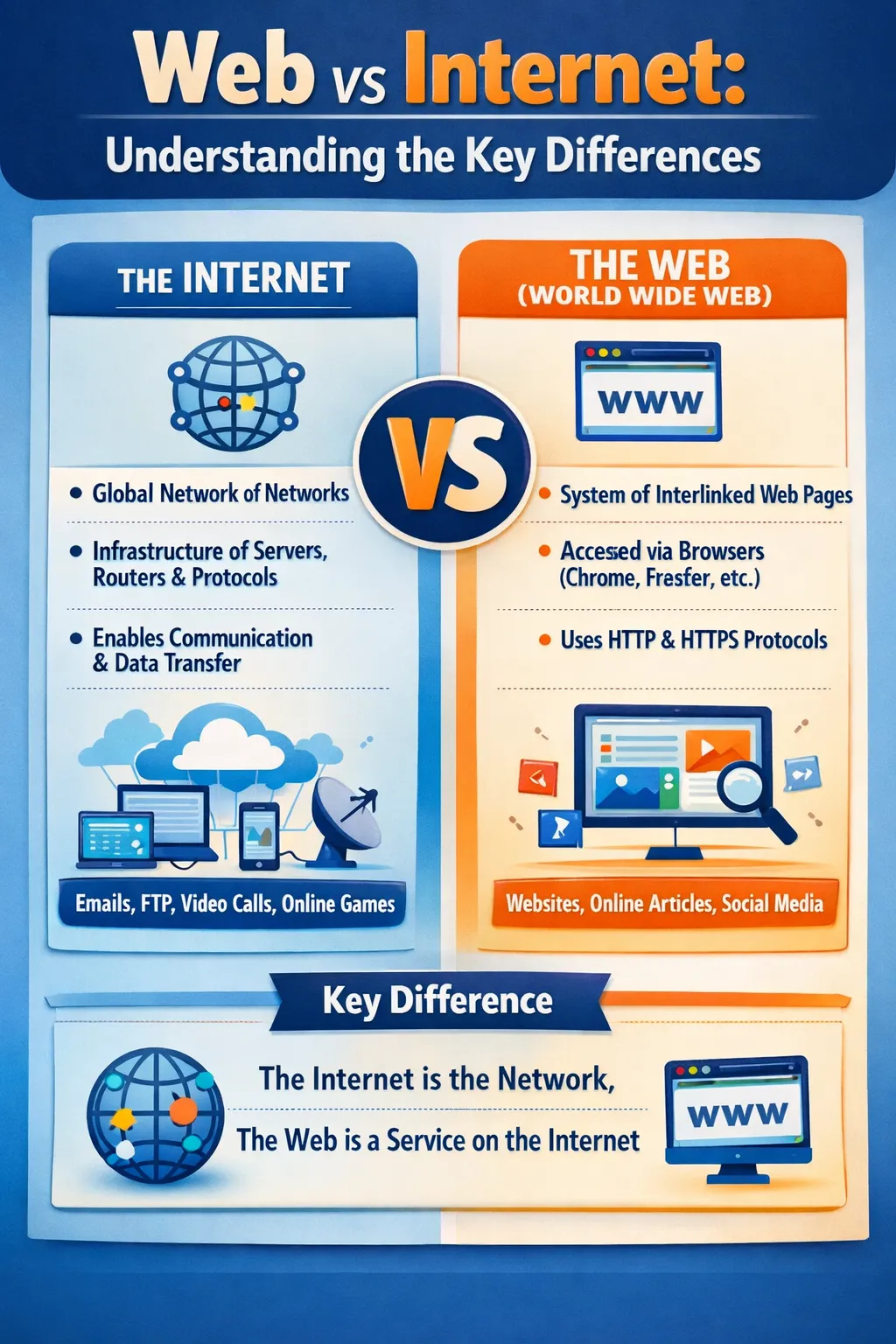
The clearest distinction is that the Internet is the physical and protocol infrastructure, while the Web is a service running on this infrastructure. The Internet facilitates communication between computers globally, regardless of the application or data type. The Web provides a standardized system for publishing and navigating information online. This means the Internet supports multiple services beyond the Web, such as Voice over IP (VoIP), FTP, and online gaming. Recognizing this helps avoid confusion in discussions about connectivity, cybersecurity, and digital innovation.
Supporting Entities: Protocols, Browsers, Servers, and ISPs
Several critical entities connect the Web and Internet. Protocols like TCP/IP and DNS ensure reliable addressing and data routing across the Internet. Web browsers (Chrome, Firefox, Safari) enable users to interact with Web content. Internet Service Providers (ISPs) connect end-users to the Internet infrastructure. These components form an ecosystem where the Internet enables data transport, and the Web structures accessible content. For example, DNS translates domain names into IP addresses, bridging user-friendly navigation with network-level addressing.
How the Web and Internet Work Together
When a user enters a URL in a browser, the Web initiates a request using HTTP/HTTPS protocols. This request travels over the Internet’s network layers, passing through routers and servers. The server hosting the website processes the request and sends back the appropriate data. This seamless interaction is a practical demonstration of the Web depending on the Internet. The Internet’s efficiency and security directly impact the Web experience, influencing load times, accessibility, and data privacy.
Real-World Impact: Connectivity, Access, and Innovation
The distinction between Web and Internet shapes how businesses, governments, and individuals approach digital strategies. For businesses, understanding this difference influences cybersecurity measures, network infrastructure investments, and content delivery strategies. Governments rely on Internet policies and Web regulations to manage digital rights and services. End-users experience this in their daily lives through connectivity quality and online service availability. For instance, poor Internet infrastructure can limit Web access, impacting education, commerce, and communication.
Evaluating Benefits and Limitations
The Internet’s benefit lies in its universal connectivity and protocol standardization, enabling global communication. The Web adds value by providing structured, accessible information and interactive services. However, the Internet’s complexity can lead to vulnerabilities such as cyberattacks, while the Web’s openness raises issues with misinformation and privacy. Understanding these trade-offs equips professionals to design resilient, user-centric digital solutions. For example, optimizing web applications requires considering both network latency (Internet) and user interface design (Web).
Common Misconceptions
A frequent misconception is that the Web is synonymous with the Internet. This misunderstanding can lead to inaccurate technical discussions or ineffective decision-making. Another misconception is believing the Internet only supports the Web, overlooking other crucial services like email and peer-to-peer networks. Clarifying these points fosters better communication among developers, strategists, and users. Have you ever wondered why your email works even when certain websites are down? That’s because email uses different Internet protocols independent of the Web.
SEO and Content Strategy Considerations
For SEO professionals and content strategists, differentiating Web and Internet influences keyword targeting, audience segmentation, and technical SEO. The Web’s relevance focuses on website content, user experience, and search engine indexing. The Internet requires attention to network performance, security, and accessibility impacting Web delivery. Incorporating both perspectives enhances strategic planning. For example, optimizing site speed involves both server-side improvements (Internet infrastructure) and front-end coding (Web technologies).
Technical Frameworks and Tools
Key tools and frameworks illustrate the Web-Internet relationship. Content delivery networks (CDNs) leverage Internet infrastructure to speed up Web content delivery globally. Protocol analyzers and network monitoring tools help maintain Internet health and troubleshoot Web access issues. Web development frameworks like React or Angular focus on the user interface, while network engineers concentrate on Internet routing and performance. This division of labor highlights the layered complexity of digital systems.
The Role of Internet Governance in Web Evolution
Internet governance bodies such as ICANN and IETF develop and oversee standards ensuring interoperability and security. Their work underpins both the Internet and the Web, shaping domain name systems, IP address allocation, and protocol updates. These standards influence Web capabilities and Internet scalability. Understanding governance frameworks is crucial for stakeholders managing digital assets or compliance. For instance, changes in DNS protocols can affect website accessibility worldwide.
Emerging Trends: Web 3.0 and Beyond
Emerging technologies blur traditional boundaries. Web 3.0 proposes decentralized Web applications using blockchain over the Internet. This evolution could redefine data ownership, privacy, and interaction models. While the Internet remains the transport layer, the Web’s architecture may shift from centralized servers to peer-to-peer networks. Such trends require continuous expertise to assess impacts on infrastructure, security, and user experience. Staying informed helps professionals anticipate and adapt to these changes.
Practical Scenario: Troubleshooting Connectivity Issues
When a website fails to load, the problem could stem from Internet connectivity, DNS resolution, or Web server errors. Diagnosing requires understanding both layers. For example, an ISP outage disrupts Internet access, while server misconfiguration impacts Web content delivery. This layered knowledge improves troubleshooting efficiency and user support. Knowing the difference can save time and resources in IT environments.
The Future of Digital Communication
The Web and Internet will continue evolving, driven by technological advances and user demands. Internet infrastructure upgrades, such as widespread 5G and fiber optics, will enhance Web experiences with faster, more reliable access. Concurrently, Web technologies will become more interactive, immersive, and intelligent. Professionals must maintain a clear understanding of both realms to design scalable, secure, and user-friendly solutions. This balance is critical for sustaining digital growth and inclusion.
Web vs Internet: Understanding the Key Differences
Conclusion
The distinction between the Web and the Internet remains fundamental to understanding digital communication. The Internet forms the global network backbone, while the Web organizes and presents information via browsers. This layered relationship shapes connectivity, innovation, and user interaction across the digital landscape. As technology progresses, maintaining clarity about these entities enables professionals to navigate complexity confidently. Embrace this insight to enhance your digital strategy and operational effectiveness.
FAQs
What is the main difference between the Web and the Internet?
The Internet is the global network infrastructure, while the Web is a service that uses this infrastructure to access linked documents and multimedia.
Can the Internet exist without the Web?
Yes, the Internet supports many services like email and file transfer independent of the Web.
Why is understanding the Web vs Internet important?
It clarifies how digital communication works, improving technical decisions and user experience strategies.


Ahaa, its fastidious discussion on the topic of this article at this place at this website, I have read all that, so now me also commenting at this place.