Top 5 Personal Robots: Complete Guide to AI Personal Companion Robots
Introduction
Personal Robots are no longer science fiction—they’re emerging as practical, AI‑driven companions and assistants for modern homes. These intelligent machines combine artificial intelligence, autonomous navigation, computer vision, and natural language processing to support everyday life in ways that go beyond static smart home devices like voice assistants or single‑purpose robots. These systems aim to deliver physical tasks, emotional companionship, environmental monitoring, and adaptive learning for families, seniors, and busy households.
Personal Robots show how artificial intelligence is entering everyday life through humanoid assistants, smart home hubs, and companion robots. These systems combine mobility, vision, voice interaction, and adaptive learning to support home tasks, automation, and interaction. The Personal Robots represent the shift of AI from screens to physical environments.
Unlike traditional smart devices, Personal Robots operate in real spaces, recognize people, and integrate with smart home systems. From functional helpers to interactive companions, they illustrate how personal robotics is becoming practical and accessible.
AI Overview—How Personal Robots Think and Act
Modern personal robots rely on advanced AI models and sensor fusion to interact with the physical world:
- Perception systems: Cameras and sensors map environments and recognize people and objects.
- Autonomy: Robots use machine learning to navigate homes and adapt to new layouts.
- Language understanding: NLP enables conversational interaction and contextual responses.
- Learning & adaptation: Reinforcement learning and shared cloud models help robots improve behavior over time.
These systems combine hardware and software intelligence to make robots responsive, socially aware, and functionally useful in everyday life.

Top 5 Personal Robots: Complete Guide to AI Personal Companion Robots
Why Personal Robots Are Emerging Now
Advances in AI and robotics are bringing household robots into reality as consumer products rather than research prototypes. Household robots are increasingly designed to integrate into daily life rather than remain in labs—performing chores, supporting elderly care, enhancing safety, and providing interaction. Experts predict that by 2030, a significant portion of developed households will have at least one advanced robot as costs fall and capabilities improve.
Personal robots sit at the intersection of smart home automation, AI companionship, and physical robotics—complementing devices like robot vacuums with richer interaction and mobility.
The Top 5 Personal Robots for Home Use
Top 5 Personal Robots: Complete Guide to AI Personal Companion Robots
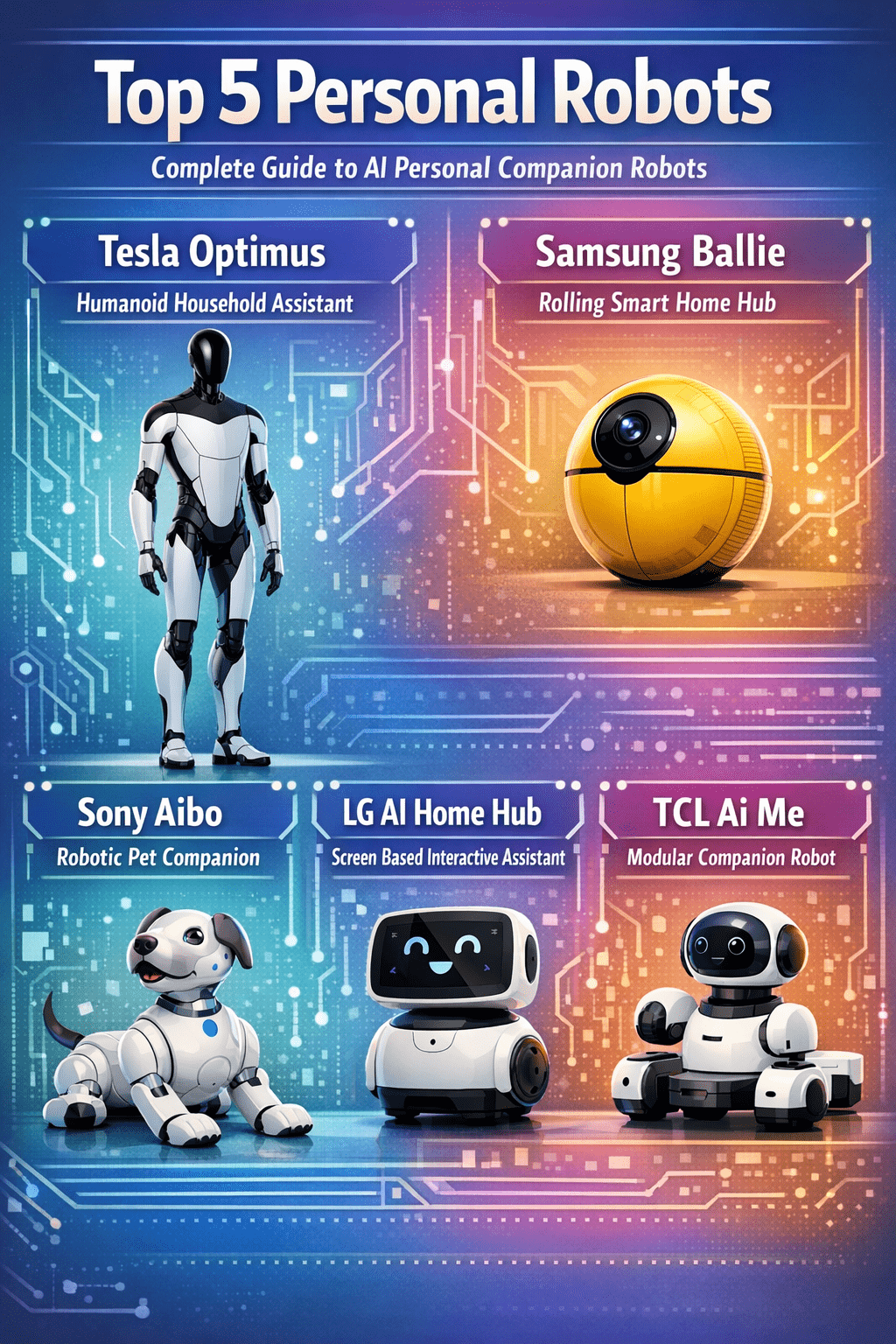
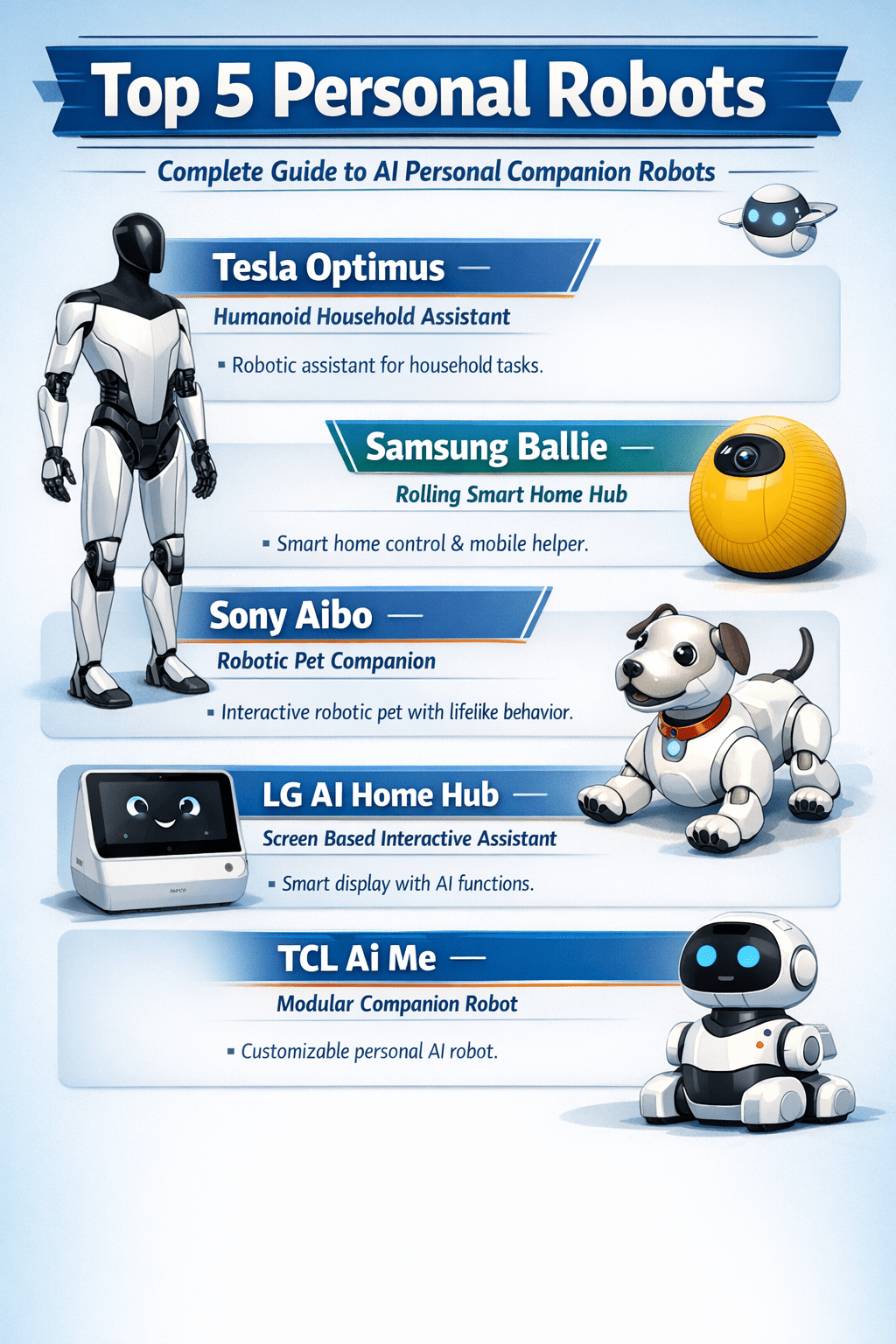
Tesla Optimus—Humanoid Household Assistant
Tesla Optimus is among the most ambitious consumer humanoid robots, designed for real physical assistance in home environments:
- Human‑like mobility: 28 degrees of freedom mimicking human movement
- Task capability: Can carry items, handle household objects, and navigate unstructured spaces
- Learning systems: Uses demonstration learning and reinforcement learning to generalize tasks
- Vision‑first navigation: Operates without specialized home sensors
The targeted price is $20,000–$30,000 once mass production scales, significantly below other humanoid competitors. This reflects broader trends toward affordable personal robotics powered by AI frameworks previously used in autonomous vehicles.
Samsung Ballie—Rolling Smart Home Hub
Samsung Ballie is a unique spherical robot that functions as a mobile smart home assistant, designed to move autonomously around the home:
- Smart home integration: Controls lighting, climate, and appliances through connectivity
- Mobility: SLAM navigation lets it follow users and patrol spaces
- Projector and interaction: Projects video and UI wherever it goes
- Companion features: Recognizes faces and personalizes routines
Ballie represents an early step toward robots that blur companion and control hub functionality, though broader consumer availability and pricing remain pending.
Sony Aibo—Robotic Pet Companion
Sony Aibo brings emotional intelligence and companionship into personal robotics:
- Life‑like behavior: Deep‑learning AI shapes unique personality traits
- Recognition: Identifies up to 100 faces and recalls interactions
- Training reinforcement: Robot responds to owner cues much like a living pet
- Social connectivity: Multiple units interact socially
Unlike task‑oriented robots, Aibo focuses on emotional engagement and companionship, offering a low‑maintenance social experience without traditional pet care responsibilities.
LG AI Home Hub—Screen-Based Interactive Assistant
LG AI Home Hub prioritizes communication and smart home control through a touchscreen interface:
- Voice and visual interaction: Easy video calling and voice control for smart devices
- Cooking and assistance: Provides step‑by‑step cooking guidance
- Voice‑optimized AI: Works well in everyday environments like kitchens and living rooms
While it lacks full autonomous mobility, its strength lies in interface‑based assistance and content delivery, integrating seamlessly with family life and household routines.
TCL Ai Me—Modular Companion Robot
TCL Ai Me blends portable assistance with stationary control, ideal for households seeking both:
- Conversational AI: Natural language interaction with personalized responses
- Environmental awareness: Recognizes people, pets, and objects in rooms
- Educational features: Interactive learning and story experiences
- Modular design: Functions as both stationary hub and mobile companion
While pricing and broad availability are still emerging, Ai Me exemplifies modular home robotics designed for family environments with children and adults alike.
| Rank | Product Name | Category | Approx. Price (USD) | Core Role |
|---|---|---|---|---|
| 1 | Tesla Optimus | Humanoid Household Assistant | $20,000–$30,000 (Projected) | Physical household tasks, logistics, general assistance |
| 2 | Samsung Ballie | Rolling Smart Home Hub | $1,500–$2,000 (Estimated) | Smart home control, monitoring, daily assistance |
| 3 | Sony Aibo | Robotic Pet Companion | $2,899 + ~$300/year cloud plan | Emotional companionship, interaction, entertainment |
| 4 | LG AI Home Hub | Screen-Based Interactive Assistant | $100–$200 (Hub) | Central smart home control, family coordination |
| 5 | TCL Ai Me | Modular Companion Robot | $619–$3,000+ (Varies) | Personal interaction, modular AI companionship |
Top 5 Personal Robots: Complete Guide to AI Personal Companion Robots
Privacy and Security Considerations
Personal robots often include cameras and microphones that capture sensitive household data. Users should evaluate:
- Local processing vs. cloud dependency
- Encryption of facial and behavioral data
- Manufacturer privacy policies and third‑party access
Robots that process data locally improve privacy but may have limited AI capabilities compared to cloud‑connected systems—a key trade‑off users and designers must consider.
Limitations and User Expectations
Current personal robots are impressive but still limited:
- Narrow task specialization: Most robots excel at specific tasks rather than full household management.
- Battery life constraints: Frequent recharging interrupts long workflows.
- Maintenance overhead: Firmware updates, cleaning, and potential repairs add ongoing cost.
- Social comfort: Acceptance varies across households and age groups.
Matching a robot’s capabilities to real, defined needs rather than science fiction expectations ensures greater satisfaction.
Conclusion
The top 5 personal robots demonstrate how AI and robotics are merging into everyday life, delivering multifunctional support that enriches modern homes. From humanoid assistants and interactive pets to smart home companions, these platforms showcase the breadth of possibilities—even as they remain early in their consumer evolution. Aligning purchase decisions with practical needs and realistic expectations helps households benefit today while preparing for the more capable robotic future ahead.
FAQS
How much do personal robots cost?
Personal robot pricing ranges from 300 USD for basic companions to over 20,000 USD for advanced humanoids like Tesla Optimus. Most consumer options fall between 1,000 and 3,000 USD for established products currently shipping.
Can personal robots replace human household help?
No current personal robot matches human household help capabilities. They handle narrow tasks like vacuuming or smart home control adequately but lack general-purpose competence for complex household management requiring judgment and dexterity.
Are personal robots safe around children and pets?
Most personal robots include safety features like obstacle detection and gentle movements designed for household coexistence. However, supervision remains advisable during initial introduction periods until animals and children become accustomed to robotic presence.