
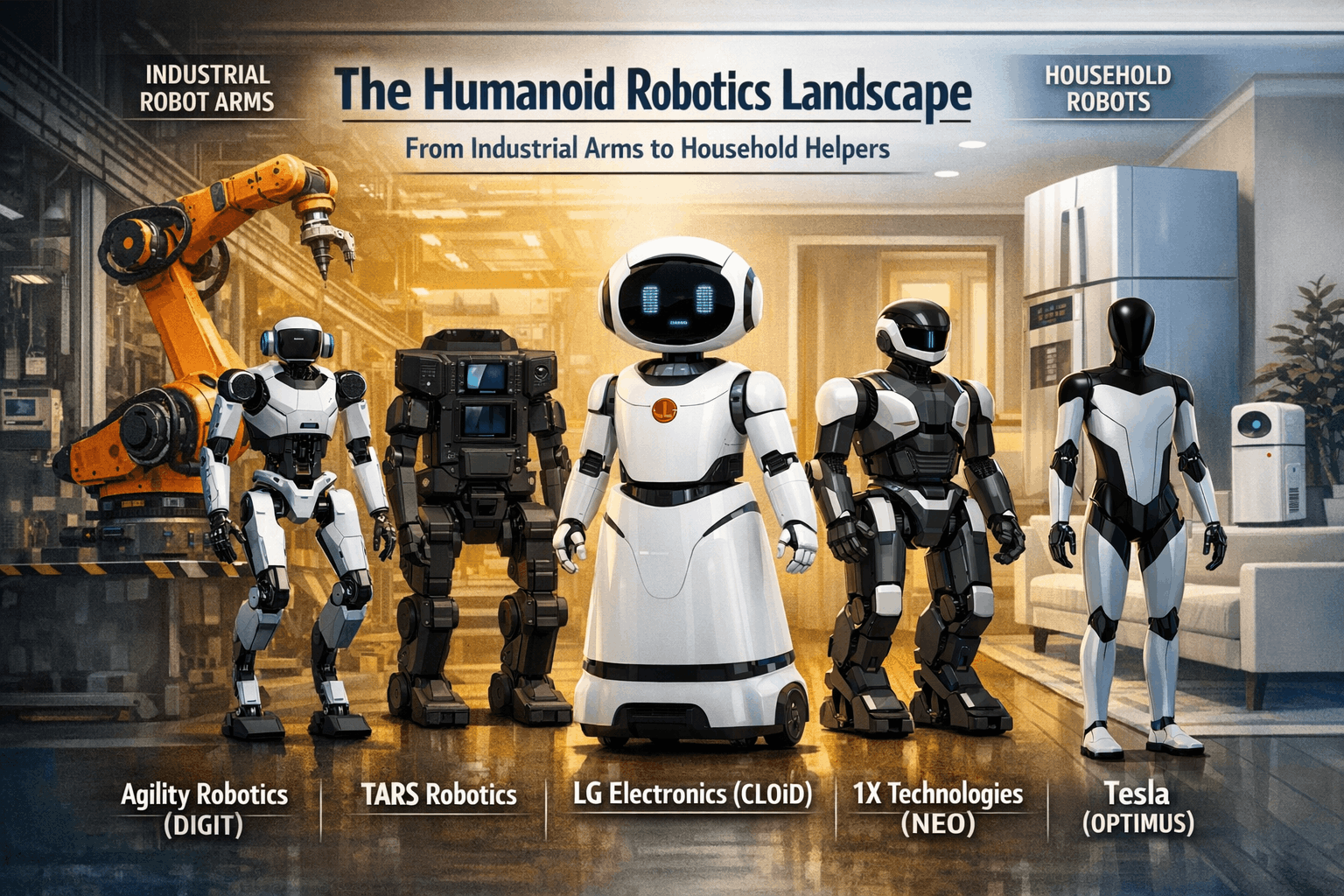
The Humanoid Robotics Landscape: From Industrial Arms to Household Helpers
Introduction
The emergence of practical Humanoid Robots marks a definitive shift in artificial intelligence from the digital to the physical world. Once confined to research labs and science fiction, the Humanoid Robot is now demonstrating real-world utility in warehouses, factories, and controlled domestic environments. This transition is driven by the convergence of advanced AI models, precision hardware, and a growing global need to address labour shortages.
As prototypes give way to commercial deployments, the Humanoid Robot sector is rapidly segmenting into specialized solutions for industrial automation and domestic assistance, each with distinct technical and economic constraints. The modern Humanoid Robot is therefore best understood not as a general-purpose intelligence, but as a task-focused physical system designed to operate within human-built spaces.
| Company/Robot | Primary Domain | Core Technological Focus | Key Differentiator/Proof Point | Stage & Commercial Context |
| Agility Robotics (Digit) | Industrial Logistics & Manufacturing | Fleet integration, safety, and industrial robustness. | First commercially deployed humanoid; moved 100k+ totes at a GXO warehouse. | In the market, deployed in customer facilities. |
| TARS Robotics | Precision Manufacturing & Flexible Automation | Ultra-fine dexterity and bimanual manipulation. | Demonstrated hand embroidery, requiring sub-millimeter precision. | Advanced prototype stage, showcasing breakthrough capabilities. |
| LG Electronics (CLOiD) | Domestic / Consumer Home | Ecosystem integration and “Physical AI” for unstructured home tasks. | Deep integration with the LG ThinQ smart home ecosystem for chore orchestration. | Unveiled at CES 2026, demonstrating functional home scenarios. |
| 1X Technologies (Neo) | Domestic / Consumer Home | Human-like interaction and mobility for personal assistance. | Marketed as a multi-modal home helper, it was among the first consumer-targeted humanoids announced. | Announced for 2026 release, priced at ~$20,000 USD. |
| Tesla (Optimus) | Aspirational General-Purpose | Leveraging Tesla’s AI, manufacturing, and sensor suite for scalability. | Part of a long-term strategic vision for AI and automation, backed by Tesla’s resources. | In development, with public demonstrations of specific tasks. |
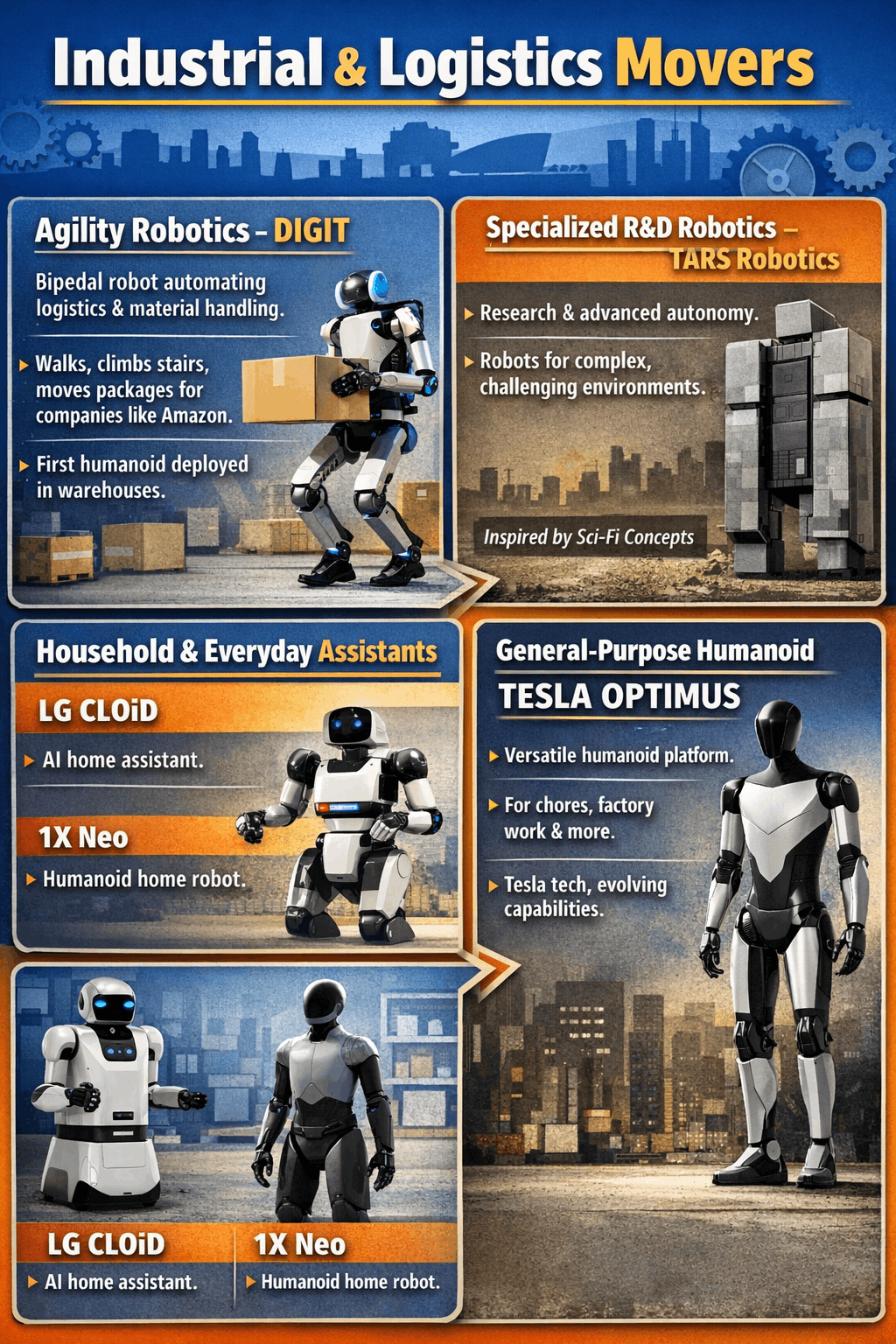
Industrial & Logistics Movers
Agility Robotics — Digit
-
Type: Bipedal humanoid robot designed for real‑world jobs.
-
Core mission: Automate logistics, warehousing & material handling.
-
Capabilities:
• Walks, climbs stairs, navigates dynamic environments.
• Picks up and moves packages/totes for companies like Amazon. -
Industrial impact: One of the first humanoids deployed commercially, reducing repetitive labor in warehouses.
Specialized R&D Robotics
TARS Robotics
(If you intended TARS Robotics as a conceptual/company category — this could refer to research or fiction‑inspired robotics rather than a single commercial product. If you want a specific company’s robot here, tell me and I can include details.)
Concept Role:
-
Bridges research & applied humanoids, often focused on robotics for complex environments and advanced autonomy.
-
Names like TARS often evoke robots designed for versatile interaction & perception tasks.
(Ask me for expanded detail on specific TARS Robotics products if available.)
Household & Everyday Assistants
LG Electronics — CLOiD
-
Type: AI‑powered home assistant robot.
-
Design: Wheeled base with articulated arms for multitasking.
-
Smart integration: Interfaces with LG’s ThinQ smart home ecosystem.
-
Example tasks: Laundry prep, appliance interaction, fetching objects.
-
Vision: “Zero Labor Home” — a robot that helps with everyday life.
1X Technologies — Neo
-
Type: Humanoid home robot designed for personal chores.
-
Purpose: Assist with daily tasks such as coffee, laundry, vacuuming.
-
Design signature: Soft, humanoid‑friendly appearance with simulated hands.
-
Status: Preorders active; aimed at consumer adoption (~$20 k range).
General‑Purpose Humanoid
Tesla — Optimus
-
Type: Broadly capable humanoid platform.
-
Vision: A “general‑purpose” robot for everyday chores, factory work, and more.
-
Tech roots: Built by Tesla leveraging automotive AI and sensor tech.
-
Features: Progressively improving hand dexterity and mobility.
-
Potential: Could scale production massively if adopted.
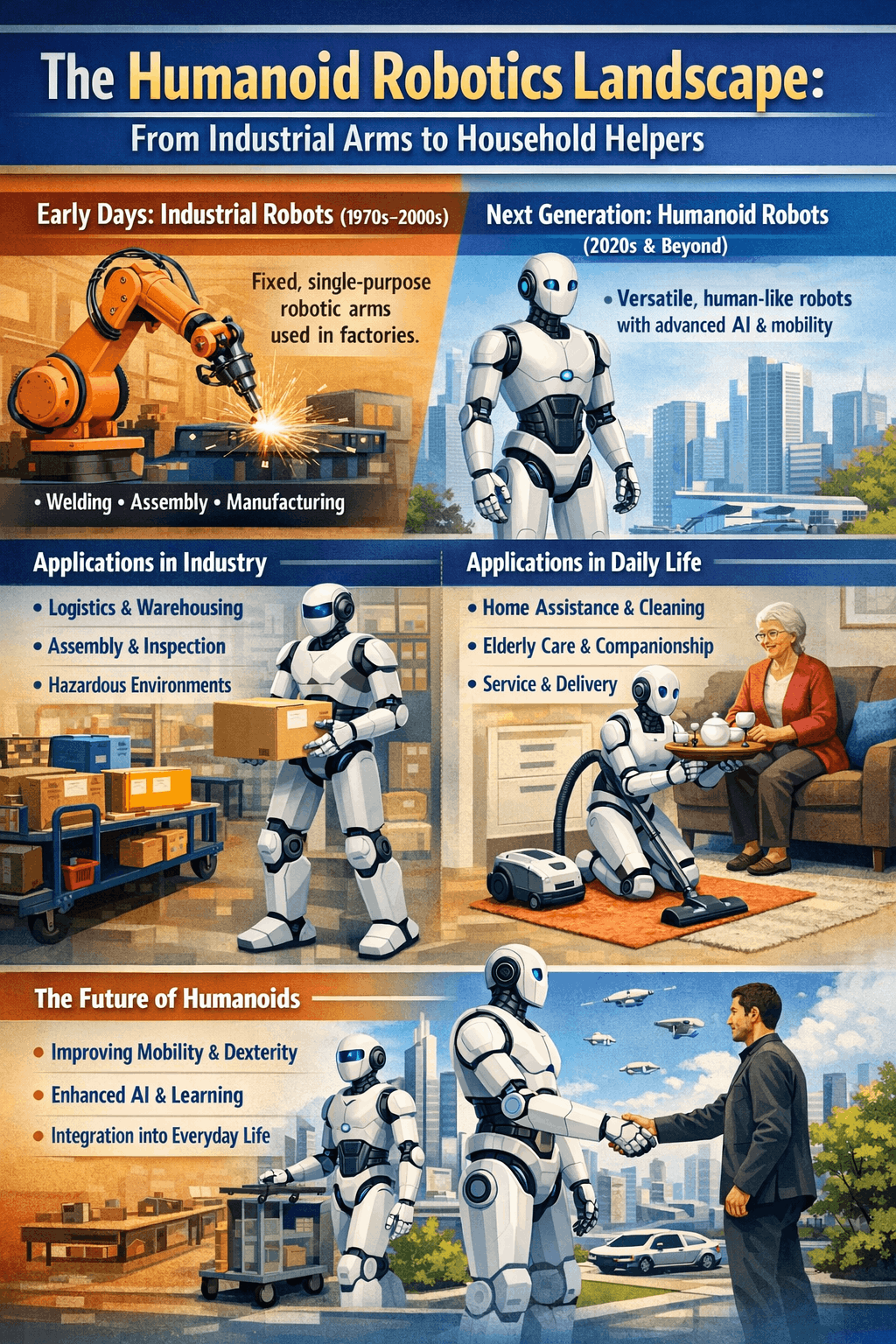
The Humanoid Robotics Landscape: From Industrial Arms to Household Helpers
The Industrial Imperative: Closing the Labor Gap with Dexterity and Integration
Industrial humanoids are engineered for reliability, safety, and seamless integration into existing workflows. Their value proposition is direct: augmenting human labor in environments plagued by shortages and performing repetitive, physically demanding tasks. Agility Robotics’ Digit exemplifies this, having transitioned from prototype to a proven warehouse asset. Its success hinges not just on bipedal mobility but on its cloud-based fleet management system (Agility Arc) and its ability to work cooperatively with other machines like Autonomous Mobile Robots (AMRs). This system integration is critical for achieving the high throughput and efficiency demanded by modern logistics.
The Dexterity Frontier: Mastering Fine Motor Skills for Complex Manufacturing
While some robots handle boxes, others are learning to thread needles. A significant automation bottleneck has been the inability of machines to manage flexible materials and perform long-sequence tasks requiring delicate force control. TARS Robotics addressed a long-standing limitation by demonstrating a humanoid robot performing hand embroidery. This feat of bimanual manipulation—coordinating both hands with sub-millimeter precision—is powered by a proprietary AI engine trained on vast real-world data. This capability unlocks new automation possibilities in electronics assembly, wire harnessing, and other precision industries where robot flexibility has been limited.
The Home Ecosystem: Orchestrating Domestic Life with “Physical AI”
The domestic environment is the ultimate unstructured challenge for a robot. Here, success depends less on raw speed and more on understanding context, user intent, and orchestrating multiple smart devices. LG’s CLOiD robot is designed as a mobile AI hub for the home, utilizing Vision-Language-Action (VLA) models to interpret scenes and translate commands into actions like loading a washing machine. Its effectiveness is amplified by deep integration into the LG ThinQ ecosystem, allowing it to command refrigerators, ovens, and other connected appliances. This approach treats the home as an integrated system to be managed, rather than a series of isolated chores.
The Safety and Security Mandate: Foundational for Scalable Adoption
As robots move closer to humans, safety transitions from a feature to a foundational requirement. Industrial leaders like Agility Robotics are implementing comprehensive suites of safety-rated components, including Category 1 safety stops, Safety PLCs, and hard-wired E-stops. Concurrently, the convergence of Information Technology (IT) and Operational Technology (OT) introduces complex cybersecurity risks. Ensuring the security of cloud-connected robot fleets and the sensitive sensor data they collect is paramount to prevent unauthorized access and build essential trust for widespread deployment.
The Strategic Visionaries: Building Platforms for a General-Purpose Future
Some players are betting on a longer-term, transformative impact. Tesla’s Optimus project leverages the company’s expertise in mass manufacturing, battery systems, and real-world AI training for autonomous vehicles. Elon Musk frames Optimus not merely as a product but as a pivotal step toward advanced artificial intelligence and a potential solution to global physical labor needs. Similarly, chipmakers like NVIDIA are positioning themselves as the “brain” providers for the industry, developing specialized AI platforms and models to accelerate robot learning and planning.
Overcoming the Last Hurdles: From Demo to Daily Driver
Despite rapid progress, significant hurdles remain before humanoids become ubiquitous. In the home, robots must safely navigate dynamic environments with children and pets, a challenge that current technology is still addressing. Cost is another major barrier, with early consumer models like the 1X Neo priced around $20,000. For industrial models, achieving and proving consistent human-level efficiency, reliability, and a positive return on investment against traditional automation is the critical path to scaling beyond pilot deployments.
Actionable Recommendations for Technology Strategists
- For Industrial Automation Leads: Prioritize vendors with proven real-world deployments and robust fleet management software. Evaluate how a humanoid solution integrates with your existing automation (WMS, MES, AMRs) rather than operating as an isolated island.
- For Product Developers in Smart Home Tech: Design for ecosystem integration from the start. Consider how future devices could be controlled or enhanced by an ambient physical AI, using open standards to ensure interoperability beyond any single brand’s walled garden.
- For All Stakeholders: Incorporate safety and security as primary design criteria, not afterthoughts. Engage early with evolving ISO standards for mobile robots and implement cybersecurity best practices for connected physical systems.
The Humanoid Robotics Landscape: From Industrial Arms to Household Helpers
Conclusion: A Disciplined March into the Physical World
The narrative around humanoid robots is maturing from speculative hype to disciplined engineering and market validation. The field is bifurcating into proven industrial tools that augment labor and ambitious consumer platforms that aim to redefine domestic life. Their ultimate success will not be determined by their ability to mimic human form, but by their tangible reliability, safety, and economic value. As the underlying AI, actuation, and integration technologies continue to advance, the coming years will be defined by scaled deployments that move beyond trade show demonstrations to become unremarkable, essential components of our working and living environments.
FAQs
What is the main advantage of a humanoid robot over other automation forms?
Their primary advantage is the ability to operate effectively in spaces and workflows already designed for humans, utilizing the same tools and navigating the same obstacles without requiring extensive and costly environmental redesign.
Are humanoid robots safe to work alongside people?
Leading industrial models are built with extensive safety features compliant with evolving machinery standards. However, safe co-existence in highly dynamic, unstructured environments like busy homes remains an active area of development and risk assessment.
When will affordable humanoid robots be available for consumers?
Early models are announced with prices in the tens of thousands of dollars, positioning them as premium products. Widespread consumer affordability at a scale comparable to major appliances is likely still several years and technological generations away.





Truly no matter if someone doesn’t know then its up to other users that they will assist, so here it occurs.