
Supersonic Power Is Solving the Energy Crisis Behind AI Infrastructure
Introduction
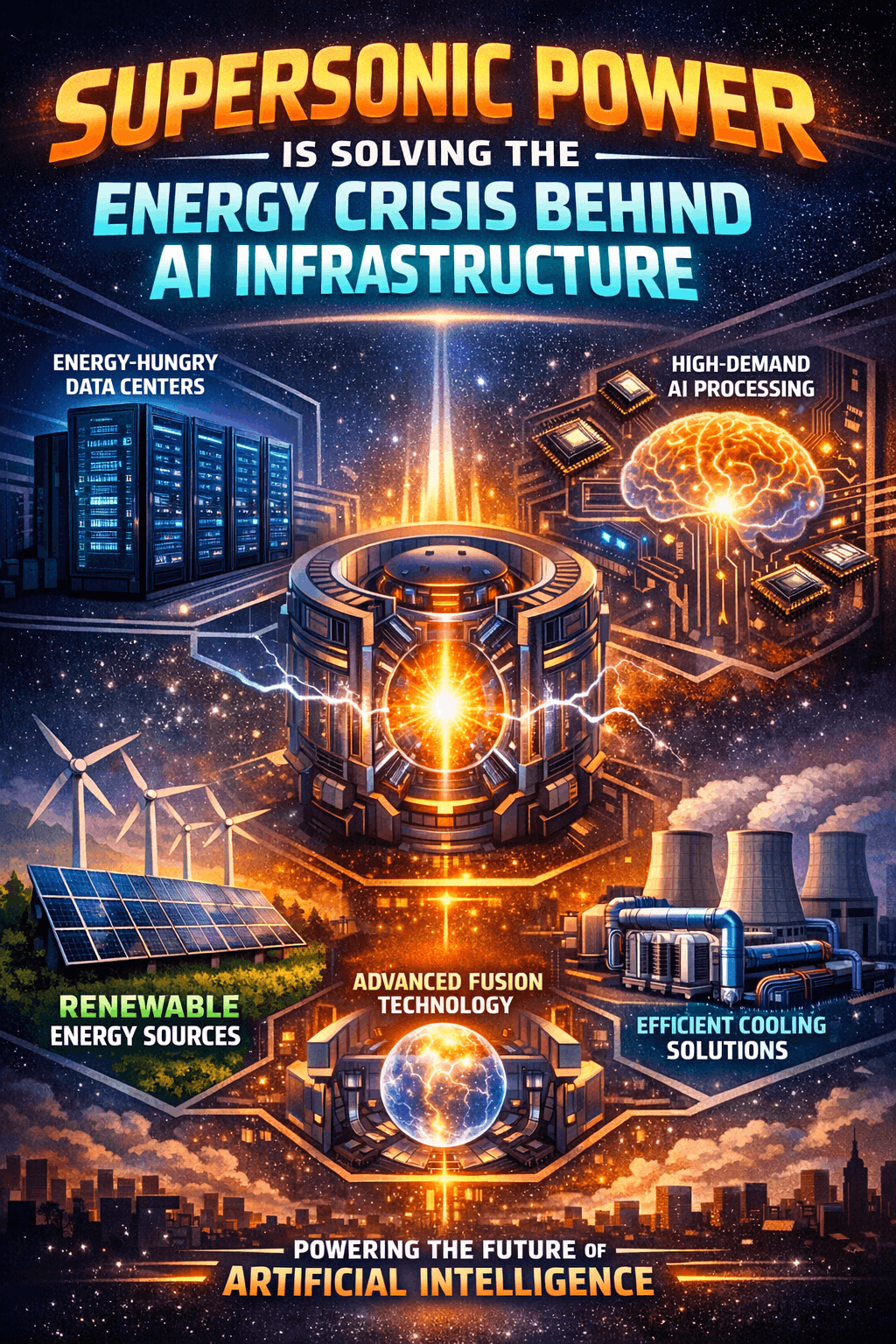
The unprecedented power demands of next-generation artificial intelligence are colliding with the physical and regulatory limitations of our electrical grids, creating a critical bottleneck for global AI infrastructure. In response, an unexpected technological crossover is accelerating the pace of deployment: Supersonic Power is being adapted for on-site energy generation, powering a new class of AI data centers. This strategic shift toward decentralized, purpose-built power is not just a trend but a fundamental re-engineering of how we supply the digital economy.
Simultaneously, governments like the UK are deploying comprehensive policy frameworks—AI Growth Zones—to systematically dismantle the barriers of grid access, planning delays, and energy costs. Together, policy reform and Supersonic Power are reshaping AI infrastructure, positioning Supersonic Power as a key driver of the next wave of AI growth.
Supersonic Power Is Solving the Energy Crisis Behind AI Infrastructure
The AI Energy Bottleneck: Grids at Capacity
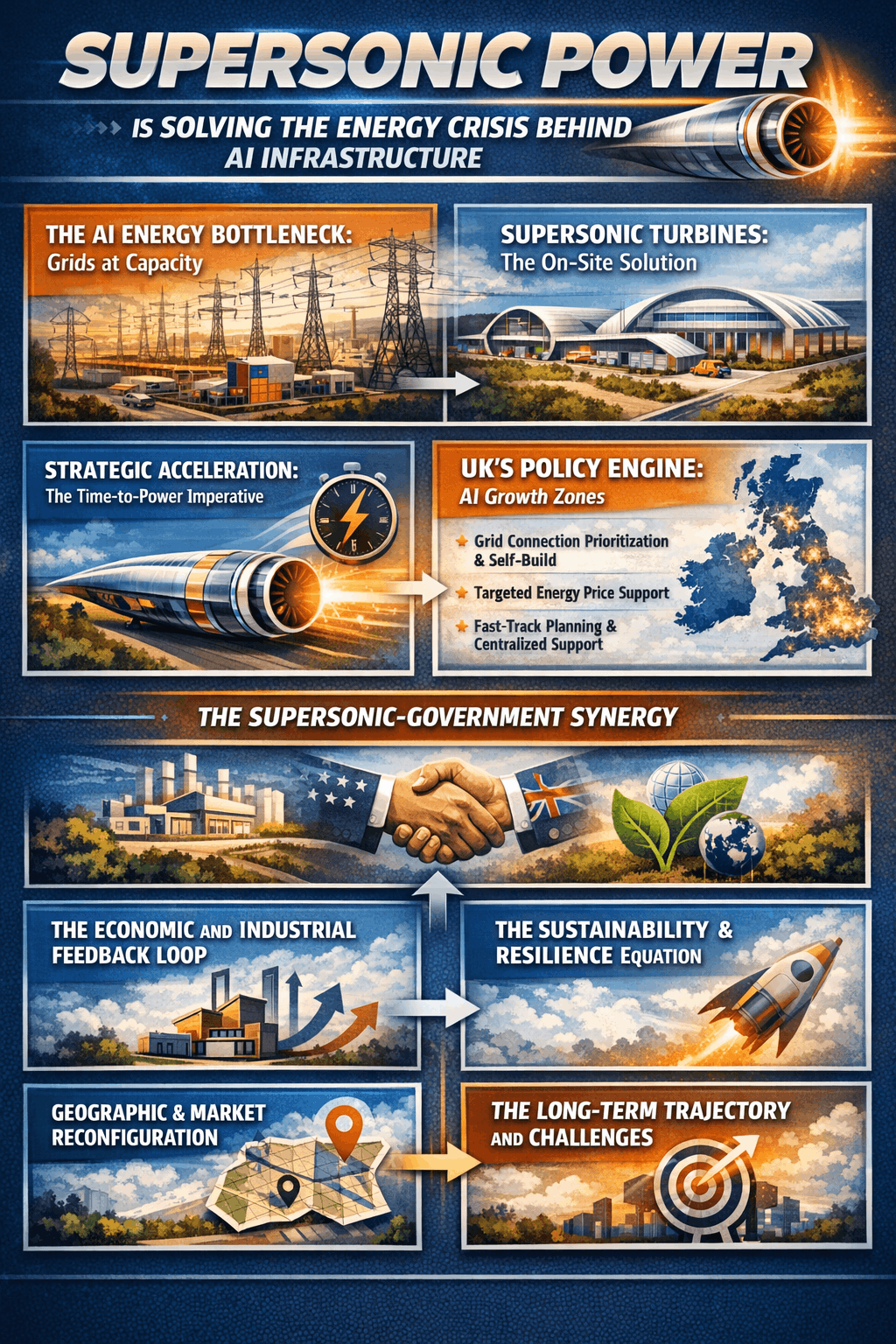
The primary constraint for new AI data center construction is no longer capital or chips, but power. Hyperscale AI facilities, packed with hundreds of thousands of power-intensive GPUs, can require over a gigawatt of electricity—comparable to the energy needs of a major city. Traditional grid infrastructure, built for a different era, cannot scale fast enough. In established markets like Northern Virginia, reserve grid capacity is projected to plummet to 1%, risking brownouts and causing a projected 11x increase in wholesale electricity prices by 2027. This has forced developers to migrate to new regions like West Texas, not for latency, but solely for access to available power and land.
Supersonic Turbines: The On-Site Solution
To bypass the congested grid, innovators are turning to decentralized generation. Boom Supersonic’s “Superpower” turbine exemplifies this shift. This 42 MW natural gas turbine is derived directly from the core technology developed for its supersonic Symphony jet engine. The engineering principles that allow an engine to operate at sustained high power under extreme thermal conditions in flight make it uniquely suited for ground-based, resilient power. It delivers its full-rated output in ambient temperatures exceeding 43°C and operates without process water, a critical advantage in hot, arid regions ideal for data center siting.
Strategic Acceleration: The Time-to-Power Imperative
For AI operators, the speed of deployment is a competitive advantage. Ordering a grid connection can mean a multi-year queue. On-site turbines like Superpower offer a radical reduction in “time-to-power,” enabling data centers to be built and energized in parallel with grid upgrades. Crusoe, an AI infrastructure leader, underscored this by becoming the launch customer for Superpower with a 1.21 GW order, directly citing its need to accelerate real-world performance and power availability. This approach transforms power from a public utility constraint into a managed, private asset.
UK’s Policy Engine: AI Growth Zones
While the US model emphasizes private on-site generation, the UK government is launching a coordinated public-policy offensive to clear infrastructure hurdles. Its AI Growth Zones (AIGZs) policy is a holistic package designed to attract over £100 billion in investment. The program’s three pillars target the most significant bottlenecks: accelerating grid connections by years, reducing energy costs by up to £80 million annually for a large data center, and streamlining a historically slow planning system. The goal is to create designated zones where AI infrastructure investment can proceed with speed and certainty.
Grid Connection Prioritization and Self-Build
The UK government identifies slow grid connections as the single biggest blocker for new AI infrastructure. Its solution is to prioritize AIGZs through new regulatory mechanisms. This includes a “reservation” mechanism to hold grid capacity for strategic projects and a “reallocation” mechanism allowing AIGZ projects to leapfrog the queue when other projects drop out. Furthermore, the government is exploring rules to let developers “self-build” their own high-voltage connection infrastructure instead of waiting for network operators, a radical step to accelerate time-to-power.
Targeted Energy Price Support
To incentivize build-out in areas that benefit the wider grid, the UK will offer direct energy bill discounts for data centers in AIGZs from 2027. By locating in regions like Scotland or northern England, data centers can utilize surplus renewable generation (e.g., wind power) that would otherwise be wasted due to grid constraints. This “constraint cost” recycling provides discounts of up to £24 per MWh in Scotland, turning a grid management problem into a financial incentive for strategic, sustainable siting.
Fast-Track Planning and Centralized Support
The UK’s planning system is being overhauled to favor AI infrastructure. Proposed reforms include revising the National Planning Policy Framework to give significant weight to AIGZs and introducing a new National Policy Statement for data centers, potentially with “Critical National Priority” status. A dedicated £4.5 million national team of planning experts will support local authorities, and a new cross-government AIGZ Delivery Unit will serve as a single point of contact for investors, aiming to create a consistent, pro-development environment.
The Supersonic-Government Synergy
The supersonic turbine and AIGZ models are complementary solutions to the same global problem. Boom’s Superpower represents the private-sector, technological path: deploying compact, resilient power units at the point of consumption. The UK’s AIGZs represent the public-sector, policy path: using state authority to rewire markets, regulations, and incentives. In practice, a future AI campus in a UK Growth Zone could utilize both: benefiting from prioritized grid connections and lower tariffs while also deploying on-site turbines for resilient baseload power, creating a hybrid model of ultimate reliability and speed.
The Economic and Industrial Feedback Loop
For Boom Supersonic, the Superpower turbine is more than a sideline; it’s a strategic vertical integration that funds and de-risks its core aerospace business. Revenue from turbine sales supports the development and certification of its Overture supersonic airliner. Simultaneously, operational data from thousands of hours of turbine use on the ground provides invaluable reliability insights for the flight engine. This creates a unique industrial feedback loop where ground-based energy generation accelerates the return of supersonic travel.
The Sustainability and Resilience Equation
Both approaches must navigate sustainability. Supersonic turbines currently run on natural gas, though they are designed for future compatibility with cleaner fuels like hydrogen. The UK’s AIGZ model encourages the use of surplus renewables. The future of sustainable AI compute likely lies in a hybrid architecture: a primary connection to a greening grid (accelerated by policy), supplemented by on-site generation for peak demand and backup, with both systems progressively transitioning to low-carbon fuels.
Geographic and Market Reconfiguration
The AI infrastructure boom is redrawing the global map. In the US, development is aggressively concentrating where power is available, moving beyond traditional connectivity hubs. In the UK, Scotland is emerging as a major hub due to its unparalleled access to wind and hydro power, attracting billion-pound investments from firms like CoreWeave. The AI data center is no longer just an IT facility; it is a massive industrial energy consumer whose location is now dictated first by energy logistics.
The Long-Term Trajectory and Challenges
The current trajectory points toward a landscape of sovereign “AI factories”—large-scale campuses engineered for high-density compute, integrated power, and liquid cooling. However, challenges persist. The industry exhibits signs of “circular investment,” where a small group of tech giants invest in each other, making true organic demand difficult to gauge. Furthermore, communities near these power-hungry facilities will increasingly grapple with the tangible impacts on local resources, from water usage to grid strain, requiring careful management and community benefit schemes embedded in projects.
Supersonic Power Is Solving the Energy Crisis Behind AI Infrastructure
Conclusion: A Converging Future of Speed and Sovereignty
The rise of supersonic AI data centers and national AI Growth Zones signals a pivotal moment. The era of treating power as an afterthought is over. The future belongs to integrated strategies where advanced engineering and proactive state policy converge to build the physical foundation of the AI economy. This is not merely about faster computing, but about achieving infrastructure sovereignty—the strategic control over the energy, land, and regulatory space required to remain competitive. The entities that master this integration, leveraging technological innovation like supersonic turbines within enabling policy frameworks, will not just participate in the AI revolution; they will power its core. To move forward, evaluate your next project not just on compute capacity, but on its power architecture and policy environment as the foundational determinants of success.
FAQs
What is the primary advantage of using supersonic-derived turbines for data centers?
The core advantage is their ability to provide full power output under extreme ambient heat without water cooling, enabling fast, flexible deployment in locations where grid power is constrained or unavailable.
How do UK AI Growth Zones reduce costs for data center operators?
They provide direct discounts on electricity bills by recycling grid “constraint cost” savings, offering up to £24/MWh off in Scotland, and can save a large facility up to £80 million annually.
Can the current AI data center construction boom be sustained?
While demand is high, sustainability depends on overcoming massive power grid bottlenecks and managing the “circular” investment patterns where a handful of large firms fund each other’s expansion.