Robotic Vacuum Cleaner: Smart Cleaning for Modern Homes
Introduction
The Robotic Vacuum Cleaner has evolved from a niche innovation into a fully established home appliance sector approaching full automation. What was once limited to simple automated cleaning has now transformed into an intelligent home maintenance solution capable of learning user habits, adapting to environments, and operating with minimal human involvement. This rapid evolution is driven by advancements in artificial intelligence, sensor integration, and expanding smart home technologies, enabling robotic vacuums to function as reliable domestic assistants rather than basic cleaning tools.
As global demand for convenience, efficiency, and healthier indoor spaces continues to rise, the Robotic Vacuum Cleaner—already valued in the tens of billions—remains on a strong growth trajectory, reflecting shifting consumer lifestyles and technological innovation. With increasing adoption worldwide, the Robotic Vacuum Cleaner is positioned at a critical turning point toward smarter, more autonomous household solutions.
Robotic Vacuum Cleaner: Smart Cleaning for Modern Homes
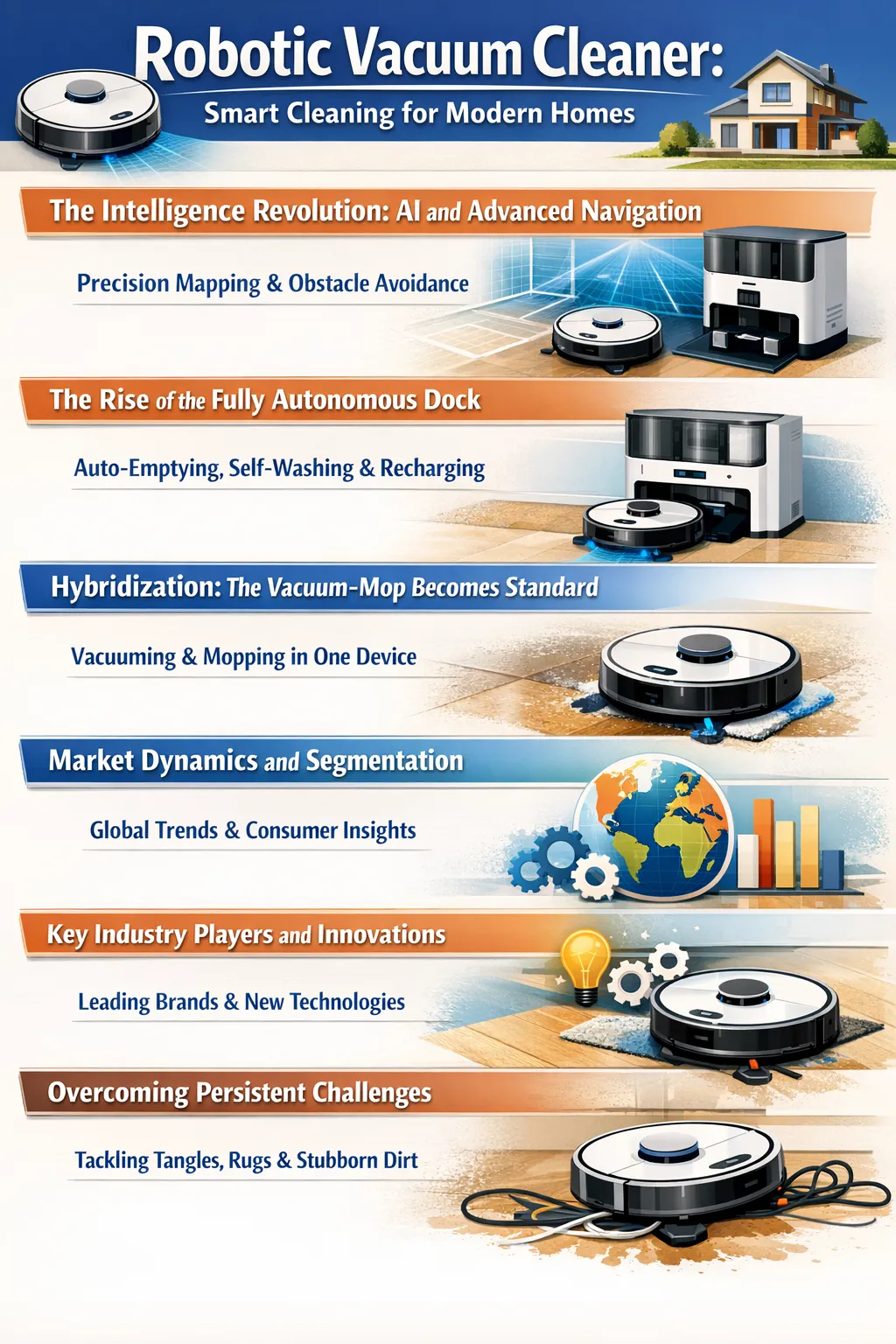
The Intelligence Revolution: AI and Advanced Navigation
The primary differentiator in the current generation of robotic vacuums is intelligent navigation, moving far beyond random bouncing. Modern units employ LiDAR (Light Detection and Ranging), 3D structured light, and high-definition cameras to create precise, real-time maps of the home.
- How It Works: These sensors scan the environment millions of times per second, building a digital floor plan. AI algorithms then process this data to identify permanent furniture, classify floor types (carpet vs. hard floor), and recognize and intelligently avoid transient obstacles like shoes, toys, or pet bowls.
- Why It Matters: This results in methodical, efficient cleaning paths with up to 95% coverage and a 65% reduction in collisions. For the user, it means the vacuum cleanly navigates complex spaces, avoids tangles with cords, and can be directed to clean specific rooms or zones via a smartphone app.
The Rise of the Fully Autonomous Dock
The promise of “hands-off” cleaning is finally being realized through next-generation docking stations. These are no longer simple charging ports but comprehensive maintenance hubs.
- How It Works: Advanced docks, such as those from Roborock, Dreame, and Ecovacs, perform a suite of automated tasks. They empty the robot’s dustbin into a sealed, high-capacity bag (often holding 60+ days of debris), automatically refill the robot’s water tank for mopping, wash and heat-dry the mop pads or rollers, and even clean the robot’s own sensors.
- Why It Matters: This automation reduces manual maintenance from a weekly chore to a monthly task of swapping a disposable dust bag. It directly addresses a key consumer barrier, making robotic vacuums a viable primary cleaning solution rather than a supplemental gadget.
Hybridization: The Vacuum-Mop Becomes Standard
The standalone robotic vacuum is giving way to the hybrid vacuum-and-mop as the dominant form factor. Nearly half of all new robotic vacuum shipments are hybrid models designed to tackle both dry debris and wet stains in a single cycle.
- How It Works: These robots house separate water tanks for clean and dirty water. They deploy rotating mop pads or rollers that scrub floors, often with adjustable pressure and, in premium models, even heated water for better stain removal. Crucially, advanced models feature “mop-lifting” technology, which automatically retracts the mop pad when transitioning to carpet to avoid getting it wet.
- Why It Matters: This integration provides a more comprehensive clean, particularly for homes with significant hard flooring. It consolidates two cleaning tasks into one automated process, offering greater value and convenience.
Market Dynamics and Segmentation
The global robotic vacuum cleaner market is characterized by explosive growth, regional leaders, and clear segmentation by price and capability.
- Explosive Growth: The market is projected to grow from approximately $11.97 billion in 2021 to over $50 billion by 2028, at a compound annual growth rate (CAGR) of over 27%. By 2034, it is forecast to reach nearly $30 billion, driven by urbanization and smart home adoption.
- Regional Leaders: The Asia-Pacific region, led by China’s manufacturing prowess and high consumer adoption, dominates the market with over 43% of global unit deployments. North America and Europe follow, with strong demand in tech-savvy and time-constrained households.
- Price Segmentation: The market neatly segments into tiers. Entry-level models (under $150) offer basic, random navigation for small spaces. The core mass market ($150-$500) features improved navigation and suction. The premium segment (above $500) is where flagship AI, advanced mopping, and full self-emptying docks are found.
Key Industry Players and Innovations
The competitive landscape features established pioneers and agile innovators. iRobot (Roomba) remains a household name with deep brand recognition, while ECOVACS (Deebot) holds a commanding presence, particularly in Asia. Brands like Roborock, Dreame, and Eufy are driving innovation with cutting-edge features at competitive prices, often introducing advancements like roller mop systems and superior obstacle avoidance.
Leading brands use major tech showcases like CES to unveil the future. At CES, trends included robots with extendable arms for corner cleaning, stair-climbing concepts, and a focus on “whole-home robotics” that integrate floor cleaning with broader home automation tasks.
Overcoming Persistent Challenges
Despite the progress, the industry faces hurdles to universal adoption.
- High Initial Cost: Premium models with full autonomy represent a significant investment, which can deter first-time buyers or those in budget-conscious segments.
- Performance on Complex Surfaces: While excellent on hard floors and low-pile carpets, performance can still be inconsistent on very thick carpets, high-pile rugs, or across high (over 20mm) thresholds between rooms.
- Software and Reliability: Navigation errors, firmware bugs, and Wi-Fi connectivity issues can undermine user trust. A notable percentage of returns are attributed to mapping inaccuracies or performance that doesn’t meet expectations for full autonomy.
Robotic Vacuum Cleaner: Smart Cleaning for Modern Homes
The Future Trajectory and Strategic Recommendations
The trajectory for robotic vacuum cleaners is toward becoming unseen, infrastructural home appliances. Future developments will focus on quieter operation, deeper integration with smart home platforms (like the Matter protocol), and predictive cleaning based on household routines.
For consumers evaluating options in this dynamic market, the key is to align features with specific needs. Consider these questions:
- Does your home have mostly hard floors, demanding an excellent hybrid mopping system?
- Do you have pets, requiring powerful suction and superior anti-tangle brush rolls?
- Is minimizing your own interaction the top priority, justifying investment in a model with a fully automated self-emptying and self-cleaning dock?
For most households seeking a true “set and forget” experience, prioritizing a model with LiDAR-based navigation, a self-emptying dock, and hybrid mopping capabilities will deliver the greatest satisfaction and long-term value, effectively making the robotic vacuum cleaner a core, autonomous component of the modern home.
Frequently Asked Questions (FAQs)
What is the biggest difference between cheap and expensive robotic vacuums?
The core difference is intelligence. Expensive models use LiDAR or cameras for systematic, map-based navigation and avoid obstacles, while cheap models often use random, bump-and-turn navigation, leading to less efficient cleaning.
Can robotic vacuums truly clean multiple rooms?
Yes, advanced models with multi-floor mapping can save maps for different levels of your home. They will clean one floor, return to their dock, and you can manually place them on another floor to clean using the saved map for that area.
Are robotic vacuums worth it for homes with pets?
Absolutely, and they are a major market driver. Look for models with “anti-tangle” brush rolls designed to avoid hair wrap, strong suction power (over 2,500 Pa), and high-quality HEPA filtration to capture dander and allergens.