Optimizing Content Using AI: A Strategist’s Guide
Introduction
The digital landscape has irrevocably shifted. To truly Optimizing Content Using AI today is to go far beyond simple keyword placement; it is to architect your entire content ecosystem to be intelligible, authoritative, and indispensable to both human readers and the advanced language models powering modern search. This evolution demands a fundamental reframing: we are no longer just writing for readers or search engine crawlers, but for AI systems that parse, evaluate, and assemble content into direct answers.
Therefore, the only sustainable strategy is to Optimizing Content Using AI as a tool to build unassailable topical authority—becoming the comprehensive, expert source these systems learn to trust and cite first. This guide about Optimizing Content Using AI provides the concrete, integrated framework to do exactly that, ensuring your work is not just seen but systematically selected as the definitive resource in your field.
Optimizing Content Using AI: A Strategist’s Guide
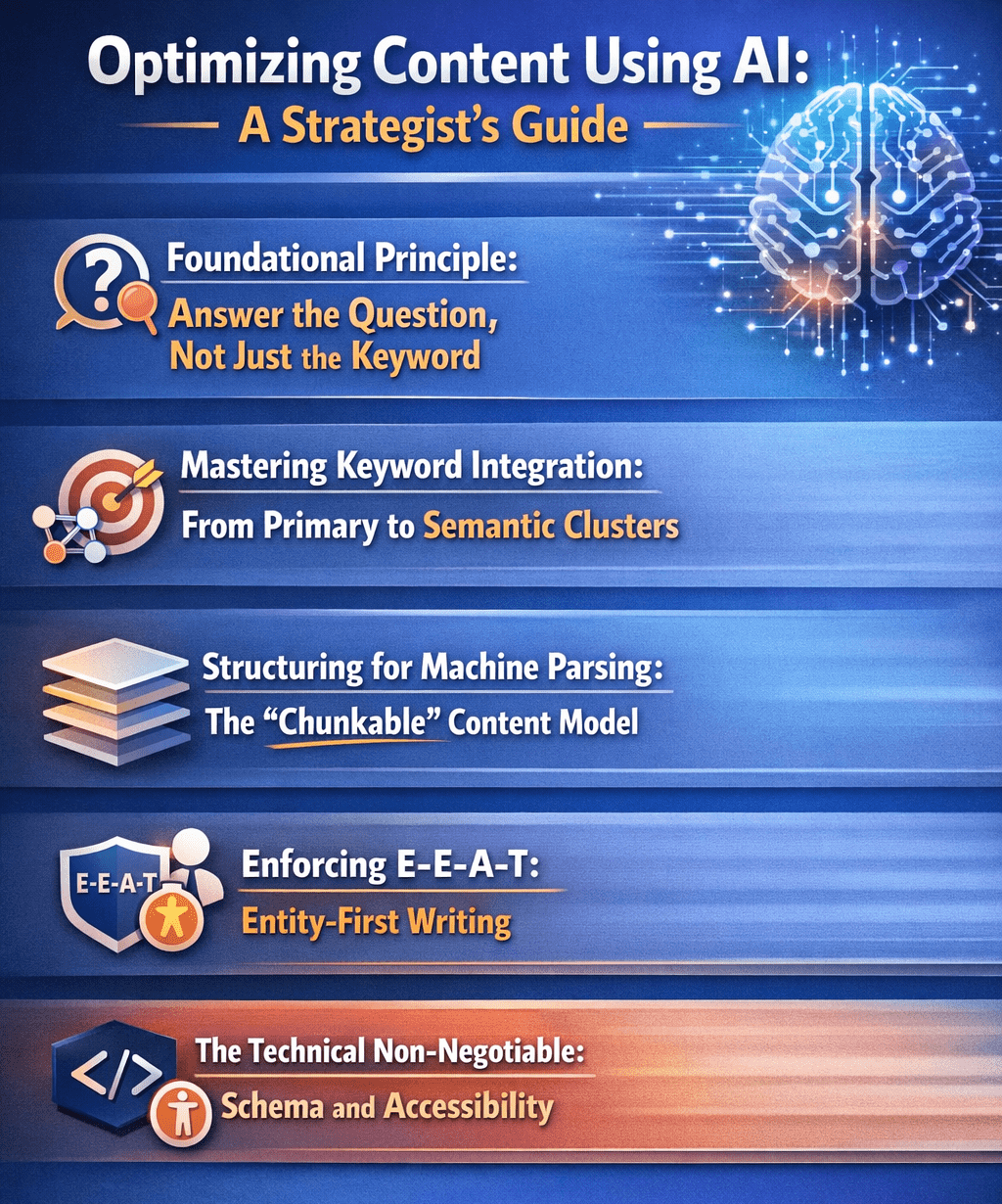
Foundational Principle: Answer the Question, Not Just the Keyword
AI systems are designed to satisfy user intent with direct, comprehensive answers. They parse content to find clear solutions to specific queries, favoring pages that lead with clarity and cover a topic thoroughly.
- Mechanism: Instead of scattering your primary keyword, structure your article to directly answer the core user question within the first 100 words. This “inverted pyramid” approach aligns with how AI extracts and summarizes information.
- Impact: Content that quickly provides a satisfying answer is more likely to be selected for AI-generated summaries (like Google’s AI Overviews) and featured snippets, increasing brand visibility even in zero-click search environments.
- Implied Outcome: For our focus, an article titled “How to Optimize Content Using AI” should open by defining the practice as using AI tools and strategies to enhance content’s visibility in AI-driven search results, immediately addressing the core informational intent.
Mastering Keyword Integration: From Primary to Semantic Clusters
Keyword strategy has evolved from single-phrase repetition to building a semantic field of related concepts. Based on analysis of top-ranking pages, here is the keyword framework you must integrate:
| Keyword Type | Target Keywords (Based on SERP Analysis) | Integration Strategy |
| Primary / Focus | how to optimize content using AI | Use naturally in the title, introduction, and 1-2 H2 headings. |
| Secondary (Core Topics) | AI content optimization, optimization for AI search, generative engine optimization (GEO) | These are core supporting concepts. Use them to introduce major sections of your article. |
| Secondary (Technical Methods) | schema markup for AI, NLP for SEO, structured data | Integrate when explaining technical implementation. They signal depth to AI systems. |
| LSI / Semantic Phrases | AI Overviews, answer engine optimization (AEO), entity SEO, machine readability, featured snippets, conversational queries, topical authority | Weave these naturally throughout the body to provide context and demonstrate comprehensive coverage without forcing the primary keyword. |
Structuring for Machine Parsing: The “Chunkable” Content Model
AI assistants do not read pages linearly; they break them into modular pieces—a process called parsing—and evaluate each chunk for relevance. Your structure must facilitate this.
- Mechanism: Use a clear, descriptive heading hierarchy (H1 > H2 > H3). Treat each H2 section as a self-contained “chapter” that answers one specific sub-question. Employ bulleted lists, numbered steps, and tables to present information in easily extractable formats.
- Impact: This modular structure makes your content “snippable.” AI can confidently lift a clear answer from a Q&A block, a step from a list, or data from a table to construct its response, directly citing your page.
- Implied Outcome: A section with an H2 like “How Does Schema Markup Help AI Understand Content?” followed by a concise definition and a simple bullet list of schema types is perfectly optimized for parsing.
Enforcing E-E-A-T with Entity-First Writing
Trust is paramount. AI systems are trained to identify and prioritize content demonstrating Experience, Expertise, Authoritativeness, and Trustworthiness (E-E-A-T).
- Mechanism: Adopt an entity-first approach. Clearly define the primary entity (e.g., “AI content optimization”) early. Consistently reference and link supporting entities (e.g., “schema markup,” “natural language processing (NLP),” and “user intent”) throughout the content.
- Impact: This reinforces topical authority and semantic relationships. It helps search engines map your content as a central, authoritative node within a knowledge graph, making it a go-to source for AI answers on the subject.
- Implied Outcome: An article that accurately references specific AI search features (like Google’s AI Overviews or Bing’s Copilot), explains technical terms correctly, and provides actionable advice establishes the author’s expertise algorithmically.
The Technical Non-Negotiable: Schema and Accessibility
The most insightful content is worthless if AI cannot access or interpret it. Technical SEO forms the critical foundation.
- Mechanism: Implement schema markup (JSON-LD format) to explicitly label your content type (e.g., Article, FAQ, How To). Ensure all key content is in plain HTML, not hidden behind JavaScript tabs or accordions, and that your site meets core technical requirements for crawling and indexing.
- Impact: Schema markup acts as a high-confidence signal, telling AI exactly what your content is about and increasing its eligibility for rich results and AI summaries. Accessible HTML ensures nothing is left on the table during parsing.
- Implied Outcome: A guide on AI optimization that includes a correctly marked-up FAQ section is more likely to have those specific answers surfaced in a search result.
Measuring Success in the AI Ecosystem
Traditional rankings are an incomplete metric. With AI Overviews providing answers directly, a page may receive significant visibility without a click.
- Mechanism: Shift your focus to new key performance indicators. Use Google Search Console to track impressions for target queries—a surge indicates AI is referencing your page. Monitor branded search volume, which can increase as your authority grows. Most importantly, track engagement metrics; traffic from AI referrals often converts at a higher rate, indicating qualified reach.
- Impact: This reframes success from “position #1” to “recognized authority.” It allows you to measure the true value of being a source for AI systems.
- Implied Outcome: An article may hold a steady position at #3 but see a 200% increase in branded searches and longer average session durations, proving its effectiveness as an authority-building asset.
Optimizing Content Using AI: A Strategist’s Guide
Conclusion
Optimizing content using AI is not about manipulating a new algorithm; it is about elevating the precision, structure, and authority of your work to meet the standards of intelligent systems. It requires a synthesis of strategic keyword integration, machine-friendly formatting, and unwavering technical rigor. The outcome is content that functions as a primary source in the information ecosystem, driving visibility and trust whether accessed via a traditional link or woven into an AI-generated answer. Begin by auditing your top-performing pages against this framework, identifying one key piece to restructure, and measuring the shift in authority-based metrics.
FAQs
What is the most important first step in AI content optimization?
Conduct deep research to understand the specific, conversational questions your audience asks AI tools, and then structure your content to answer those questions directly and clearly.
Can I use AI to write content and still rank well?
Yes, but the output must be heavily edited for originality, depth, and human expertise. AI-generated drafts often lack the unique perspective and trust signals that both readers and search algorithms require.
Does optimizing for AI hurt my traditional SEO?
No, it enhances it. The principles of clarity, structure, and authority satisfy both AI systems and traditional search algorithms, creating a more resilient and future-proof content asset.