Neuromorphic Chips: An Expert Overview
Introduction
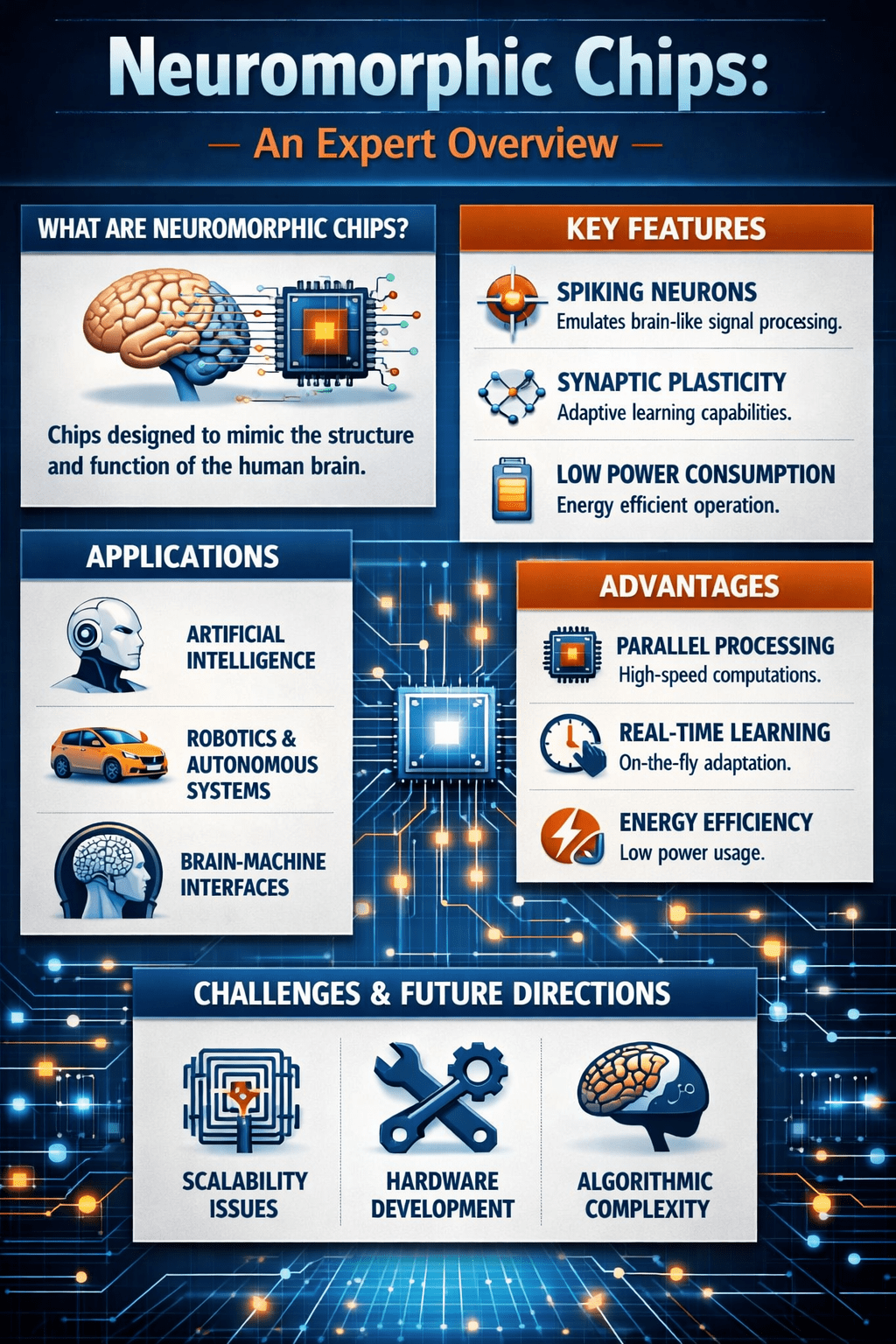
Neuromorphic Chips (Brain-Inspired Computing) are specialized processors designed to resemble the structure and function of the human brain. In contrast to traditional processors, which follow rigid, sequential instruction execution, Neuromorphic Chips operate using event‑driven, parallel processing, making them exceptionally energy‑efficient and responsive. This human brain‑inspired computing approach is rapidly emerging as a key technology for real‑time AI, edge intelligence, and low‑power cognitive systems.
Understanding Neuromorphic Chips is essential for engineers, researchers, and decision‑makers aiming to deploy next‑generation computing that performs complex tasks with minimal energy. As demand for energy‑efficient, adaptive systems grows, neuromorphic designs are influencing AI hardware, sensory computing, and future cognitive applications.
What Is Neuromorphic Computing?
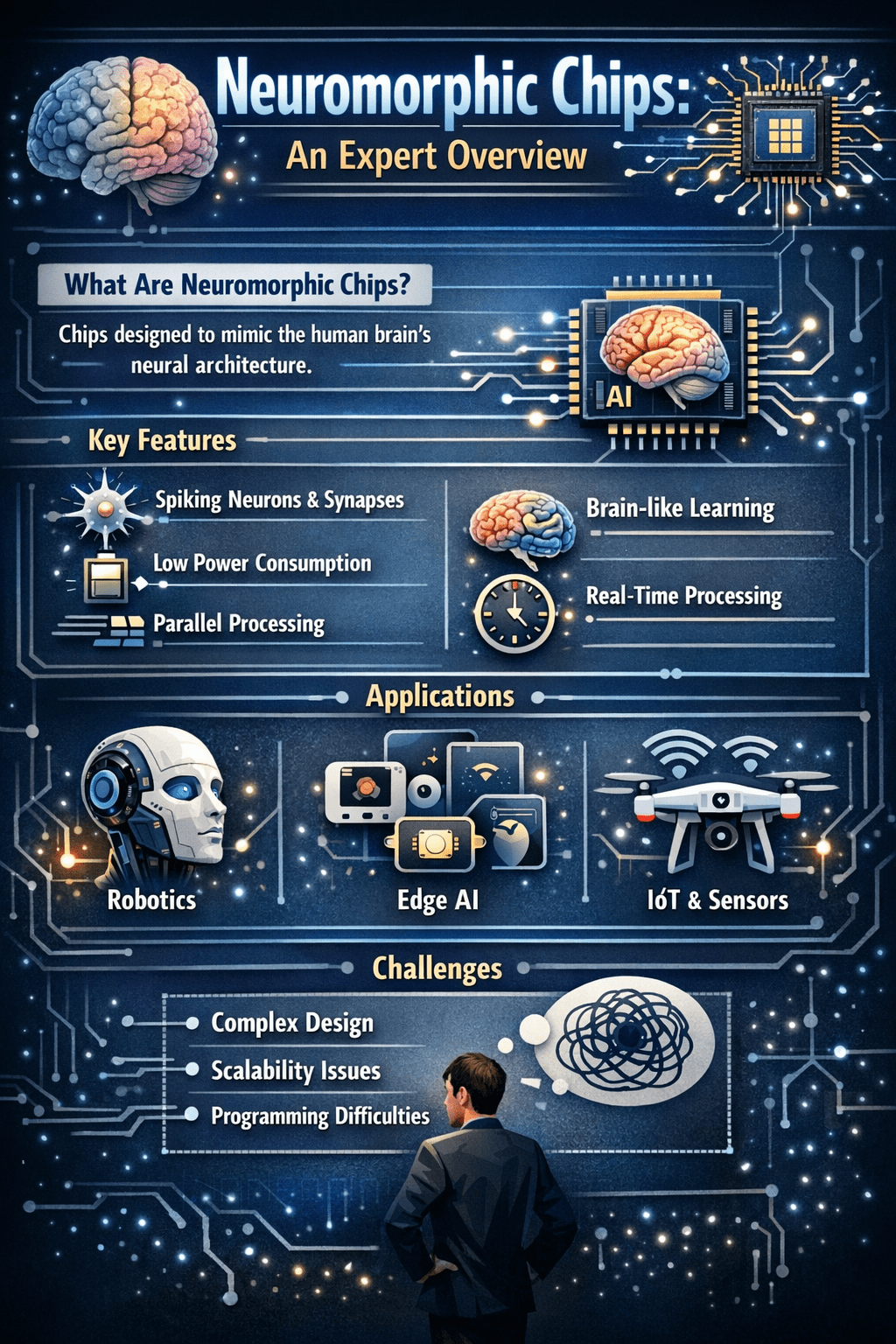
Neuromorphic computing applies artificial spiking neural networks (SNNs)—models that mimic how biological neurons communicate with discrete spikes of activity—to hardware systems. Instead of processing continuous streams of data like GPUs or CPUs, neuromorphic systems compute only when signals (“spikes”) occur, conserving energy and mimicking biological temporal dynamics. This key mechanism enables real‑time, low‑latency responses ideal for robotics, autonomous navigation, and adaptive sensing.
Spiking neurons and synaptic plasticity mechanisms, such as spike‑timing dependent plasticity (STDP), allow on‑chip learning and dynamic adaptation without constant retraining on external servers, making neuromorphic chips ideal for edge computing applications with limited power budgets.
How Neuromorphic Chips Work
Brain‑Inspired Architecture
At their core, neuromorphic chips integrate artificial neurons and synapses into hardware that processes, stores, and adapts information similarly to the human brain. Unlike the traditional von Neumann architecture, which separates memory and processing, neuromorphic systems place them together, reducing data transfer delays and energy consumption. This enables asynchronous event‑driven processing, where computation occurs only when needed.
Spiking Neural Networks
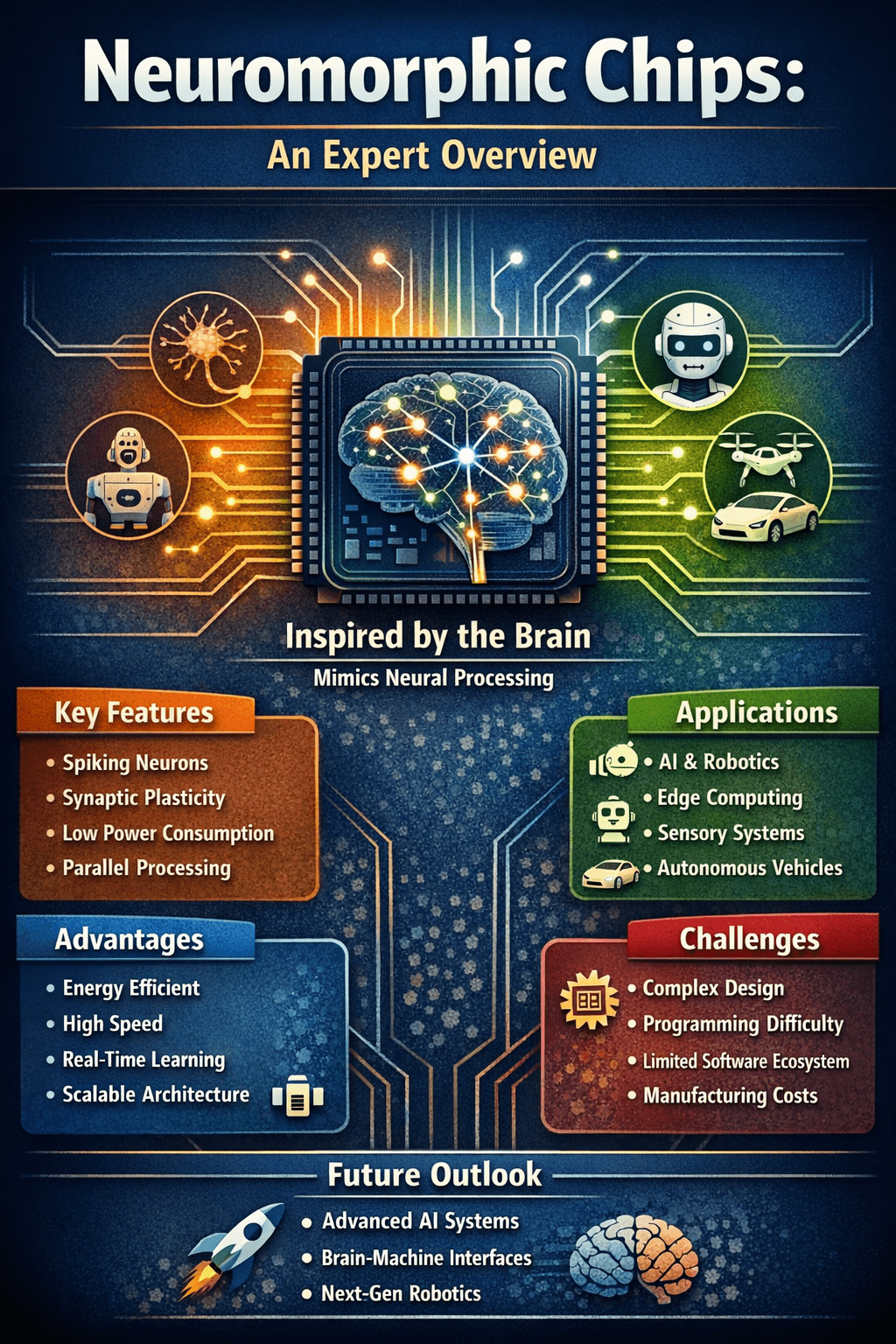
Spiking neural networks are the computational foundation of neuromorphic computing. They communicate using spikes—discrete pulses that resemble biological neural firing—allowing temporal encoding of information, lower latency, and energy efficiency up to orders of magnitude higher than conventional systems.
Neuromorphic Chips: An Expert Overview
Major Neuromorphic Components and Entities
Artificial Neurons and Synapses
Artificial neurons simulate the firing behavior of biological neurons, while synthetic synapses adjust connection strength through learning rules like STDP. Together, they enable adaptation, pattern recognition, and temporal processing on the device.
Neuromorphic Chip Platforms
Key implementations include:
-
Intel Loihi series—supports on‑chip learning with millions of artificial neurons.
-
IBM TrueNorth / NorthPole—energy‑efficient event‑driven processors optimized for inference.
-
SpiNNaker architecture—a massive parallel spiking network system for large‑scale simulations.
-
BrainChip Akida—a commercial edge neuromorphic processor.
These platforms demonstrate the spectrum from research prototypes to commercial products.
Neuromorphic Chips: An Expert Overview
Applications Across Industries
Edge Intelligence and IoT
Neuromorphic chips are transforming edge computing by enabling always‑on, low‑power processing for smart sensors, wearables, and autonomous devices. Applications include anomaly detection, sensory signal processing, and adaptive control systems.
Robotics and Autonomous Systems
In robotics, neuromorphic processors provide ultra‑fast, energy‑efficient sensory interpretation and reaction times, allowing robots to navigate dynamic environments in real time.
Pattern Recognition and Cognitive Computing
Neuromorphic systems excel at tasks such as audio recognition, gesture detection, and temporal pattern learning without relying on power‑intensive computation typical of deep learning models.
Advantages Over Traditional AI Hardware
Neuromorphic chips inherently integrate processing and memory, eliminating the memory bottleneck found in CPUs/GPUs. This enables:
-
10× to 1000× energy efficiency improvements compared with conventional architectures.
-
Real‑time adaptive learning on the device without retraining.
-
Scalability through parallel event processing, making them suitable for large, complex workloads.
Challenges and Future Directions
Despite growth, neuromorphic computing faces challenges:
-
Training complexity of spiking networks remains more difficult than deep learning models.
-
Hardware standardization and integration with existing AI toolchains are ongoing hurdles.
-
Continued research aims to combine neuromorphic computing with photonic and analog devices to further enhance efficiency and performance.
Neuromorphic Chips: An Expert Overview
Neuromorphic Chip Research by Country & Region
| Region | Country | Focus/Key Initiatives |
|---|---|---|
| North America | United States | DARPA programs, IBM TrueNorth, Intel Loihi, Corporate R&D |
| Canada | Academic research, Industry neuromorphic sensors, Edge AI | |
| Mexico | Emerging pilot programs, Smart devices, Industrial systems | |
| Europe | Germany | University research, Government funding for neuromorphic hardware |
| United Kingdom | Academic and industry neuromorphic projects | |
| France | Research in brain-inspired architectures | |
| Netherlands | Startups and academic labs | |
| Switzerland | ETH Zurich, Institute for Neuroinformatics, Commercial startups | |
| Spain | Academic and industrial innovation | |
| Italy | Research collaborations in neuromorphic computing | |
| Sweden | University and industry neuromorphic initiatives | |
| Asia-Pacific | China | State-led funding, National AI strategy, Large-scale neuromorphic research centers |
| Japan | Robotics integration, Sensor networks, Industrial applications | |
| South Korea | Semiconductor industry, Automotive neuromorphic systems | |
| India | Emerging initiatives, AI, and smart infrastructure | |
| Singapore | Government and research-backed projects | |
| Latin America | Brazil | Leading neuromorphic AI projects in South America |
| Argentina | Academic and industry adoption initiatives | |
| Middle East & Africa | UAE | Smart-city and government neuromorphic projects |
| Saudi Arabia | Government AI applications and research | |
| Israel | Defense and security neuromorphic programs | |
| South Africa | Academic and industrial pilot programs | |
| Egypt | Emerging academic and industrial research |
Conclusion
Neuromorphic chips and human brain‑inspired computing offer a realistic path toward energy‑efficient, adaptive computing that mirrors biological intelligence. By combining parallel, event‑driven processing with on‑chip learning, these systems redefine how complex computation can be achieved in resource‑constrained environments. As research accelerates and hardware matures, neuromorphic computing is poised to shape the future of AI, edge intelligence, and cognitive systems across industries.
FAQ
How do neuromorphic chips differ from conventional AI hardware?
They mimic brain-like event-driven processing, integrating memory and computing to reduce energy use and improve real-time responsiveness.
Where are neuromorphic chips used today?
They are applied in robotics, edge sensors, and adaptive sensory processing systems where energy and latency are critical.
Why are spiking neural networks important?
Because they encode temporal information efficiently and power only when events occur, enabling real‑time, low‑power computation.