Metaverse 2.0: The Next Evolution of Digital Worlds
Introduction
Metaverse 2.0 represents the next phase of digital environments, shifting beyond early gaming‑focused virtual worlds toward interconnected, AI‑driven experiences that support work, commerce, education, healthcare, and complex social interaction. This evolution brings hyper-realistic graphics, photorealistic avatars, and enterprise‑grade digital twins that blur the lines between physical and digital realities. By focusing on utility, interoperability, and real‑world integration, Metaverse 2.0 is becoming an essential layer of digital life. Metaverse 2.0 transforms entertainment-focused virtual spaces into AI-powered, interoperable ecosystems for work, learning, simulation, and commerce.
What Is Metaverse 2.0?
Metaverse 2.0 is the next stage of digital environments where virtual spaces are interconnected, AI-driven, and designed for real-world use. Unlike early metaverse platforms that focused mainly on entertainment, Metaverse 2.0 supports practical applications such as collaboration, training, simulation, and digital modeling across multiple devices and platforms.
Metaverse 2.0: The Next Evolution of Digital Worlds
Key Differences Metaverse 2.0 vs. Metaverse 1.0
| Feature | Metaverse 1.0 | Metaverse 2.0 |
|---|---|---|
| World Dynamics | Static environments | Evolving, adaptive worlds |
| Focus | Gaming and entertainment | Enterprise, education, commerce |
| Graphics | Basic, blocky | High-fidelity, photorealistic |
| AI Usage | Minimal | Core engine driving content and behavior |
| Economy | Limited digital assets | Robust NFT-based and integrated economy |
| Interoperability | Siloed platforms | Seamless cross-platform interactions |
Characteristic of Metaverse 2.0
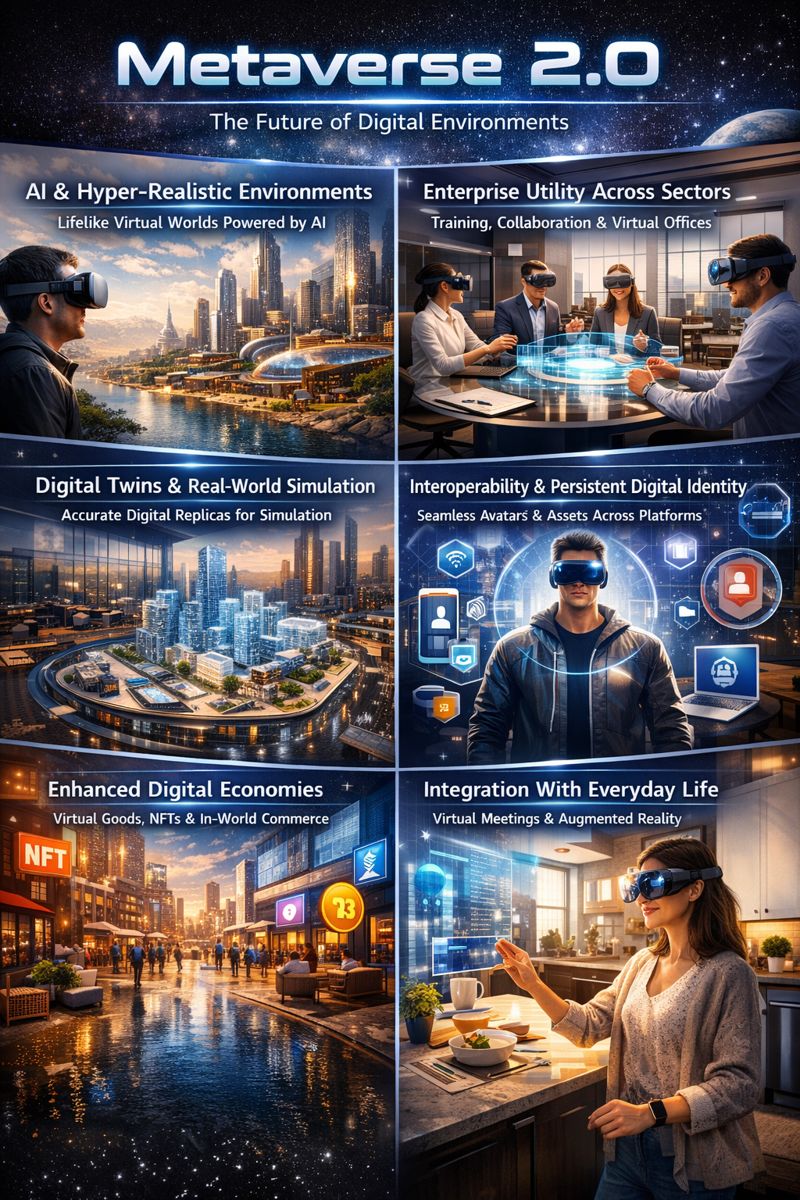
AI and Hyper‑Realistic Environments
At the core of Metaverse 2.0 is AI‑powered generation of environments and content. Advanced 3D rendering techniques and generative models create richly detailed virtual spaces that approach the fidelity of real life. AI also constructs intelligent agents and adaptive experiences, enabling environments to evolve dynamically based on user behavior. Hyper‑realistic visuals and real‑time interactivity make virtual worlds feel tangible and engaging.
Impact: Users experience digital environments that look and behave like physical spaces, increasing immersion and effectiveness for training, collaboration, and simulation.
Enterprise Utility Across Sectors
Metaverse 2.0 is grounded in real‑world application, with enterprise use cases rapidly expanding:
-
Remote collaboration and virtual offices that feel more natural than traditional video meetings.
-
Immersive education and training where students practice complex skills in safe, simulated environments.
-
Virtual showrooms and product demos that replace costly physical prototypes.
-
Healthcare consultations and wellness experiences that reach patients regardless of location.
These applications extend beyond entertainment into tools that drive productivity, learning, and customer engagement.
Digital Twins and Real‑World Simulation
Digital twins—high‑fidelity digital replicas of physical objects, systems, or environments—are foundational to Metaverse 2.0. They integrate real‑time data, enabling accurate simulation, monitoring, and predictive analysis. Digital twins are used in manufacturing, smart cities, supply chains, and urban planning to model complex systems and optimize real‑world operations virtually.
Outcome: Organizations can experiment, forecast, and improve outcomes before committing to physical changes, reducing risk and cost.
Interoperability and Persistent Digital Identity
A defining advancement of Metaverse 2.0 is seamless interoperability across platforms. Users, assets, and digital identities can move fluidly between environments without losing state or function. Standardized systems support shared identity, consistent presence, and persistent data across virtual worlds, enabling a unified digital experience rather than fragmented, siloed spaces.
Impact: Interoperability fosters continuity, allowing avatars, digital goods, and services to function across multiple metaverse environments.
Enhanced Digital Economies
Metaverse 2.0 supports robust digital economies that go beyond speculative NFTs:
-
NFT‑enabled licensing and smart contracts manage digital rights securely.
-
Virtual property and branded digital assets support monetization through commerce, events, and experiences.
-
In‑world transactions and hybrid payment systems blend digital and physical commerce.
These systems integrate economic activity directly into virtual environments, enabling creators and enterprises to engage new revenue streams.
Integration With Everyday Life
Digital worlds in Metaverse 2.0 increasingly complement daily life and work. Virtual meetings, hybrid events, and augmented spaces reduce geographical barriers and expand access to global services. Augmented reality layers digital information onto the physical world, making immersive experiences accessible through everyday devices like AR glasses or mobile phones.
Impact: The metaverse becomes part of routine activities—work, learning, commerce, and social connection—rather than a separate digital playground.
Metaverse 2.0: The Next Evolution of Digital Worlds
Key Technologies Driving Metaverse 2.0
Metaverse 2.0 advances only through the convergence of multiple technologies:
-
AI and machine learning: Automates world generation and personalization.
-
Extended Reality (AR/VR/XR): Enables immersive spatial interaction.
-
Cloud, 5G/6G, and edge computing: Provides low‑latency, distributed computing at scale.
-
Blockchain and Web3 frameworks: Support digital ownership, secure transactions, and decentralized systems.
Together, these technologies form the backbone of persistent, scalable, and interoperable digital experiences.
Real‑World Example: Photorealistic Capturing Tools
Innovations like real‑world scanning tools allow users to capture physical spaces and transform them into detailed metaverse locations. This capability enhances authenticity and bridges the virtual/real divide by turning real environments into explorable digital twins.
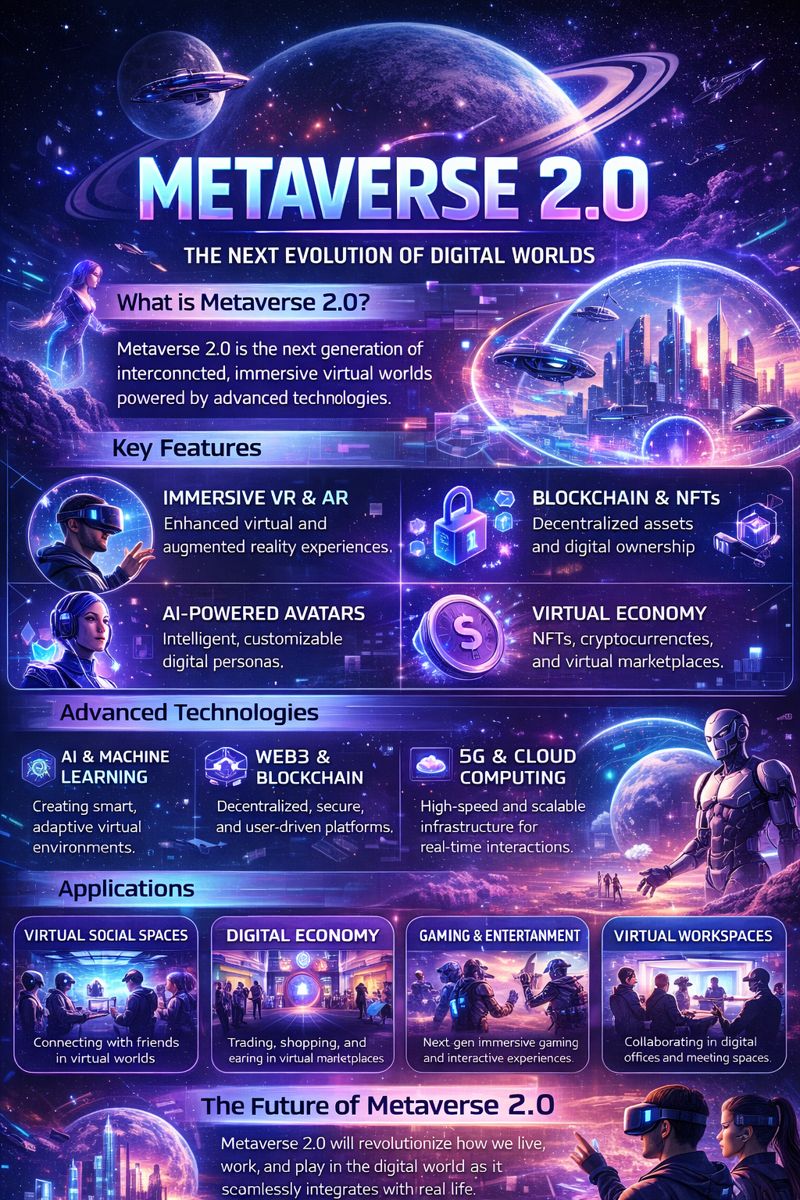
Metaverse 2.0: The Next Evolution of Digital Worlds
Conclusion
Metaverse 2.0 represents a shift from isolated, entertainment‑focused virtual spaces to interconnected digital ecosystems with practical utility. Through AI, hyper‑realism, interoperability, digital twins, and economic systems, these environments are becoming integral to how people work, learn, socialize, and transact. As Metaverse 2.0 continues to mature, it will not only reshape digital interaction but also extend and enhance real‑world systems in meaningful ways.
Recommendation
Prioritize interoperability and real‑world applications when engaging with Metaverse 2.0 technologies. Identify workflows that benefit from immersive collaboration, digital prototyping, or virtual simulation. Choose platforms that support cross‑platform identity and asset portability, and invest in foundational skills like spatial computing, AI content design, and data governance to maximize long‑term value
FAQs
Is Metaverse 2.0 just about gaming?
No—it now prioritizes enterprise, education, healthcare, and commerce with practical tools and functionality.
What makes Metaverse 2.0 different from earlier versions?
It features AI‑driven content, hyper‑realistic environments, and interoperability across platforms.
Do I need VR hardware to access Metaverse 2.0?
No—access is available via desktop, mobile, AR glasses, and mixed‑reality devices.