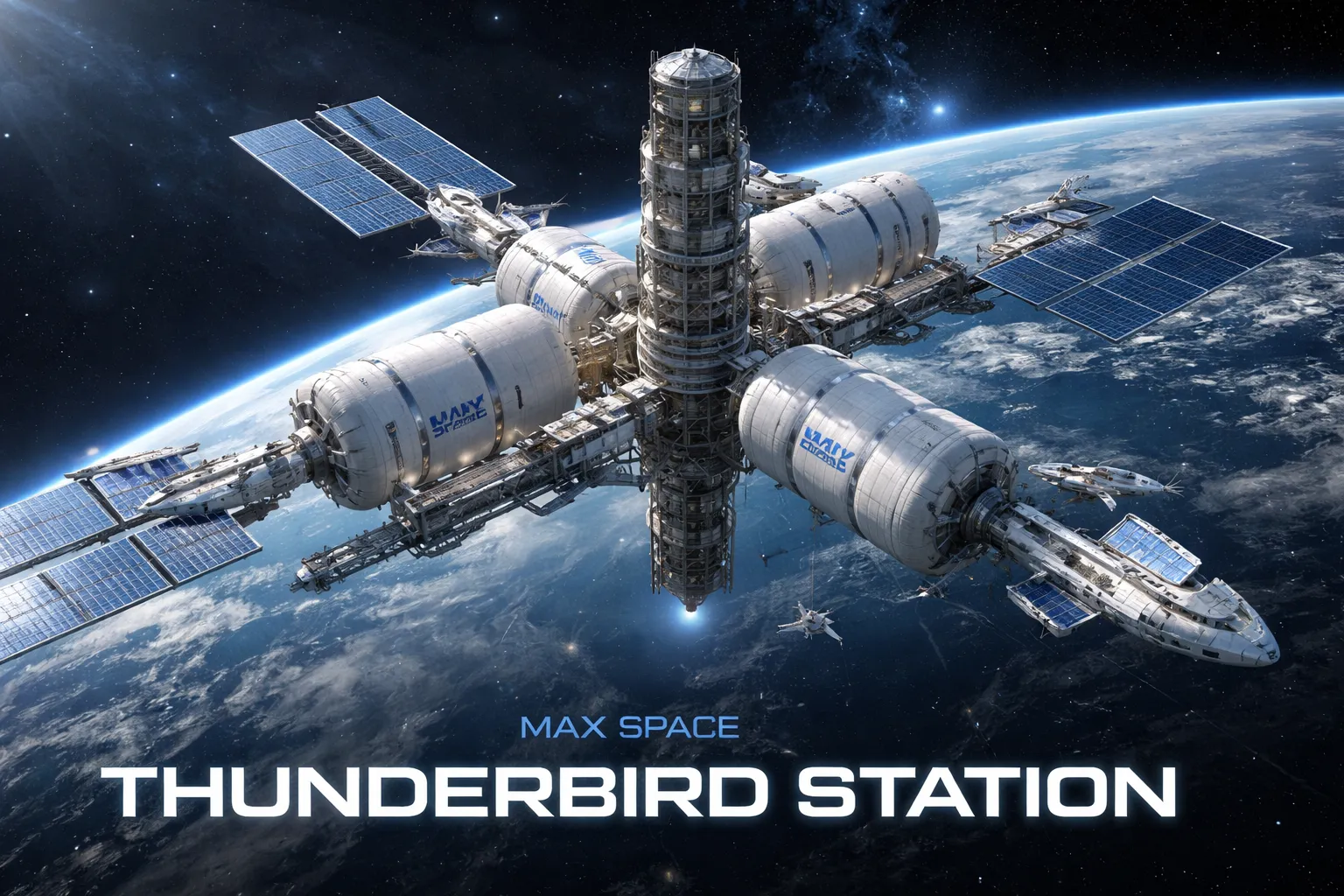
Max Space Thunderbird Station: The Expandable Commercial Space Station
Introduction
The International Space Station required more than 40 assembly flights and over a decade to become fully operational. Max Space Thunderbird Station offers a fundamentally different approach: a single launch, a single module, and no orbital assembly required. This commercial space station, developed by the Florida-based startup Max Space, represents a significant shift in how humanity builds infrastructure in low Earth orbit.
Unlike traditional rigid-module stations that launch in their final shape, the Max Space Thunderbird Station launches compactly inside a SpaceX Falcon 9 fairing and expands to 20 times its original volume once in orbit. The final pressurized volume reaches 350 cubic meters—approximately one-third the size of the ISS but delivered in a single mission . For commercial operators, government agencies, and research institutions, this fundamentally changes the economics of orbital real estate.
Max Space Thunderbird Station is designed to support four crew members continuously, with capacity for up to eight for short-duration missions. It features two docking ports, over 60 payload lockers, and a reconfigurable interior that astronauts can modify during missions to accommodate research, manufacturing, or living needs. The company plans to launch a scaled prototype, Mission Evolution, in early 2027, followed by the full Thunderbird Station as soon as 2029.
Core Technology: Expandable Habitats
Expandable vs. Rigid Module Architecture
Max Space emphasizes that its expandable module technology differs fundamentally from traditional rigid designs. The company claims its approach results in modules with more predictable safety margins and better scalability to larger sizes. Unlike balloons that rely solely on internal pressure for structural integrity, Max Space modules use layered materials that maintain their shape while providing superior ballistic protection.
The modules are built with layers of materials like Kevlar and Vectran, lightweight fiber materials that can be packed for launch and deployed once in orbit. The company states the material has been tested to withstand vibration, temperature extremes, vacuum conditions, and micrometeoroid impacts.
Safety Engineering and Materials
The safety architecture of expandable modules often raises questions among operators accustomed to metallic structures. Max Space addresses this with a multi-layered design approximately 18 inches thick, incorporating multiple gas barriers, thermal insulation, and micrometeoroid orbital debris protection layers.
The company reports a safety factor of 5 for its expandable habitats, compared to the factor of 2 typically required for metallic pressure vessels in NASA programs. The Kevlar and Vectran materials used in the structure outperform conventional metals like aluminum and titanium in ballistic impact resistance. The habitat is tested to extremes far exceeding NASA standards, including thermal, compression, vibration, and vacuum testing.
Morphic Interior Structure
A defining feature of Thunderbird Station is what the company calls its “morphic interior structure.” Unlike traditional space stations where interior layouts are fixed at launch, Thunderbird uses soft goods and reconfigurable elements that astronauts can adjust during missions.
This design flexibility serves multiple purposes. Research missions can dedicate volume to experiment racks and workstations. Manufacturing operations can reconfigure space for production lines. Crew living quarters can be adjusted for privacy and comfort during extended stays. According to CEO Saleem Miyan, the approach is comparable to “moving furniture in a house” but adapted for microgravity conditions.
Former NASA astronaut Nicole Stott, now lead astronaut for Max Space, explained the practical advantages: “Onboard the ISS, we move racks and payloads around routinely, and while it’s not difficult, it is cumbersome and time-consuming.
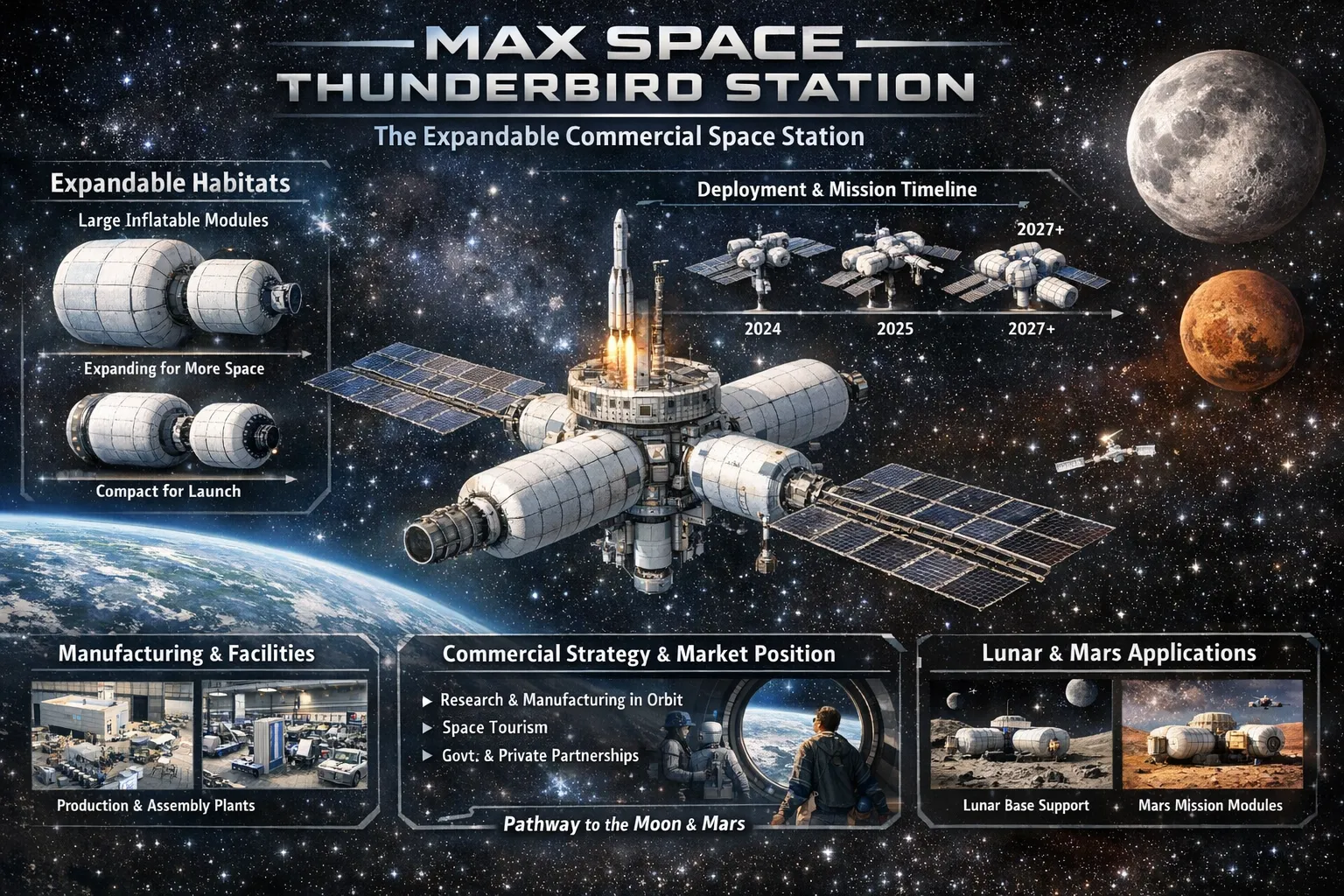
Max Space Thunderbird Station: The Expandable Commercial Space Station
Deployment Roadmap and Mission Timeline
Mission Evolution: 2027 Demonstration Prototype
Before deploying the complete Thunderbird Station, Max Space plans to launch a smaller orbital prototype known as Mission Evolution. This demonstration mission is targeted for early 2027 and is expected to fly as part of a SpaceX rideshare launch.
The prototype will feature an internal volume of approximately 5 cubic meters and will serve as a technology validation platform. It will carry onboard sensors, imaging systems, and compact experimental payloads designed to verify the station’s deployment systems in orbit.
A major focus of this mission is to test the habitat’s protective shield against micrometeoroids and orbital debris, described by the company as a “layer of leaves” defensive structure. In addition, the prototype will evaluate environmental control and life-support capabilities under real space conditions.
Max Space has stated that funding for this milestone is already secured through strategic and institutional backers, supported by a pre-seed investment round exceeding $10 million.
Thunderbird Station: Full Deployment Targeted for 2029
Provided the prototype mission delivers successful results, Max Space intends to launch the full Thunderbird Station in 2029.
Unlike traditional space stations that require multiple launches and astronaut assembly, Thunderbird is designed for single-launch deployment aboard one Falcon 9 rocket. Once in orbit, the station will autonomously expand into its full operational form without requiring human construction in space.
The completed habitat will offer approximately 350 cubic meters of pressurized living space. It is designed to permanently support four full-time crew members, while also accommodating four additional short-duration occupants.
Planned interior features include:
- Private crew sleeping pods
- Large domed observation windows for Earth viewing
- Flexible shared spaces for research, work, and recreation
This design emphasizes both crew comfort and operational efficiency.
Manufacturing and Facility Development
Kennedy Space Center Expansion
To support production, Max Space is establishing a dedicated manufacturing operation at Exploration Park near Kennedy Space Center.
The company expects to recruit 30 to 50 employees during the first half of 2026, operating from a facility spanning roughly 20,000 to 30,000 square feet.
This location offers major logistical advantages, including immediate access to launch infrastructure and the highly specialized aerospace workforce concentrated along Florida’s Space Coast.
The site will focus on manufacturing the station’s expandable habitat modules, which rely on Kevlar-based structural materials forming multiple protective layers.
Commercial Strategy and Market Position
Alignment with NASA’s CLD Program
Max Space’s development strategy closely aligns with NASA’s revised Commercial Low Earth Orbit Destinations (CLD) program, updated in August 2025.
NASA’s shift from selecting a single prime contractor to funding multiple Space Act Agreements opened the door for independent station concepts such as Thunderbird. As a result, Max Space submitted its own proposal and accelerated development efforts. To strengthen alignment with NASA’s technical and scientific objectives, the company also brought in former NASA associate chief scientist Kartik Sheth.
CEO Saleem Miyan emphasized that the policy shift created a direct opportunity to demonstrate how these expandable modules could support long-term human habitation in orbit.
Commercial Customer Segments
While NASA remains an important potential customer, Max Space is also targeting a range of private-sector and institutional markets.
Key sectors include:
- Semiconductor manufacturing in microgravity
- Fiber-optic production
- Pharmaceutical research
- Advanced materials processing
- Government and defense orbital missions
The company appears to be prioritizing industrial and scientific use cases over tourism.
This strategy reflects growing interest in orbital infrastructure as a platform for high-value manufacturing and research applications.
Economic Advantage
A central strength of Thunderbird Station lies in its cost efficiency per cubic meter of habitable volume.
Traditional rigid habitats require larger rockets and often multiple launches. By contrast, Max Space’s expandable design folds compactly during launch and deploys once in orbit.
This provides two major economic benefits:
- Reduced launch mass
- Efficient use of Falcon 9 fairing volume
As a result, a station with 350 cubic meters of living space can be launched on a smaller and less expensive rocket than a rigid module of similar size.
This dramatically improves the economics of orbital infrastructure.
Lunar and Mars Applications
Beyond Low Earth Orbit
Thunderbird’s expandable habitat architecture is not limited to Earth orbit.
Max Space has designed the same core technology for future use in:
- Lunar surface habitats
- Mars transit vehicles
- Deep-space stations
- Planetary surface outposts
For lunar missions, the modules could be placed inside lava tubes, naturally formed underground tunnels created by ancient volcanic activity. These formations offer built-in radiation protection, making them highly attractive for long-duration habitation.
The expandable design makes it possible to rapidly create substantial living volume within these naturally shielded environments. The company also envisions the same system supporting long-duration missions to Mars and beyond.
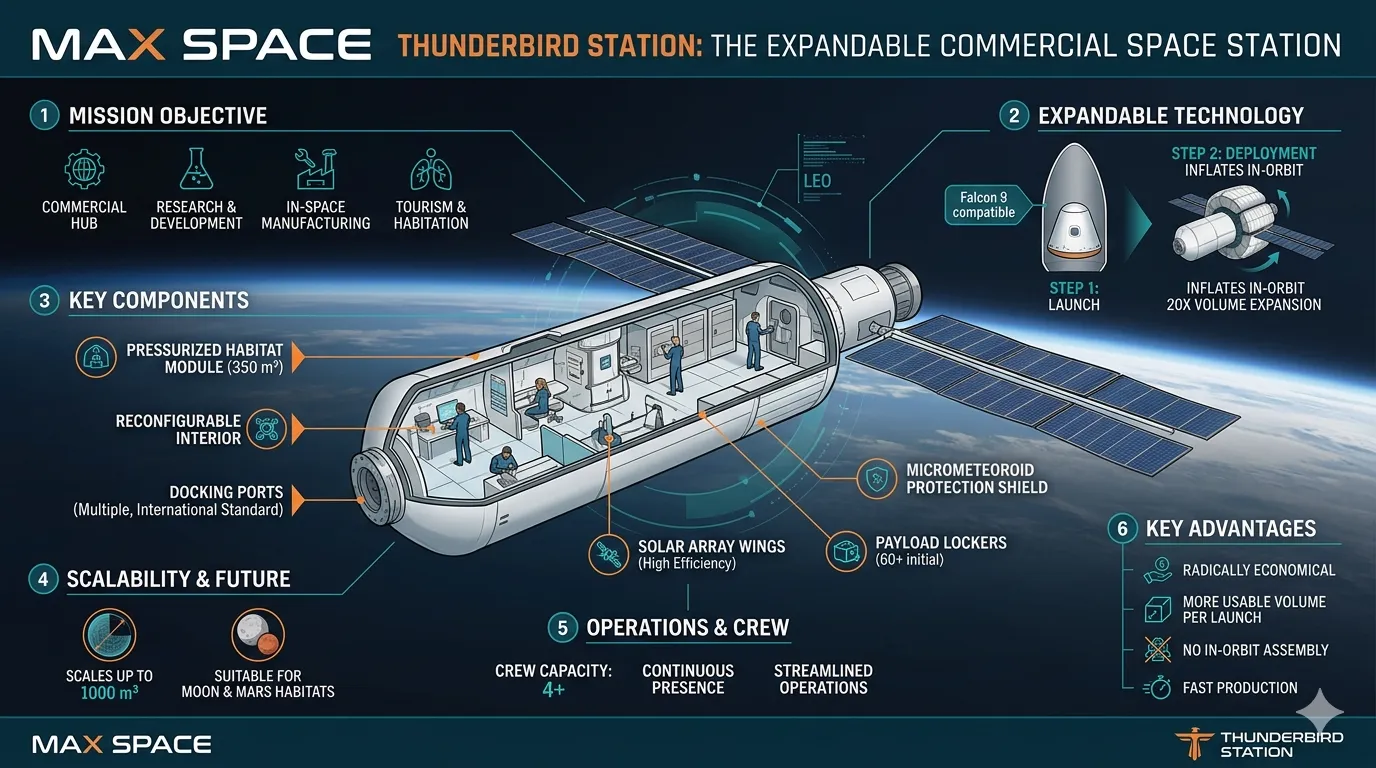
Max Space Thunderbird Station: The Expandable Commercial Space Station
Conclusion
The transition from government-owned orbital stations to commercially operated platforms is accelerating, and Thunderbird Station introduces a highly differentiated architectural approach. By focusing on single-launch deployment, expandable volume, and lower cost per habitable space, Max Space aims to solve one of the most persistent challenges in space infrastructure: the high cost of launch relative to usable volume. The 2027 prototype mission will be the first true test of this vision in orbit. If successful, Thunderbird could prove that large-scale orbital habitats no longer need the complexity and expense of on-orbit assembly. This would mark a major shift in how future space stations, lunar bases, and Mars habitats are designed and deployed.
FAQs
What is the primary advantage of Thunderbird Station over traditional space station designs?
The single-launch deployment eliminates the need for orbital assembly, reducing both mission complexity and cost compared to multi-launch station architectures. A single Falcon 9 delivers 350 cubic meters of habitable volume.
When will the full Thunderbird Station be operational?
Max Space targets a 2029 launch for the full station, following a prototype demonstration mission (Mission Evolution) scheduled for early 2027 on a SpaceX rideshare mission.
What materials are used in the expandable habitat structure and how safe are they?
The modules use layers of Kevlar and Vectran fibers in an 18-inch-thick wall structure, providing ballistic impact protection and structural integrity with a safety factor of 5—more than double NASA’s standard requirement for metallic pressure vessels.