Maglev Technology: The Future of High-Speed Gliding Trains
Introduction
Magnetic levitation (maglev) represents the pinnacle of modern rail innovation, enabling trains to float above their guideways without physical contact. Driven by powerful electromagnetic forces instead of wheels and rails, these systems eliminate friction and mechanical wear, allowing for higher speeds, quieter operation, and smoother journeys. At the core of this breakthrough is Maglev Technology, which offers a fundamentally different travel experience compared to traditional rail systems. This guide explores how it works, where it is currently deployed, and the economic factors shaping the global adoption of Maglev Technology, highlighting why Maglev Technology continues to generate worldwide interest.
Defining Maglev Technology
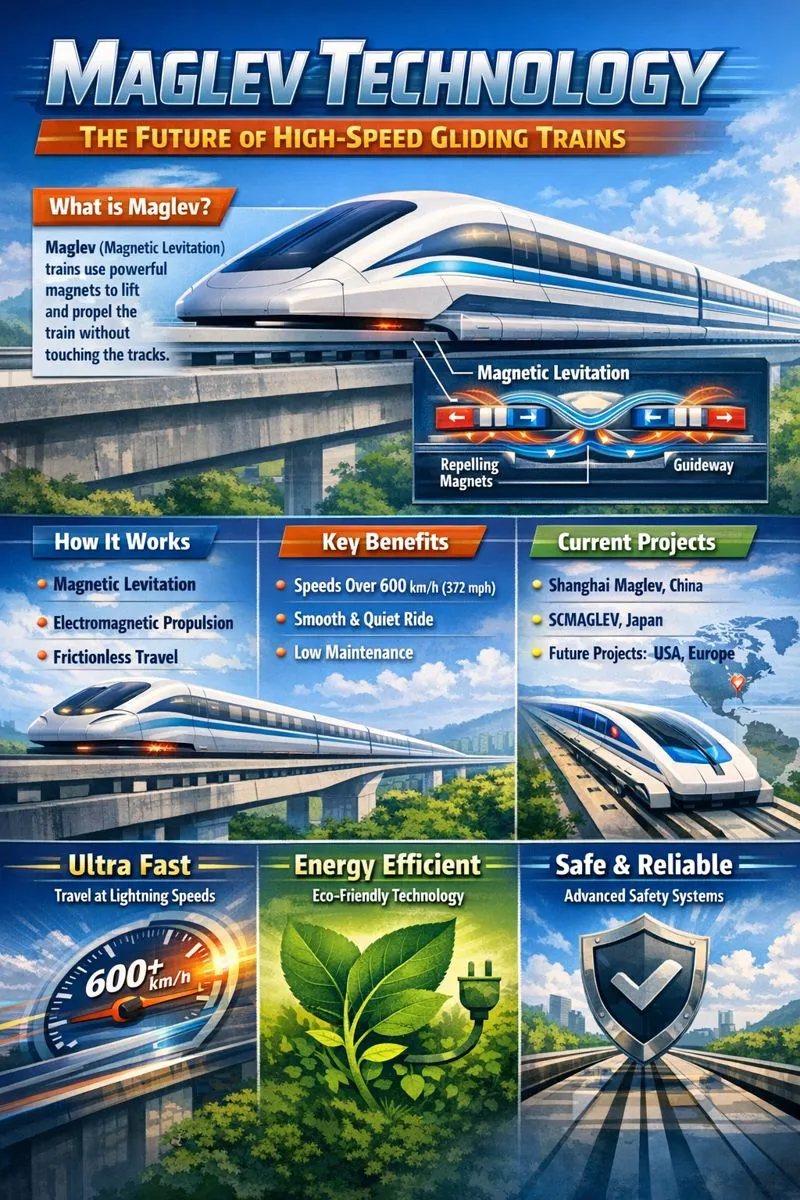
Maglev (from “magnetic levitation”) is a system where trains are levitated above a guideway using powerful electromagnets. By removing rolling resistance, these trains can achieve speeds far surpassing traditional high-speed rail. The technology is distinct from wheeled “bullet trains,” offering a near-silent, frictionless glide.
Maglev Technology: The Future of High-Speed Gliding Trains
The Core Principle: Magnetic Levitation and Propulsion
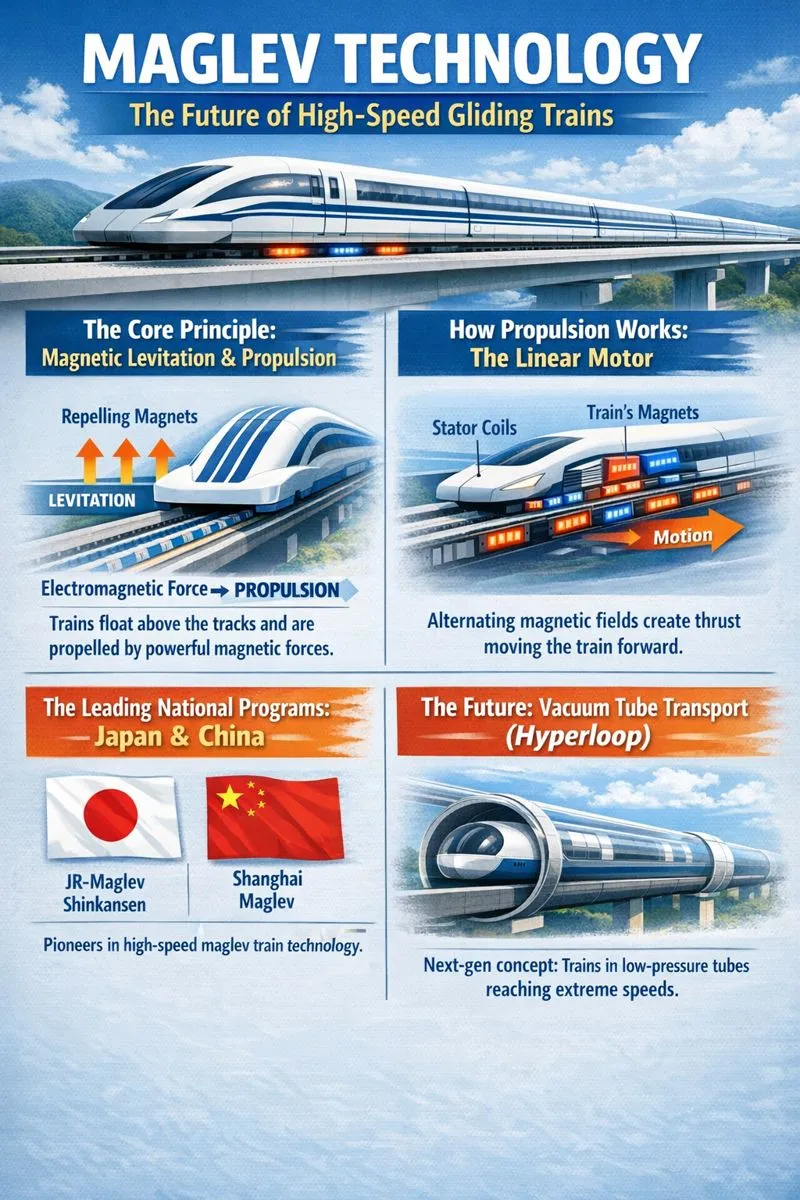
The system operates on basic magnetic principles: opposite poles attract and like poles repel. Electromagnets in the train and the guideway create controlled magnetic fields. These fields perform two critical functions: lifting the train a short distance off the track and propelling it forward.
Primary Maglev Systems: EMS vs. EDS
Two main technical approaches dominate:
- Electromagnetic Suspension (EMS): Used by Germany’s Transrapid system, EMS employs standard electromagnets attached to the train that attract it upward to a steel guideway. It provides levitation even at a standstill.
- Electrodynamic Suspension (EDS): Used by Japan’s SCMaglev, EDS relies on superconducting magnets cooled to extremely low temperatures. These magnets induce repulsive forces in coils on the guideway, levitating the train higher off the track. This system is highly efficient at very high speeds.
How Propulsion Works: The Linear Motor
Maglev trains do not have a traditional onboard engine. Instead, propulsion is provided by a linear motor. The guideway wall contains a continuous line of coils. By constantly alternating the current in these coils, the magnetic field shifts, continuously pulling the train from the front and pushing it from the rear.
The Critical Advantage: Eliminating Friction
The primary benefit of levitation is the near-total elimination of mechanical friction. This directly enables higher top speeds, superior acceleration and deceleration, and drastically reduces wear on components, leading to lower long-term maintenance costs.
Operational Speed and World Records
Maglev trains currently hold the fastest speed ever recorded for rail transportation. In 2015, a Japanese L0 Series SCMaglev achieved 603 km/h (375 mph) on a test track. The fastest commercial maglev service is the Shanghai Transrapid, connecting Pudong Airport to the city at operational speeds of up to 431 km/h (268 mph).
Global Operational Networks
Despite decades of research, commercial maglev adoption is selective. Currently, there are only seven operational maglev lines worldwide—four located in China, two in South Korea, and one in Japan. The UK pioneered the first commercial maglev in 1984—a low-speed shuttle at Birmingham Airport—though it closed in 1995.
The Pioneering UK “Hovertrain” Project
Britain was an early leader in the field. In the late 1960s, Tracked Hovercraft Ltd., with government funding, developed the RTV-31 test vehicle. Combining hovercraft and linear induction motor technology, it reached 107 mph on a Cambridgeshire test track before the project was cancelled in 1973 due to high projected costs for commercial development.
The Major Hurdle: Infrastructure Cost
The single greatest barrier to maglev adoption is capital cost. Building entirely new dedicated guideways, often requiring extensive elevated sections, is exponentially more expensive than upgrading conventional rail. A proposed UK line (Ultraspeed) was rejected in 2007 partly because its estimated £60 billion cost far exceeded that of conventional high-speed alternatives.
Energy Efficiency and Environmental Trade-offs
While maglev trains are very energy-efficient during operation due to low friction, their total environmental impact is complex. A UK government study on the Ultraspeed proposal concluded that its overall carbon emissions could be higher than conventional high-speed rail, partly due to passengers driving to suburban stations and the national energy mix.
The Leading National Programs: Japan and China
- Japan: A leader in EDS technology, Japan is constructing the Chūō Shinkansen line linking Tokyo, Nagoya, and eventually Osaka. Using SCMaglev technology, it aims for speeds of 505 km/h, cutting the Tokyo-Osaka journey to about 67 minutes.
- China: China operates the Shanghai Transrapid and is developing its own systems. It is also researching next-generation technology like high-temperature superconducting (HTS) maglev for potential use in vacuum tube transport.
Comparative Analysis: Maglev vs. Conventional High-Speed Rail
| Feature | Maglev (SCMaglev Example) | Conventional High-Speed Rail (e.g., UK Javelin) |
| Max Speed | 500+ km/h (314+ mph) | 225-350 km/h (140-217 mph) |
| Propulsion | Linear Induction Motor (No onboard engine) | Electric motors on bogies |
| Infrastructure | A dedicated, non-compatible guideway is required | Can often integrate with existing rail networks |
| Noise/Vibration | Extremely low (no physical contact) | Higher (wheel-rail contact) |
The Future: Vacuum Tube Transport (Hyperloop)
To overcome the ultimate limit of aerodynamic drag, concepts like the Hyperloop propose placing maglev trains inside low-pressure or vacuum tubes. This could enable speeds exceeding 1,000 km/h, radically shrinking intercontinental travel times. These systems, however, remain in the experimental phase.
Safety and Reliability Considerations
Maglev systems offer inherent safety benefits; the magnetic forces naturally center the train on the guideway, making derailments highly unlikely. However, like any complex system, they are not immune to failure, as underscored by a fatal 2006 collision on a German test track.
A Realistic Assessment for the UK and US Context
For nations with extensive existing rail networks like the UK and US, the business case for intercity maglev is challenging. The astronomical upfront investment is difficult to justify against incremental upgrades to conventional high-speed rail, as the long-debated HS2 project in Britain demonstrates.
Maglev Technology: The Future of High-Speed Gliding Trains
Conclusion
Maglev technology stands as a remarkable engineering achievement, demonstrating a clear path to faster, smoother, and more efficient intercity travel. Its proven speed records and operational success in Asia validate its technical promise. However, its future as a mainstream transportation solution hinges not on engineering breakthroughs but on pragmatic economics and strategic infrastructure planning. The transition from a compelling technological prototype to a widespread public utility requires a confluence of political will, vast capital, and a long-term vision that prioritizes revolutionary advancement over incremental improvement.
Frequently Asked Questions
What is the main difference between a maglev and a bullet train?
A maglev train levitates and is propelled by magnets without touching the guideway, while a bullet train (like the Shinkansen) is a conventional, albeit very fast, wheel-on-rail electric train.
Why are there so few maglev lines in operation?
The primary reason is cost. Constructing the dedicated, non-compatible guideway infrastructure requires a massive initial investment that most governments find prohibitive compared to upgrading traditional rail networks.
Can maglev trains operate in bad weather?
Yes, one of the noted advantages of maglev systems is their resilience to adverse weather conditions like ice or leaves on the line, as there is no physical wheel-rail contact that can be disrupted.