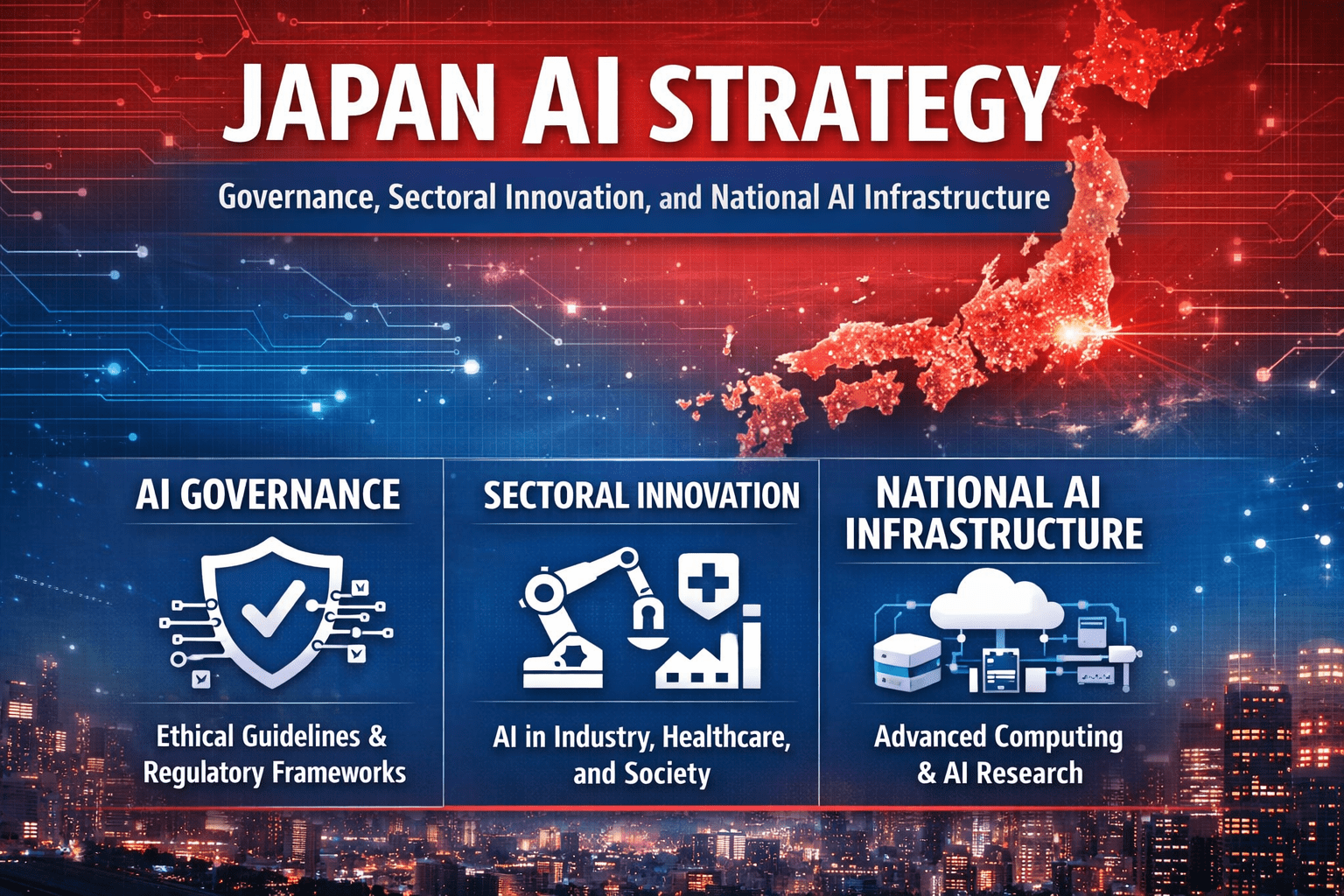
Japan AI Strategy: Governance, Sectoral Innovation, and National AI Infrastructure
Introduction
Japan’s AI Strategy positions the nation as a global leader in AI governance, innovative applications, and national infrastructure development. Japan AI Strategy integrates public policy, industrial collaboration, and digital infrastructure to accelerate AI adoption across sectors while balancing innovation with responsible risk management. Under the AI Promotion Act and AI Basic Plan, Japan AI Strategy aims to scale AI use in public services, enterprise solutions, and advanced research, demonstrating how a “soft law” regulatory framework can foster collaboration and voluntary compliance.
This strategy underscores Japan’s ambition to enhance competitiveness and promote widely adopted AI systems. The broad adoption of AI technologies across healthcare, transportation, and enterprise cloud systems makes Japan’s approach a case study in global AI policy evolution.
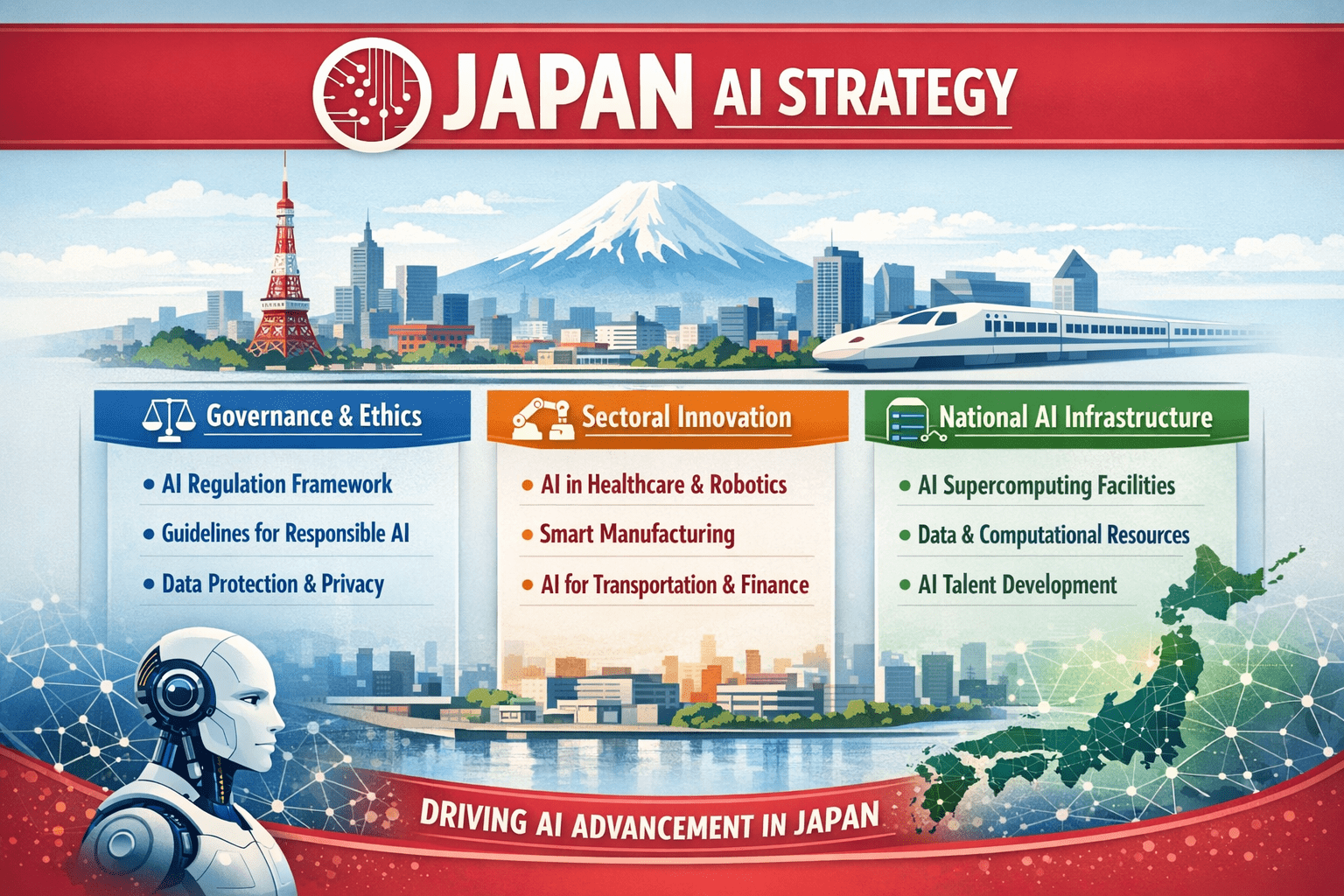
Japan AI Strategy: Governance, Sectoral Innovation, and National AI Infrastructure
National Policy and Governance Framework
Japan’s AI Promotion Act, enacted in 2025, establishes a strategic foundation for AI development, research, and utilization, emphasizing transparency, risk mitigation, and international cooperation. Unlike the European Union’s regulatory focus on strict penalties, Japan uses soft‑law principles, encouraging corporations and institutions to adopt best practices while fostering innovation and competitiveness across industries.
The Act institutionalizes the AI Strategy Headquarters under the Prime Minister’s Office, reinforcing cross‑agency coordination for AI adoption and setting priorities for national AI policy. This centralized governance structure supports the implementation of a comprehensive AI Basic Plan, which calls for accelerated public sector AI use, improved data infrastructure, and stronger global integration.
Government and Cloud Infrastructure Integration
A key pillar of Japan’s strategy is integrating AI into government operations and cloud infrastructure. Agencies plan to deploy Government AI platforms, enhancing administrative efficiency and decision-making. Cloud partnerships with major providers and domestic tech firms aim to unify computing resources, data pipelines, and AI services into a cohesive national framework.
In parallel, private investment accelerates infrastructure build‑out. For example, SoftBank is repurposing a large plant into an AI data center in Osaka, in collaboration with OpenAI, marking significant infrastructure expansion and local commercialization of advanced AI models.
Sectoral Innovation: Healthcare, Mobility, and Consumer Tech
Japan’s AI strategy drives real‑world AI innovation across multiple sectors:
Healthcare & Aging: AI systems and AI IoT technologies support elderly care and monitoring, enhancing quality of life and easing workforce shortages. Asia
Transportation: Mobility AI platforms like the Toyota‑NTT collaboration are developing machine‑learning systems to reduce traffic accidents and improve autonomous navigation by 2030, strengthening Japan’s position in automotive AI.
Retail & Accessibility: Japanese companies are deploying AI-powered tools to improve customer experience and accessibility, demonstrating how private-sector innovation supports national AI objectives. These sectoral upgrades demonstrate how Japan’s AI Strategy translates into measurable advancements in automation, data analytics, and cognitive computing across commercial and public domains.
Strategic AI Investments and International Competitiveness
Japan’s approach includes significant investment in talent, R&D, and AI infrastructure. Government projections suggest large funding pools and public‑private partnerships will attract global talent and raise national competitiveness indices. For instance, boosting AI utilization among citizens and firms is a priority to narrow gaps with the United States and China.
Moreover, initiatives to expand the semiconductor and high‑performance computing supply chain, including new memory facility builds and AI‑accelerator investments, aim to position Japan as a leading AI hardware producer.
Balancing Innovation with Social Impact
A notable aspect of Japan’s policy is balancing innovation with inclusivity and safety. The AI Basic Plan champions human‑centric AI and emphasizes workforce training for AI integration. It also underscores transparent risk management for critical sectors like autonomous systems and healthcare. This balance reflects Japan’s tradition of collaborative governance and social acceptance of technology norms.
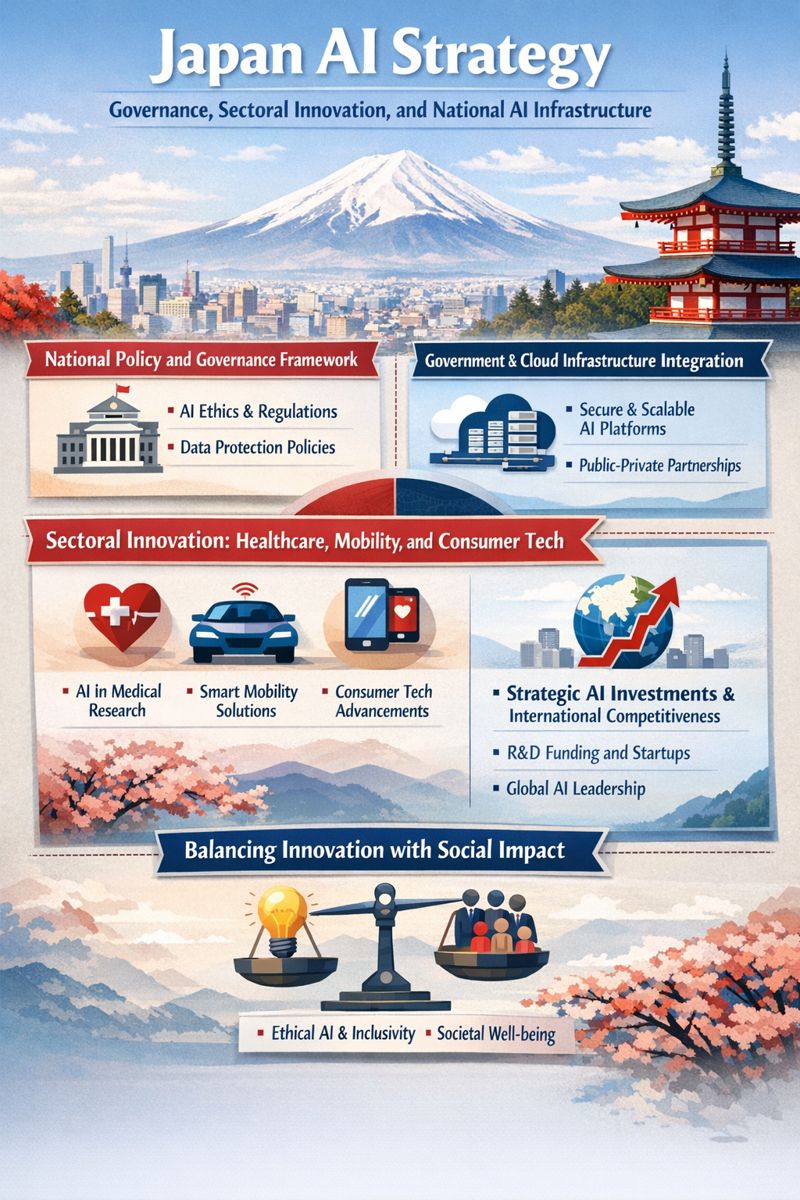
Japan AI Strategy: Governance, Sectoral Innovation, and National AI Infrastructure
Conclusion
Japan’s AI Strategy provides a model for harmonizing AI policy, economic innovation, and ethical governance. By focusing on collaborative regulation, strategic investments, and cross‑sector transformation, Japan aims to enhance its technological leadership while ensuring AI adoption yields broad societal benefits. Professionals should observe how these policies evolve and integrate their strategic planning to align with Japan’s ambitious AI ecosystem development.
Recommendations
To navigate Japan’s evolving AI landscape:
- Monitor outputs from the AI Strategy Headquarters and updated AI Basic Plans for policy direction.
- Engage with national cloud and data infrastructure initiatives to leverage public and private resources.
- Align innovation projects with sectoral trends in mobility, healthcare, and robotics to maximize adoption and compliance.
These steps will help organizations anticipate regulation and integrate with Japan’s long‑term AI ecosystem.
FAQs
What is Japan’s AI Strategy?
It is a national policy framework aligning AI governance, sector innovation, and infrastructure development to strengthen competitiveness and societal AI use.
How does Japan regulate AI?
Japan uses a “soft‑law” governance approach that prioritizes transparency, cooperation, and innovation over punitive regulation.
Which sectors benefit most from the strategy?
Healthcare, transportation, and cloud‑based enterprise services are key areas of AI deployment under Japan’s strategy.