
DeepMind GNoME AI: Accelerating Materials Discovery with AI
Introduction
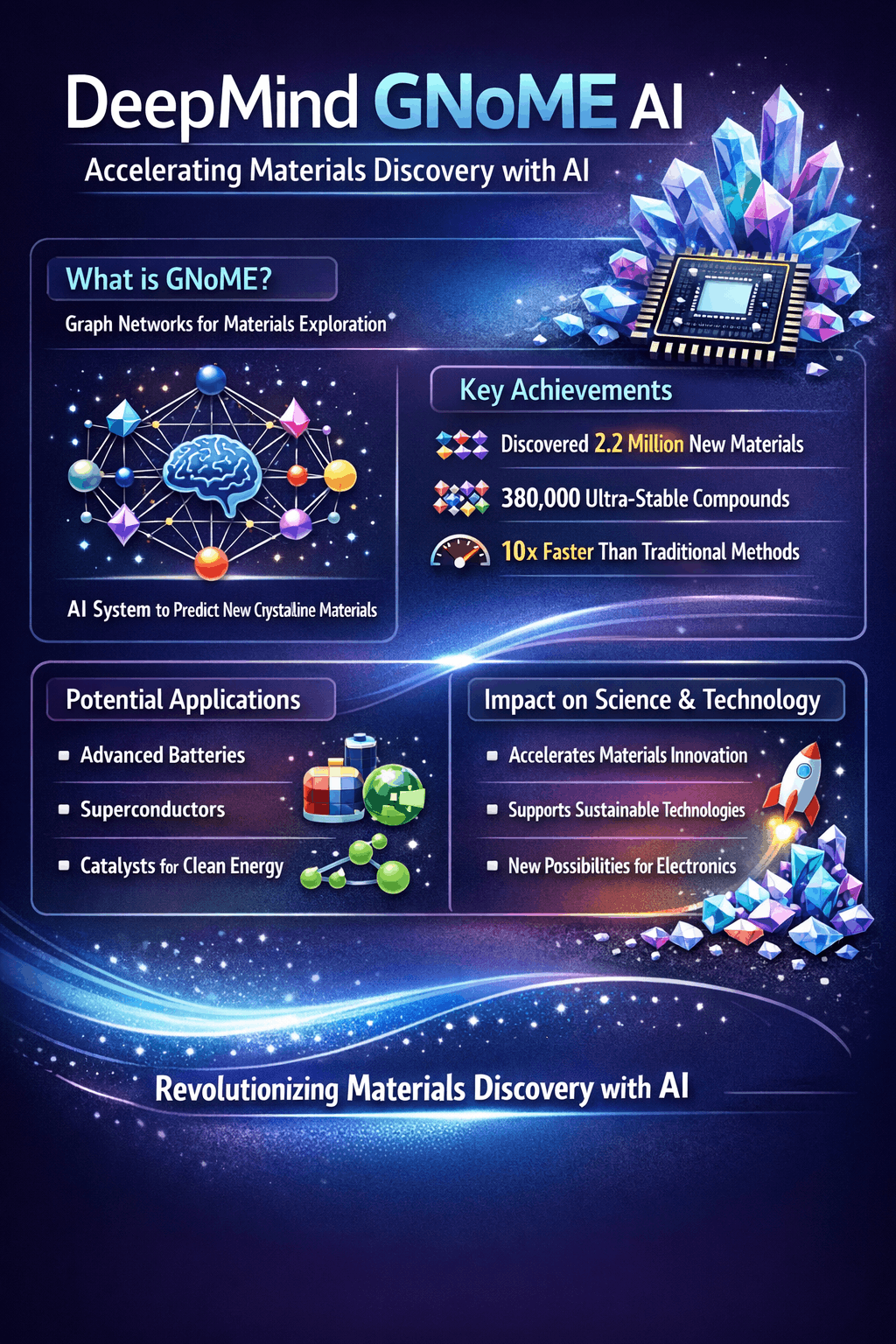
Humanity’s catalog of known stable materials has just grown by an order of magnitude, driven by a single revolutionary force: DeepMind GNoME AI. This pioneering artificial intelligence system has autonomously discovered 2.2 million new crystal structures, a staggering feat that unlocks unprecedented opportunities for innovation.
The power of DeepMind GNoME AI lies in its ability to move beyond human intuition, mapping vast regions of unexplored chemical space to pinpoint 380,000 highly stable candidates for next-generation batteries, semiconductors, and beyond. The era of AI-driven material design is here, and its engine is DeepMind GNoME AI.
What is DeepMind’s GNoME AI?
DeepMind’s GNoME (Graph Networks for Materials Exploration) is a specialized deep learning tool that predicts the existence and stability of new inorganic crystals—fundamental materials for modern technology—by analyzing their atomic structure.
Core Concepts:
To understand how it works, focus on these three interconnected ideas:
| Concept | What It Is | Why It’s Crucial for GNoME |
| Graph Neural Network (GNN) | An AI model where atoms are “nodes” and the bonds between them are “edges,” forming a graph. | Allows the AI to learn directly from a material’s geometric structure, making it the perfect architecture for modeling crystals. |
| Stability Prediction | The model’s primary task is calculating if a proposed arrangement of atoms will hold together in reality. | This is the key filter. Discovering millions of structures is useless unless you can pinpoint the stable ones for synthesis. |
| Active Learning Loop | An iterative process where the AI’s predictions are verified by physics simulations, and the results are fed back to train it further. | This is the engine of discovery. It transformed GNoME from ~50% accurate to >80% accurate, enabling reliable high-volume predictions. |
DeepMind GNoME AI: Accelerating Materials Discovery with AI
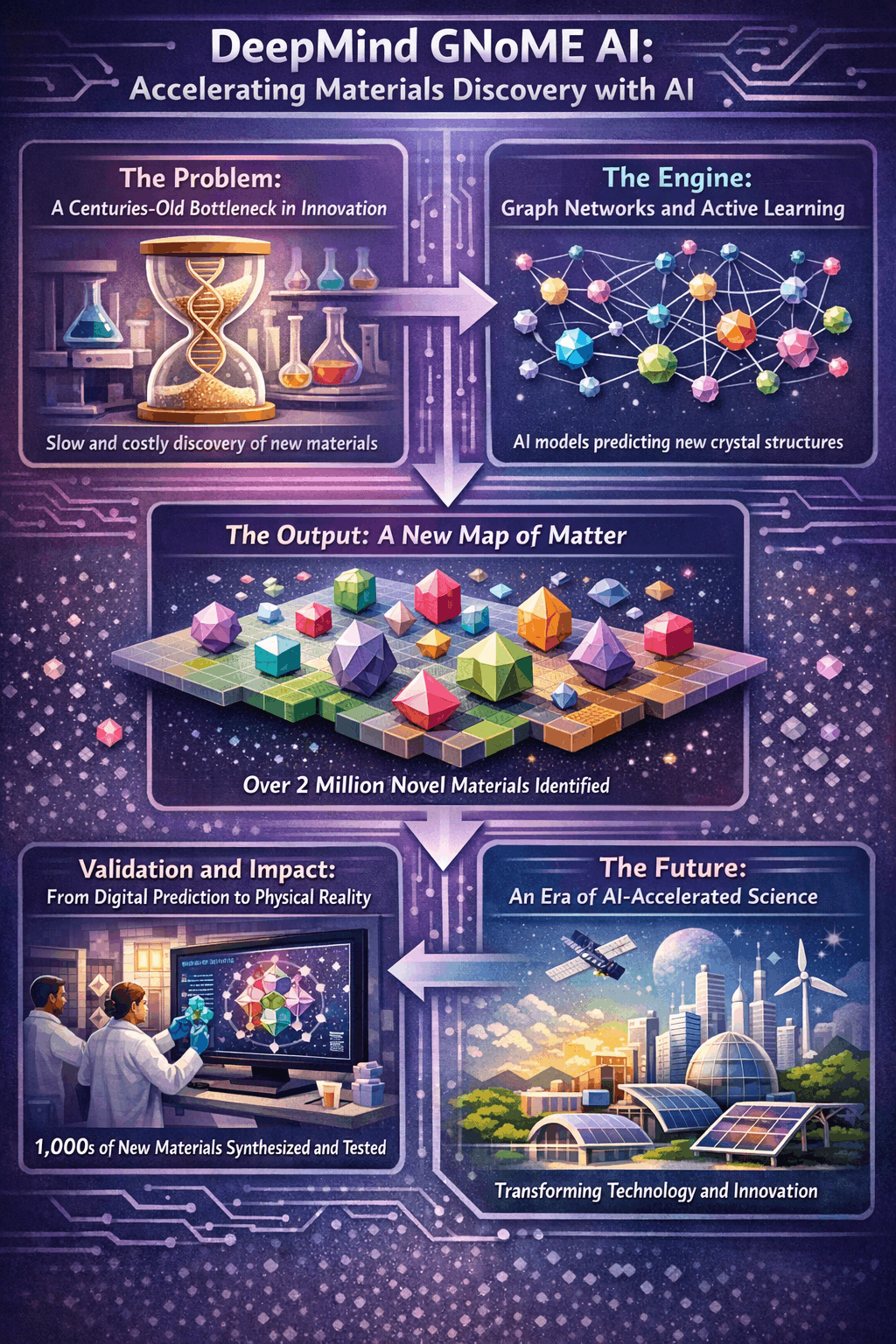
The Problem: A Centuries-Old Bottleneck in Innovation
The quest for new materials is foundational to technological progress. Every leap in battery efficiency, solar cell performance, or microprocessor speed is ultimately enabled by the underlying materials. However, the traditional discovery process is fundamentally limited. Experimental approaches involve painstaking synthesis in labs, a process that can take months for a single material with no guarantee of success. Computational methods, while faster, have been constrained by the immense cost of high-fidelity quantum mechanical calculations and the limited chemical intuition of human researchers.
Before GNoME, major computational databases like the Materials Project had catalogued approximately 48,000 stable materials after years of global effort. The chemical space of possible stable inorganic crystals, however, is estimated to be vastly larger. Researchers were effectively searching for a needle in a universe of haystacks, guided by rules that inherently limited the diversity of their search. This bottleneck meant that developing next-generation technologies was often a waiting game, dependent on a slow, serendipitous discovery process.
The Engine: Graph Networks and Active Learning
GNoME’s breakthrough stems from its core architecture and a powerful, iterative training methodology. At its heart, GNoME is a graph neural network (GNN), a type of AI model perfectly suited for modeling materials.
- Graph Networks as a Natural Fit: A crystal structure can be elegantly represented as a mathematical graph where atoms are nodes and the bonds between them are edges. GNNs process this structure directly, learning the complex relationships and forces that determine a material’s stability.
- The Active Learning Flywheel: GNoME’s true power was unlocked through active learning. The process began with known data from the Materials Project. The AI would then generate millions of candidate structures and predict their stability. The most promising candidates were evaluated using Density Functional Theory (DFT), the established computational method for calculating material energies. These high-quality DFT results were then fed back into the model as new training data. With each cycle, GNoME became more accurate, creating a virtuous, self-improving discovery engine.
This approach yielded extraordinary improvements. GNoME’s precision in predicting stable materials soared from under 10% to over 80%, and its prediction error for crystal energies dropped to a remarkably low 11 meV/atom. The system also demonstrated emergent generalization, accurately predicting the stability of materials with five or more unique elements—a combinatorial space previously considered too complex for efficient exploration.
The Output: A New Map of Matter
The output of this AI-driven exploration is a dataset of historic proportions. GNoME’s discovery of 2.2 million new crystals that are stable by current scientific standards represents what researchers equate to nearly 800 years’ worth of traditional knowledge. Of these, 381,000 materials lie on the updated “convex hull”—a technical definition meaning they are the most stable configurations possible given their chemical composition, making them prime candidates for real-world applications.
The diversity of discoveries is as significant as the scale. GNoME uncovered 52,000 new layered compounds similar to graphene (which could revolutionize electronics) and 528 promising lithium-ion conductors, which is 25 times more than a prior study had identified, pointing to a future of safer, higher-capacity batteries. Crucially, these discoveries weren’t just incremental; they included over 45,500 entirely new crystal prototypes that could not have been found through simple substitution of known materials, expanding the very architectural blueprints of solid-state chemistry.
Validation and Impact: From Digital Prediction to Physical Reality
An AI-predicted material is only as good as our ability to create it. GNoME’s predictions have moved decisively from theory to practice. External research labs around the world have already independently synthesized 736 of GNoME’s new materials, providing robust experimental validation that its digital discoveries reflect physical reality.
Furthermore, in a landmark demonstration of closed-loop AI discovery, collaborators at the Lawrence Berkeley National Laboratory used GNoME’s data to guide an autonomous robotic laboratory (A-Lab). This AI-driven lab successfully synthesized more than 41 novel materials from scratch, formulating its own “recipes” and adjusting them in real time. This proves the pathway from AI prediction to automated synthesis is not only possible but operational, dramatically compressing the innovation timeline.
The Future: An Era of AI-Accelerated Science
GNoME signifies more than a one-time discovery bonanza; it heralds a new methodology for scientific inquiry. By open-sourcing its database of 380,000 stable materials to the research community via the Materials Project, DeepMind has provided a foundational resource that will fuel global research for years to come.
The future trajectory is clear: the integration of AI discovery tools like GNoME with autonomous robotic synthesis labs will create a continuous, high-throughput pipeline for materials innovation. This shifts the scientist’s role from a manual experimenter to a strategic guide and interpreter, focusing human creativity on designing the goals and applications for this new universe of materials. The focus turns to technologies critical for a sustainable future, such as better electrocatalysts for green fuel production, novel photovoltaics, and lossless superconductors.
DeepMind GNoME AI: Accelerating Materials Discovery with AI
Conclusion
DeepMind’s GNoME project stands as a towering achievement in applied AI, demonstrating that deep learning can do more than recognize patterns—it can actively drive the expansion of human knowledge in fundamental science. By breaking the centuries-old bottleneck in materials discovery, GNoME has not just found millions of new crystals; it has provided the tools and the map for a new era of accelerated technological development. The race to develop the transformative technologies of the 21st century—from grid-scale energy storage to quantum computers—will undoubtedly be run on a track paved by AI-discovered materials. The synthesis of human intelligence and artificial exploration has begun, and its potential is just starting to crystallize.
FAQs
What did GNoME discover?
It discovered 2.2 million new crystal structures, identifying 380,000 as highly stable, a tenfold increase in known stable materials for technologies like batteries.
Is it accurate?
Yes, its predictions are validated; researchers have already synthesized 736 new materials in labs, confirming the AI’s high accuracy and real-world relevance.
What’s it useful for?
It specifically found 528 promising lithium-ion conductors for better batteries and 52,000 layered compounds for advanced electronics, accelerating innovation.