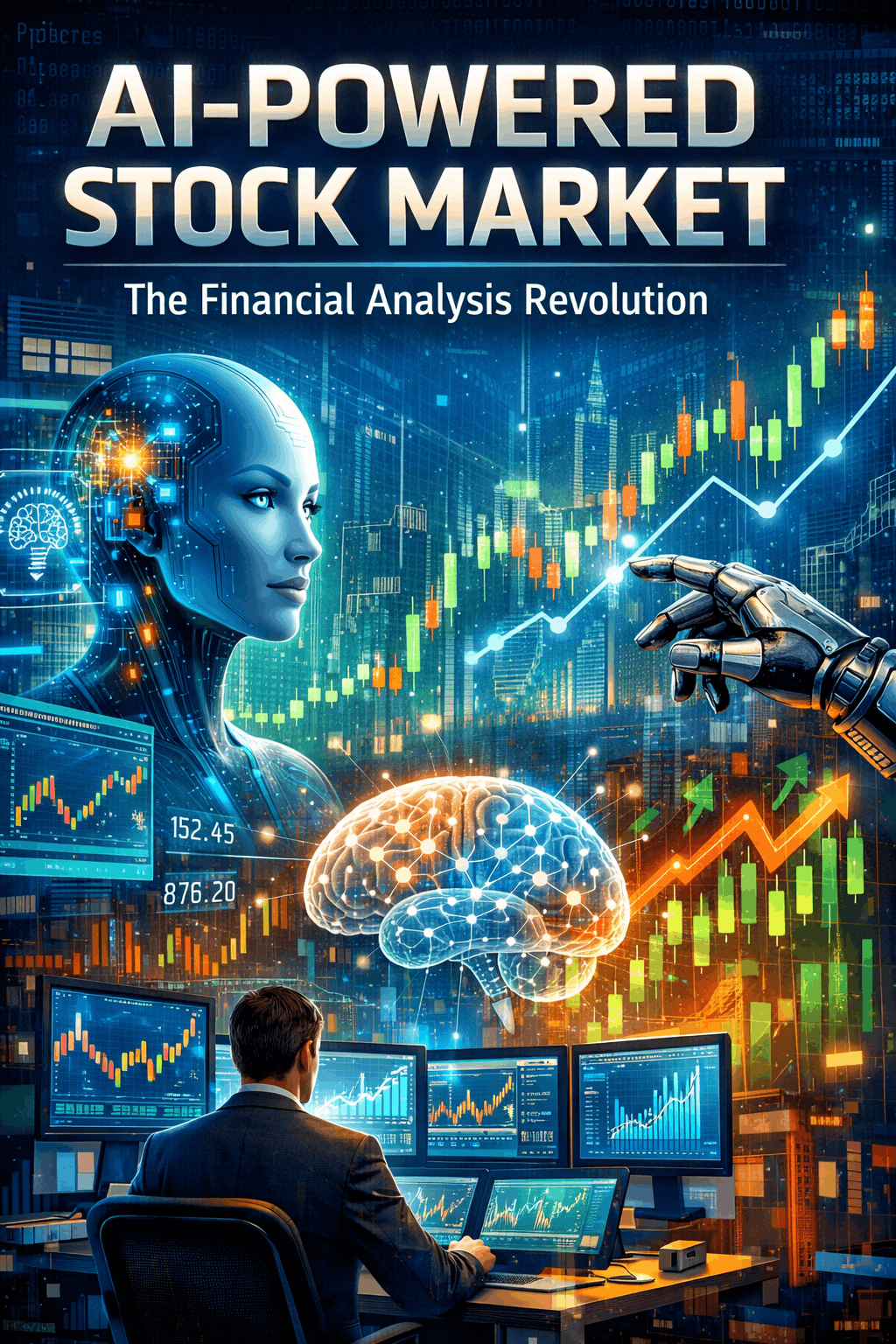
AI-Powered Stock Market: The Financial Analysis Revolution
Introduction
AI-Powered Stock Market is undergoing a foundational transformation, driven by the pervasive integration of AI-Powered Stock Market. This shift represents far more than mere automation; it is a complete re-engineering of financial analysis, risk management, and execution. This revolution enables data-driven decision-making at millisecond speeds, fundamentally altering market dynamics. However, it’s ultimate test—and most profound application—lies in navigating the volatile landscapes of political instability and economic uncertainty. This analysis deconstructs how AI-Powered Stock Market is engineered not just for efficiency and prediction, but for resilience, surveillance, and strategic foresight, establishing a new paradigm for the augmented financial strategist.
Overview of the AI Bubble Phenomenon
The AI bubble stock market refers to the growing concern that artificial intelligence–focused companies are experiencing inflated stock valuations driven by speculative investment rather than proportional financial performance. This theory has gained traction amid rapid advancements and widespread adoption of AI technologies across industries.
Key Insights
- Diverging Opinions: Institutions like the Bank of England have warned of a possible market correction due to potential overvaluation.
- Strong Fundamentals Argument: Proponents against the bubble theory point to robust corporate financial health, strong earnings, and substantial realized revenue streams from current AI market leaders (e.g., Nvidia, Alphabet, Microsoft), contrasting this with the revenue-negative valuations common in the late 1990s.
- Speculation Concerns: Concerns persist that rapid capital inflows and massive spending on AI infrastructure (data centers, chips) may be driven by overenthusiasm and speculation, potentially leading to a crash if AI-related revenues fail to meet high market expectations.
- Market Impact: A potential market correction could have contagion effects across the entire stock market, not just AI-related companies.
Prominent AI Stocks Performance
| Ticker | Company | Performance (Year) | Market Cap |
|---|---|---|---|
| Alphabet Inc | 66.45% | $4.059 T | |
| NVDA | NVIDIA Corp | 31.65% | $4.458 T |
| MSFT | Microsoft Corporation | 15.43% | $3.414 T |
| AMZN | Amazon.com Inc | 8.89% | $2.59 T |
| META | Meta Platforms Inc | 8.05% | $1.551 T |
| PLTR | Palantir Technologies | 170.67% | $425.20 B |
AI-Powered Stock Market: The Financial Analysis Revolution
The Core Engine: AI’s Foundation Mechanisms & Key Applications
The Core Entity: AI-Driven Quantitative Models
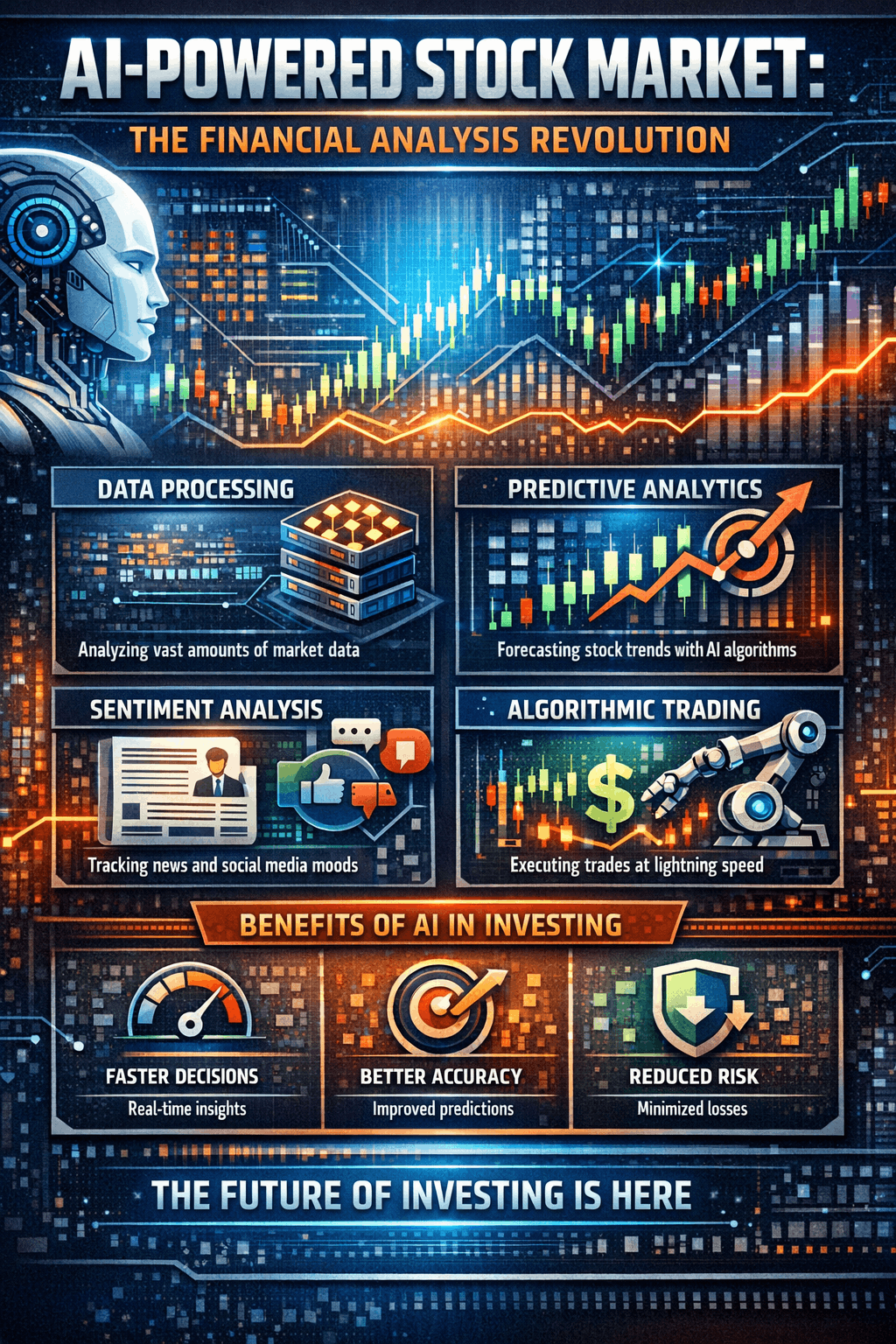
The primary entity is the ecosystem of AI quantitative models. These are not simple tools but complex ensembles—including neural networks and NLP—designed to process structured and unstructured data. They identify non-linear patterns for ROI analysis, dividend sustainability modeling, and market cycle analysis, moving far beyond traditional analytical capabilities.
Algorithmic and High-Frequency Trading (HFT)
AI powers algorithms that execute trades in milliseconds based on pre-defined rules and real-time data, capitalizing on microscopic price discrepancies. This application underscores the dual nature of AI: enabling immense efficiency and liquidity while introducing risks of amplified volatility, as seen in historical flash crashes exacerbated by algorithmic feedback loops.
Predictive Analytics and Financial Forecasting
Machine learning models analyze historical data, financial reports, and macroeconomic indicators to forecast price movements and identify trends. This transforms investment theses from speculative bets into probabilistic simulations, though a critical limitation remains the models’ inherent reliance on historical data patterns.
Sentiment Analysis via Natural Language Processing (NLP)
AI scans news articles, social media, and earnings calls to gauge market sentiment. This capability is crucial for integrating the impact of news and public perception—key drivers during periods of political instability and uncertain circumstances—directly into trading and risk models.
Portfolio Management, Optimization & Robo-Advisors
AI-driven systems and robo-advisors optimize asset allocation based on risk tolerance and goals, running millions of simulations. They provide 24/7 management and rebalancing, democratizing access to sophisticated portfolio strategies while operating within the constraints of their underlying algorithms.
Risk Management, Fraud Detection & Market Surveillance
AI continuously monitors for unusual patterns, market manipulation, and operational risks. Regulatory bodies like the SEC and exchanges like Nasdaq deploy AI for surveillance, automating compliance and helping ensure market integrity—a non-negotiable function in maintaining trust during volatile periods.
The Critical Integration: Navigating Instability and Uncertainty
Geopolitical Risk and Adaptive Sentiment Analysis
During instability, NLP tools are tuned to parse official statements, policy shifts, and conflict-related news. This real-time sentiment analysis feeds directly into volatility models, allowing for the pre-emptive stress-testing of portfolios against potential political shocks before they fully materialize.
Regulatory Change Forecasting and Compliance Automation
Political change begets regulatory risk. AI monitors legislative and central bank communications to forecast the impact of new rules. This transforms compliance from a reactive cost into a strategic input, allowing firms to adapt their strategies proactively rather than defensively.
Advanced Scenario for “Black Swan” Events
Beyond standard models, AI generates thousands of bespoke, low-probability crisis scenarios (e.g., capital controls, regional conflicts). The goal is not to predict the specific “black swan” but to understand portfolio vulnerabilities and ensure liquidity and hedging strategies are robust across all uncertain outcomes.
Real-Time Economic and Supply Chain Monitoring
Instability disrupts fundamentals. AI uses alternative data—satellite imagery, shipping traffic, global supplier sentiment—to model economic activity in near-real-time. This provides a ground-truth assessment of how geopolitical decisions directly impact corporate earnings and dividend safety for multinational firms.
Sovereign and Counterparty Risk Reassessment
AI enables the continuous, dynamic monitoring of sovereign credit risk and the financial health of banks and brokers. By analyzing debt levels, CDS spreads, and political risk scores, systems can automatically adjust exposure limits to mitigate counterparty failure risk during a systemic crisis.
Governance, Transparency, and the Human-AI Partnership
Explainable AI (XAI) for Accountability and Trust
The “black box” problem is a major risk. XAI techniques are being developed to make AI decisions interpretable, allowing systems to articulate why a trade or hedge was executed. This transparency is critical for building trust with clients and satisfying regulatory scrutiny during and after market turmoil.
Automated, Rules-Based Crisis Response Frameworks
For extreme volatility, AI can execute predefined, human-approved protocols (e.g., automatic circuit breakers, hedging triggers). This balances the need for millisecond response with strict governance, preventing emotional decisions and containing losses during events like flash crashes.
Behavioral Bias Detection in Human Overseers
AI can reflexively monitor its human operators. By analyzing decision patterns and communications, it can flag behavioral biases like panic or herding that are amplified during uncertainty, providing a crucial safety net against human error under stress.
The “Red Team” Challenge: Mitigating Historical Bias
A core vulnerability is AI’s dependence on past data. A mandatory strategic practice is adversarial “Red Team” testing, where a separate model actively works to generate plausible shock scenarios that break the primary model’s assumptions. This continuous stress-testing is essential to avoid overconfidence in outdated patterns.
Analysis: Weighing the Benefits against Inherent Risks
| Aspect | Benefits & Strategic Advantages | Risks & Critical Limitations |
| Speed & Efficiency | Analyzes vast datasets and executes trades in fractions of second, improving market liquidity and capitalizing on short-lived pricing opportunities. | Can amplify market volatility; a single error can cascade (e.g., 2010 Flash Crash). Software integrity is paramount. |
| Decision-Making | Eliminates emotional bias (fear, greed), enforcing disciplined, data-driven strategies. | Over-reliance on historical data; may fail in unprecedented events (“black swan” scenarios). |
| Analytical Depth | Uncovers complex, non-linear patterns in vast datasets beyond human capability, enhancing predictive analytics. | “Black box” opacity in complex models challenges transparency, auditability, and trust. |
| Risk & Surveillance | Enables 24/7 monitoring, real-time fraud detection, and sophisticated compliance automation. | Creates cybersecurity vulnerabilities; sophisticated AI itself could be weaponized for market manipulation. |
| Strategic Foresight | Powers advanced scenario testing and adaptive modeling for geopolitical and regime-shift risks. | Requires impeccable, curated data; outcomes are only as good as the data and parameters fed into the system (“garbage in, garbage out”). |
The Future Outlook: The Hybrid Model
The trajectory points toward deeper integration of explainable AI (XAI) and generative AI for simulating complex market environments. The future is a hybrid model: AI acts as an unparalleled decision-support system, processing complexity and identifying signals, while human experts provide ethical judgment, strategic oversight, and manage exceptions. This partnership is essential for navigating the inherent uncertainties of global markets.
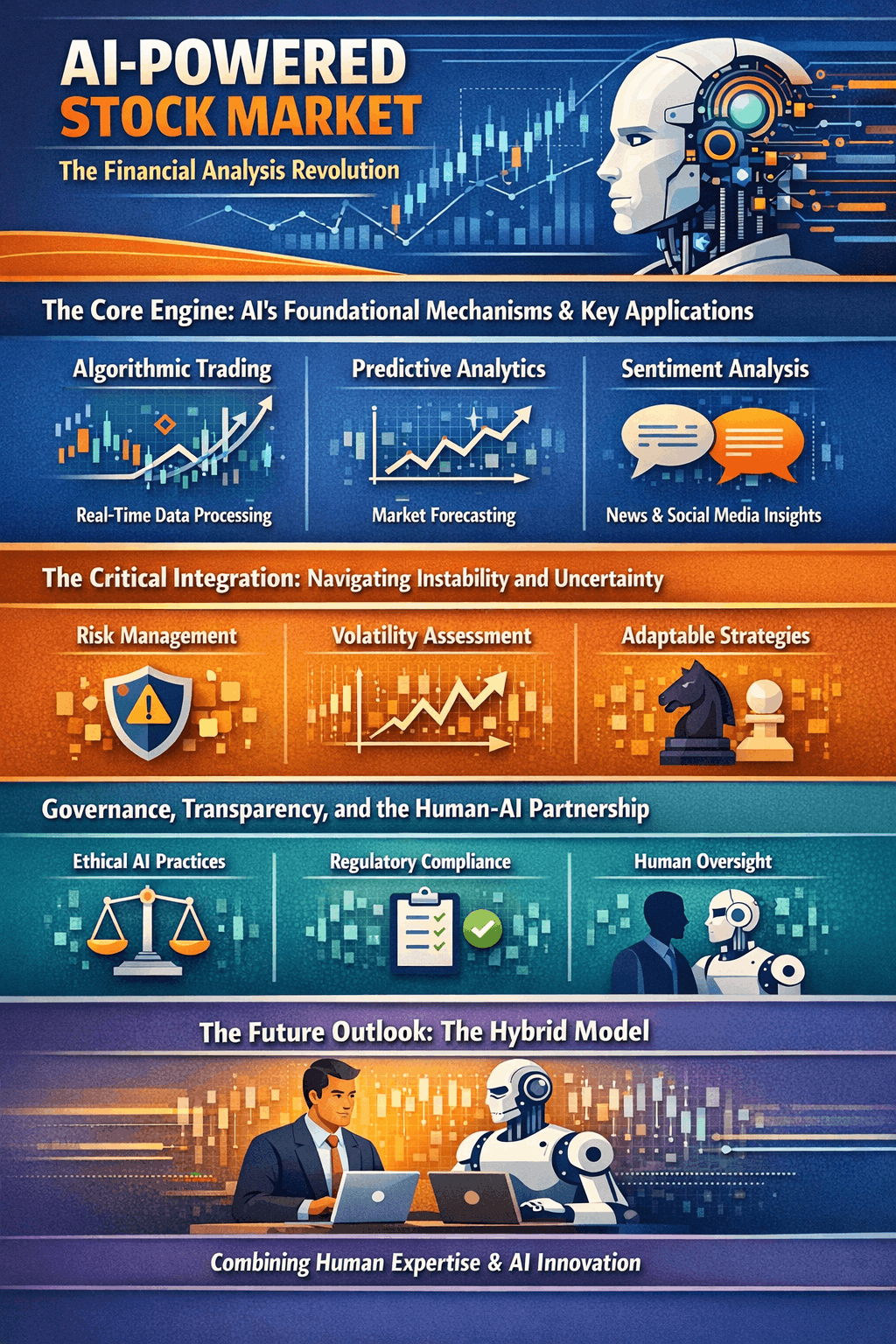
AI-Powered Stock Market: The Financial Analysis Revolution
Conclusion: The Imperative of Augmented Intelligence
The integration of AI in the Stock Exchange marks a decisive evolution from qualitative finance to quantitative strategic science. Its power in ROI and dividend analysis provides depth; its capacity for market fluctuation analysis provides discipline. Yet, its most significant role is serving as a strategic context engine for an age defined by political instability and uncertain circumstances. By systematically converting volatility and chaos into navigable scenarios and probabilistic insights, AI empowers the human expert. The goal is not autonomous trading machines, but augmented intelligence—a synergistic partnership where human wisdom directs computational power to make more informed, resilient, and accountable financial decisions for the complex world ahead.
FAQs
Can AI truly predict stock market crashes or “black swan” events?
No. AI cannot predict unprecedented events, but it can stress-test portfolios against extreme scenarios to improve resilience.
How can investors trust AI “black box” decisions?
Through governance. Explainable AI, human oversight, and independent model validation create transparency and accountability.
Will AI replace human fund managers and analysts?
Unlikely. AI augments human expertise by handling data and execution, while humans provide judgment, strategy, and ethics.