AI-Powered Charger Stations: The Definitive Guide to the Future of Electric Mobility
Introduction
The most pressing challenge in the electric vehicle revolution is not simply the number of charging stations but their intelligence and flexibility. As the global fast charging equipment market surges toward a projected value exceeding $25 billion, it’s becoming clear that solving “charge anxiety” requires more than hardware. The future belongs to AI-Powered Charger Stations, which transform static infrastructure into a dynamic, responsive energy network. For technology leaders in the UK and USA, this shift is not just technical; it is a strategic imperative for unlocking new revenue, ensuring grid stability, and delivering a seamless user experience that accelerates EV adoption.
The true power of AI-Powered Charger Stations lies in their ability to solve core market problems by integrating four key layers: dynamic energy management, predictive operational intelligence, advanced interoperability, and novel business models. These stations use artificial intelligence not as a marketing term, but as an operational engine for optimizing every watt of energy and every minute of uptime. The AI-Powered Charger Stations will become the critical node connecting vehicles, drivers, businesses, and the power grid into a single, intelligent ecosystem.
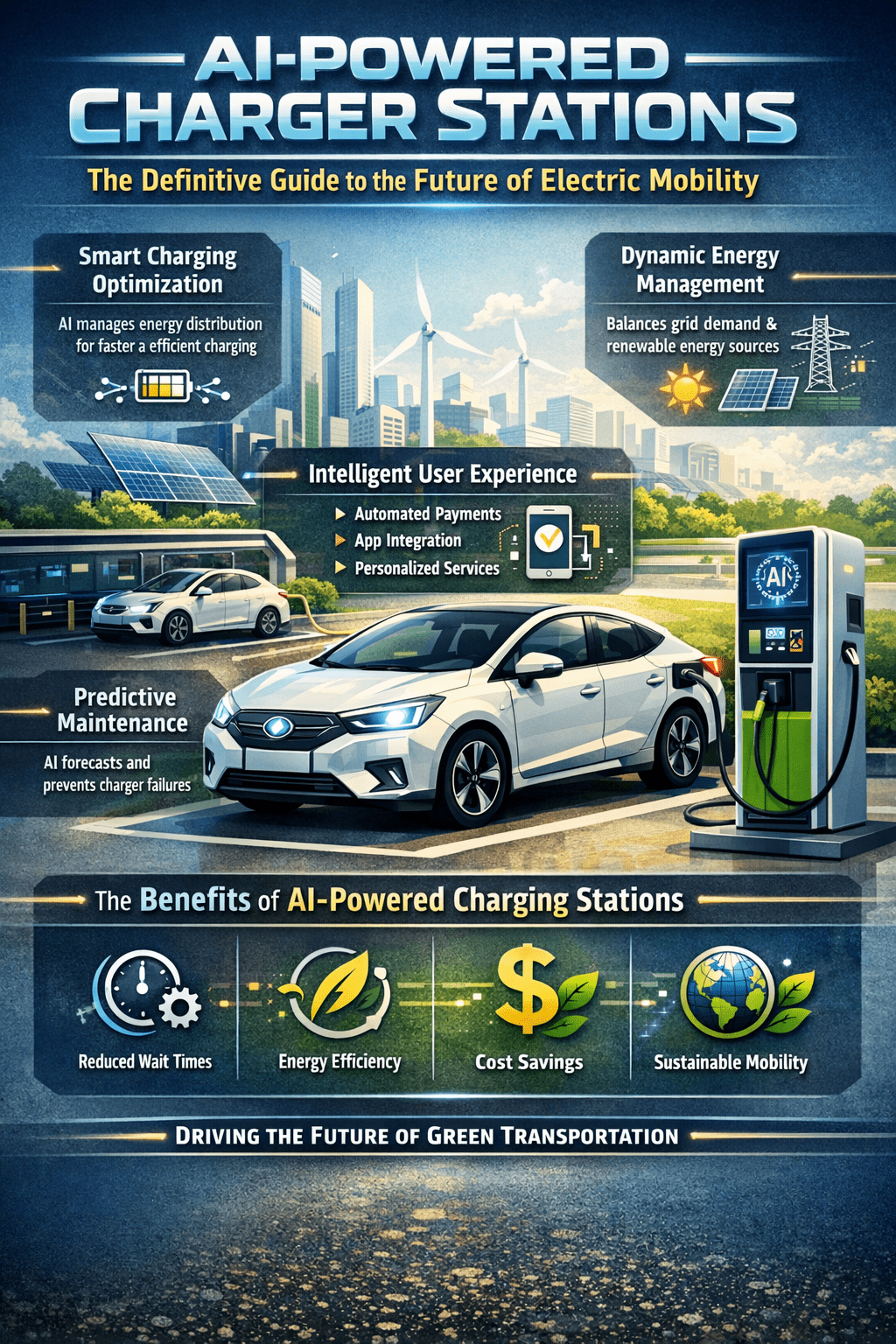
AI-Powered Charger Stations: The Definitive Guide to the Future of Electric Mobility
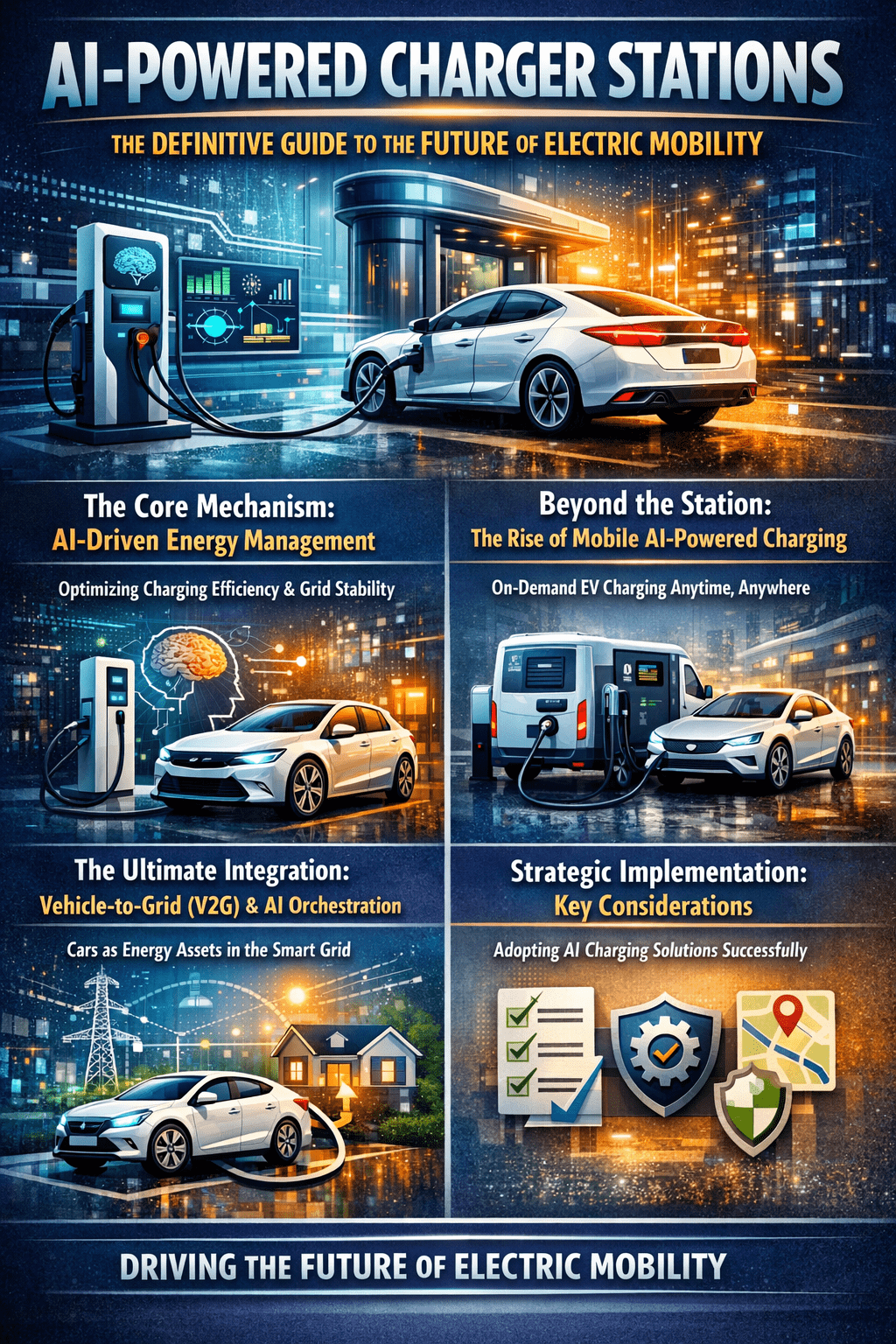
The Core Mechanism: AI-Driven Energy Management
AI-powered chargers fundamentally change how energy is delivered and managed. They function as intelligent nodes within a larger network, continuously analyzing multiple data streams to make real-time decisions. The primary mechanism involves dynamic load balancing and predictive scheduling, where AI algorithms optimize charging based on grid capacity, energy prices, and real-time demand.
Why it matters for businesses and the grid: For site hosts like fuel retailers or fleet depots, this means avoiding crippling peak demand charges from utilities by intelligently smoothing power consumption. For the grid, networks of AI chargers can act as a virtual power plant (VPP), aggregating to support stability and integrate renewable energy sources. This transforms a cost center into a revenue-generating asset, with utilities offering incentives for participation in demand response programs.
Beyond the Station: The Rise of Mobile AI-Powered Charging
Fixed infrastructure has limitations: grid connection bottlenecks, high civil works costs, and inability to serve volatile demand peaks. This is why mobile EV charging services, powered by portable Battery Energy Storage Systems (BESS), are evolving from a niche rescue service into a scalable infrastructure layer.
How it works: Companies deploy fleets of battery-integrated mobile DC fast chargers or even autonomous charging robots. These units are dispatched via AI-powered logistics platforms to locations with urgent demand—such as airports during return surges, fleet depots at shift changes, or events.
Why it matters for user experience and business: This model directly attacks “charge anxiety” by delivering power to the vehicle anywhere. For businesses, it offers a flexible, low-CapEx way to test charging demand or serve customers without a multi-year grid upgrade project. The economic model shifts from selling kilowatt-hours to selling guaranteed vehicle uptime and operational certainty.
The Ultimate Integration: Vehicle-to-Grid (V2G) and AI Orchestration
The most transformative application of AI is in orchestrating bidirectional charging (V2G). This technology allows an EV to charge from the grid and discharge energy back to it, turning fleets of parked cars into a massive, distributed energy resource.
How it works with AI: AI platforms aggregate hundreds or thousands of EV batteries—from school buses to corporate fleets—into a single dispatchable asset. The AI forecasts availability, manages state of charge for driver needs, and decides when to buy, store, or sell energy based on real-time market prices and grid signals.
Why it matters for strategy: This unlocks a powerful new revenue stream. Fleet operators can monetize their parked assets by providing grid services. As noted in industry analysis, V2G has matured from a pilot concept into “a strategic component of the broader distributed-energy-management economy.” For the UK and US, where grid modernization is critical, this represents a multi-billion dollar opportunity to build resilience without massive new power plants.
Strategic Implementation: Key Considerations
Adopting AI-powered charging is a strategic business decision. Leaders should focus on these key areas:
- Data and Interoperability: Success depends on data—from real-time charger status to energy market forecasts. Choose platforms that support open standards like OCPP and facilitate roaming agreements, which are crucial for a seamless driver experience.
- Business Model Innovation: The Charging-as-a-Service (CaaS) model is gaining traction, where a third party owns and operates the hardware for a subscription fee. This lowers barriers to entry for retailers and fleets, shifting cost from capital expenditure (CapEx) to operational expenditure (OpEx).
- The Hybrid Future: Infrastructure will not be one-size-fits-all. The most resilient networks will combine ultra-fast fixed hubs (350 kW+), flexible mobile charging services, and V2G-capable fleet depots into a single, AI-optimized system.
AI-Powered Charger Stations: The Definitive Guide to the Future of Electric Mobility
Conclusion
AI-powered charger stations represent the indispensable intelligence layer for the next phase of electric mobility. They are the key to moving from a fragile network of simple plugs to a resilient, profitable, and user-centric energy ecosystem. The competitive advantage will go to those who understand that the value is no longer in the steel and cables but in the software and algorithms that orchestrate them. The question is not whether to adopt AI in charging, but how quickly you can integrate it to transform operational costs into strategic assets and customer anxiety into unshakeable loyalty.
I hope this revised, data-driven guide provides a strong foundation for your content. If you wish to explore a specific section—like mobile charging business models or V2G revenue calculations—in greater detail, I am ready to elaborate further.
Strategic Recommendation
Begin with a pilot focused on a high-value, constrained use case. For a delivery fleet, this might be an AI-driven depot management system to minimize energy costs. For a retailer, it could be a CaaS installation with smart load balancing. Use the data and insights to build a roadmap for broader integration with mobile services or V2G capabilities.