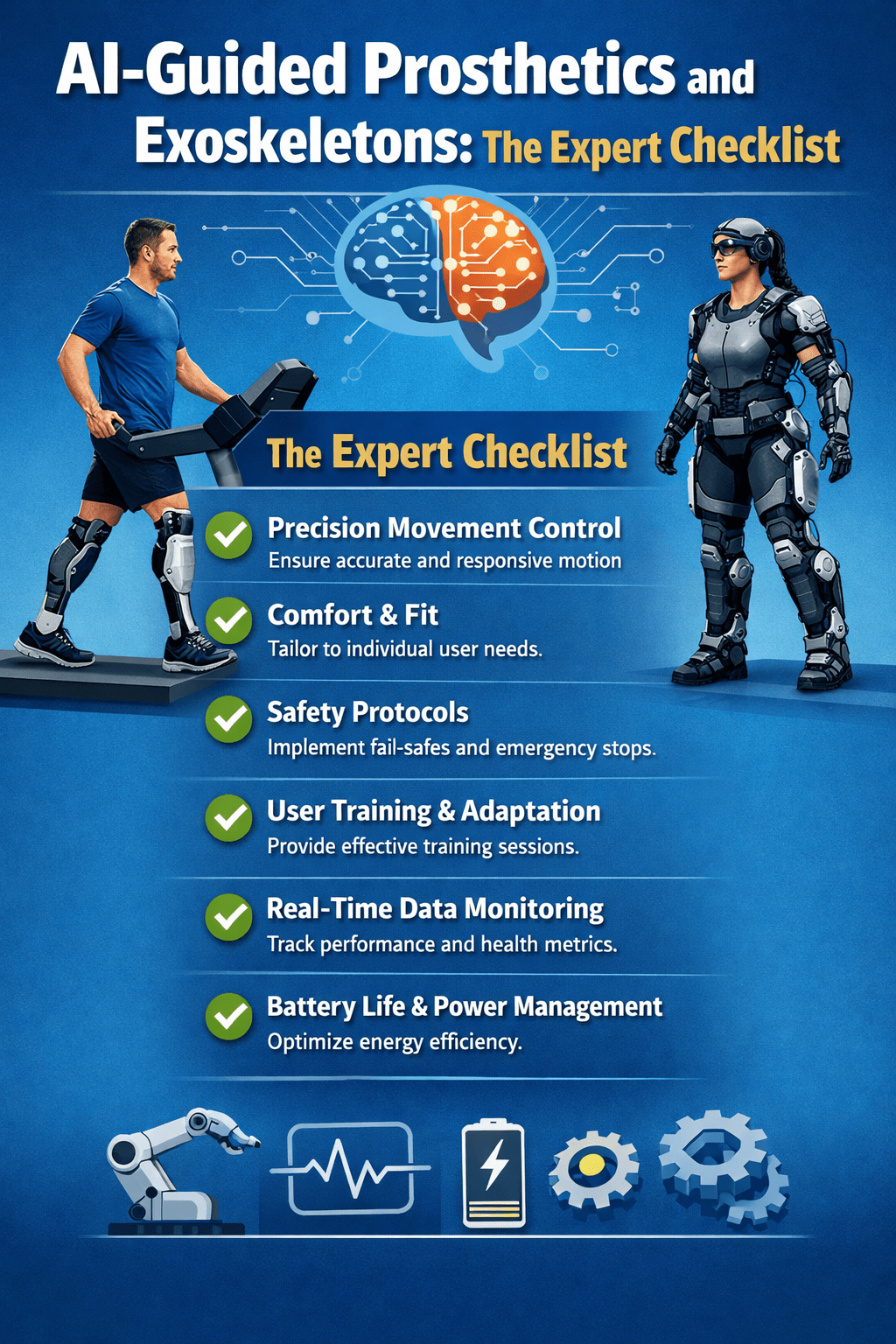
AI-Guided Prosthetics and Exoskeletons: The Expert Checklist
Introduction
Revolutionizing human mobility, AI-Guided Prosthetics and Exoskeletons are no longer passive devices but intelligent, responsive partners. Building on the transition from mechanical aids to intelligent extensions, this new generation of AI-Guided Prosthetics and Exoskeletons leverages artificial intelligence and machine learning to interpret user intent with remarkable precision. This technological synergy creates a powerful solution that is central to modern rehabilitation, firmly establishing AI-Guided Prosthetics and Exoskeletons as the cornerstone of personalized, life-changing mobility restoration.
Foundational Definitions and Distinctions
Clarify the Core Objective: The primary goal of advanced AI-guided prosthetic development is to create a limb that functions as a natural extension of the body, allowing users to perform daily tasks without conscious mechanical effort. The aim is intuitive human-machine interaction.
Differentiate Between Devices: A prosthetic replaces a missing biological limb. An exoskeleton augments, assists, or enables movement in an existing limb or body part. Do not conflate the two; they serve distinct user needs.
Understand the User Expectation: Users demand naturalness, freedom, comfort, safety, and reliability. The technology must become an unobtrusive part of the user’s life, not a device they must constantly manage.
Acknowledge the Driving Need: A growing, aging global population and improvements in trauma care are increasing the number of individuals living with limb loss or mobility impairments, creating urgent demand for sophisticated, user-centric solutions.
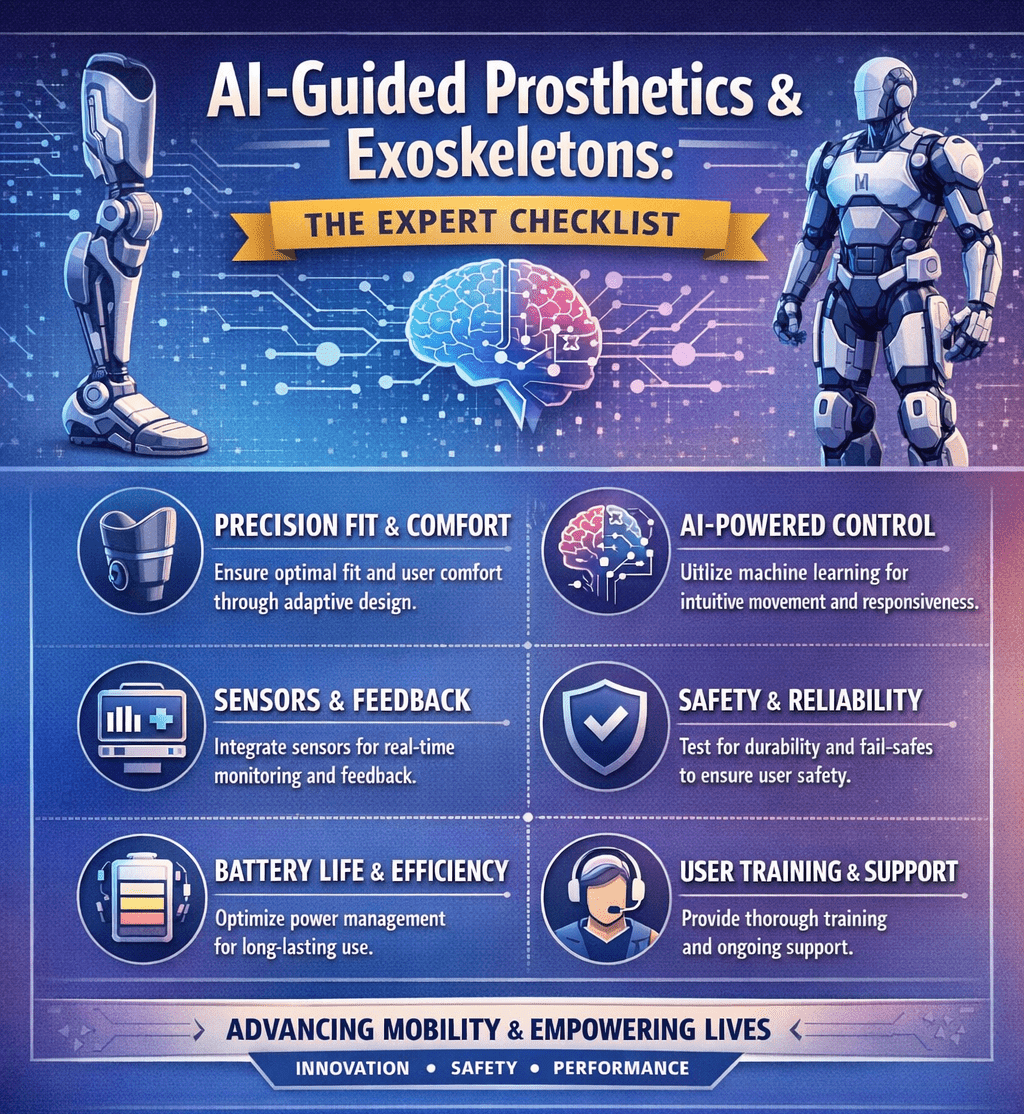
AI-Guided Prosthetics and Exoskeletons: The Expert Checklist
The Evolution of Control: From Pre-Programmed to Neural
Identify the Legacy Limitation: Traditional “smart” prosthetics often rely on robotic sensors and predefined gait algorithms, offering assistance but not true neural control. The user adapts to the device’s programming.
Recognize the Paradigm Shift: The new frontier is full neural modulation, where the user’s own nervous system directly controls movement. This is achieved through advanced surgical techniques and AI interfaces that interpret biological signals.
Integrate the Agonist-Antagonist Myoneural Interface (AMI): Pioneered by MIT, this surgical procedure reconnects paired muscles in the residual limb. It preserves dynamic communication, enabling the brain to receive crucial proprioceptive feedback about the limb’s position in space.
Leverage the Power of Feedback: Even a small amount of restored neural feedback (less than 20% of natural levels) can significantly enhance a user’s ability to control walking speed, adapt to terrain, and avoid obstacles intuitively.
AI and Machine Learning as the Enabling Core
Employ AI to Decode Intent: Artificial intelligence algorithms, particularly machine learning, are trained to interpret electrical signals from the user’s muscles or nerves. This translates faint biological commands into precise prosthetic movements.
Implement Adaptive Learning Systems: Use reinforcement learning to allow the device to learn from user interactions and environmental feedback. The system continuously refines its responses through trial and error, personalizing performance over time.
Utilize Convolutional Neural Networks (CNNs): Apply CNNs for processing visual data from integrated cameras, enabling object recognition and predictive grasping without direct muscle input. This is key for vision-controlled systems.
Augment Control with Shared Autonomy: Develop systems that balance human intent with machine precision. The AI handles the complex micro-adjustments of grip and balance, reducing the user’s cognitive burden and making simple tasks simple again.
Sensory Restoration and Haptic Feedback
Move Beyond Movement to Sensation: A major historical drawback has been the inability to perceive touch or pressure. True embodiment requires sensory input.
Develop Electronic Dermis (E-Dermis): Integrate sensor-embedded synthetic skin that mimics the activity of peripheral nerves to simulate touch and pain sensation. This allows for reflexive reactions, like releasing a pointed object.
Incorporate Multi-Modal Sensing: Equip devices with pressure, proximity, temperature, and wetness sensors. This data feed allows the AI to adjust its grip on slippery glass or sense texture, closing the perception-action loop.
Provide Biomimetic Stimulation: Use AI to translate sensor data into natural-feeling sensory feedback signals delivered to the user through neural interfaces. This makes interaction with the environment more intuitive and less mentally taxing.
Exoskeleton Design Principles and Applications
Categorize by Purpose and Structure: Define exoskeletons by their field: Medical (rehabilitation/assistance), occupational (injury reduction), or recreational. Structure falls into rigid (hard frame) or soft (exosuit, using textiles).
Select the Appropriate Actuation: Choose between powered (electric, hydraulic) for active force generation and passive (springs, counterweights) for support without external power. Passive suits are common in industry for overhead work.
Design for Specific Body Parts and Tasks: Avoid “full-body” sci-fi tropes. Design tools for specific needs: upper body for industrial lifting, lower body for gait rehabilitation, or a single joint for ankle support.
Prioritize Medical Rehabilitation Goals: In clinical settings, exoskeletons provide gait training, increase therapeutic dose, allow precise movement constraint, and offer objective performance data to clinicians. They can assist movement or resist it to build strength.
Practical Implementation and Future Horizon
Embrace Additive Manufacturing: Utilize 3D printing for lightweight, customizable, and affordable designs, especially for pediatric patients who require frequent replacement. This is critical for accessibility.
Address the Critical Challenge of Cost: Innovation must be matched with affordability. While next-gen bionic arms aim for a ~$20,000 price point, cost remains a primary barrier to adoption for many users. Accessible design is non-negotiable.
Ensure Robust, Silent Drive Systems: Source compact, high-torque, low-noise motors and gearheads. Users reject obtrusive devices; the mechanics must be powerful yet imperceptible in daily life.
Validate Through Real-World User Testing: Development must be guided by continuous feedback from the amputee and clinical communities. Lab success must translate to practical, reliable use in unpredictable environments.
Envision the Ultimate Goal: The trajectory points toward a complete “rebuilding” of human function. The future is a seamless, neurally integrated biomechanical limb that feels like part of the self and performs with natural grace and dexterity.
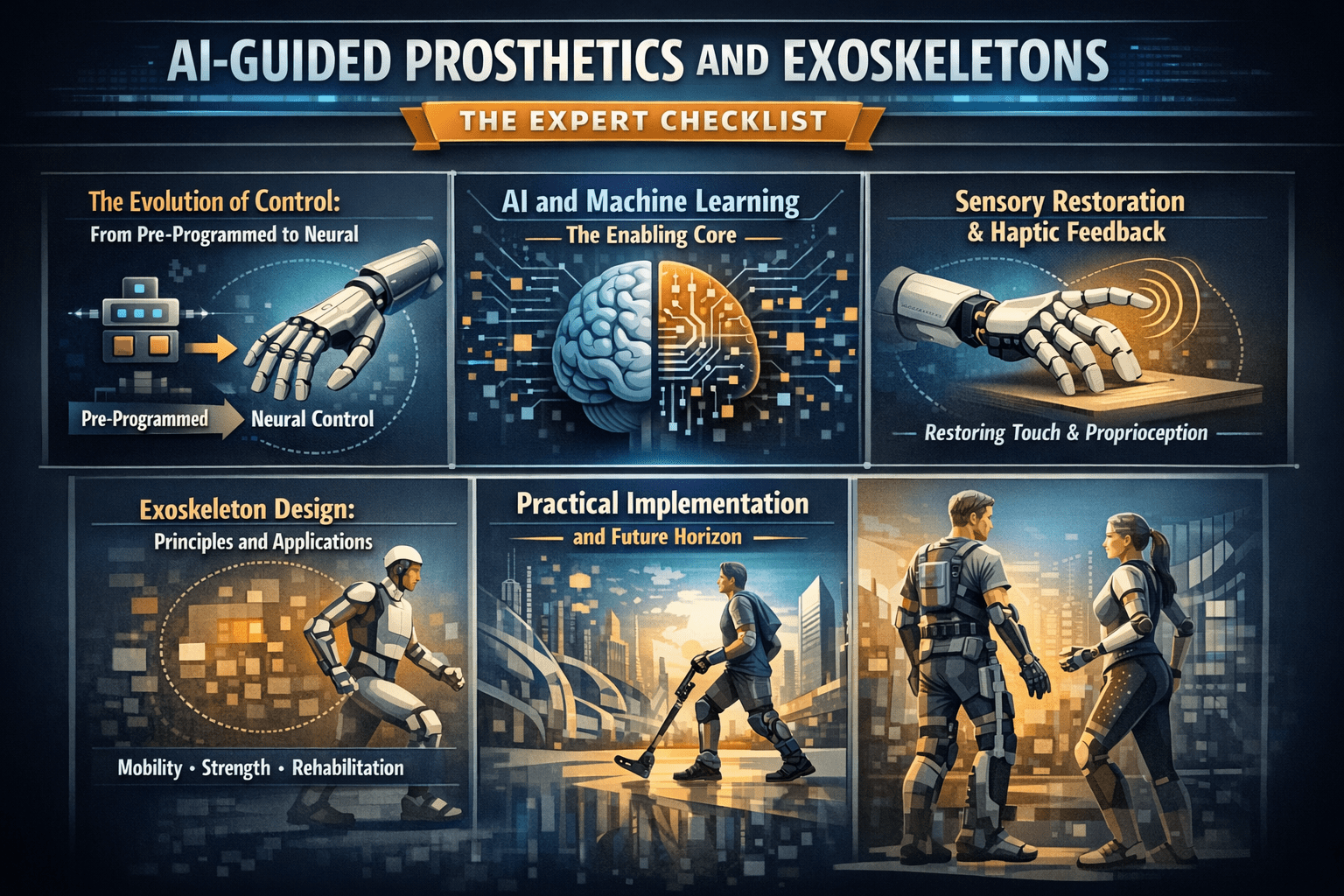
AI-Guided Prosthetics and Exoskeletons: The Expert Checklist
Conclusion
We are moving from an era of replacement to one of restoration and augmentation. The integration of artificial intelligence with neural interfaces is not merely improving devices; it is redefining the relationship between human intention and physical action. The promise is a future where technology dissolves the concept of limitation, allowing for seamless expression of movement and touch. The next step is to move these breakthroughs from the lab and niche applications into robust, accessible, and user-validated products that redefine quality of life. Evaluate these principles, apply them rigorously, and contribute to building that future.
FAQs
What is the difference between an AI prosthetic and a traditional robotic prosthetic?
A traditional robotic limb often follows pre-programmed movement patterns, while an AI prosthetic uses machine learning to interpret the user’s unique neural or muscle signals, enabling adaptive and personalized control.
Can exoskeletons give users superhuman strength?
Current industrial and medical exoskeletons are designed primarily to reduce fatigue, prevent injury, and assist rehabilitation, not to provide superhuman power. Their goal is to support natural human movement and endurance.
Are mind-controlled prosthetics available now?
Advanced research systems exist, like the MIT neuroprosthetic leg, but widespread commercial availability is still emerging. Non-invasive, AI-powered arms that interpret muscle signals are closer to market and offer a significant leap in control.