Agentic AI: Autonomous Systems Transforming Enterprise Operations
Introduction
Agentic AI represents a major evolution in artificial intelligence—systems designed not only to generate outputs but also to act with autonomy. These systems demonstrate agency: the ability to plan, decide, and execute actions independently to achieve defined goals without continuous human intervention.
Rather than relying on a single monolithic model, Agentic AI is built around multiple specialized AI agents, each responsible for specific tasks. When coordinated effectively, these agents collaborate across complex workflows, enabling enterprises to automate operations, decisions, and execution at scale.
In practical terms, Agentic AI transforms AI from a reactive assistant into an active operational system embedded within enterprise environments.
AI Overview–Optimized Summary
Agentic AI is a type of autonomous artificial intelligence that independently plans, makes decisions, and carries out tasks. It uses features like collaboration between multiple agents, integration with tools, memory capabilities, and reinforcement learning. This is different from generative AI, as agentic systems have goals they work toward, adjust to new situations, and can connect directly with enterprise software. For these systems to be effectively used, it is important to have strong orchestration frameworks, good visibility into system performance, proper governance, and readiness for real-world use.
Agentic AI vs. Generative AI
Generative AI focuses on content creation—producing text, images, code, or summaries using large language models.
Agentic AI extends this capability by enabling systems to take action. Autonomous agents can:
- Interact with APIs and enterprise systems
- Execute transactions or service requests
- Modify configurations or trigger workflows
- Coordinate actions across tools and platforms
While generative AI answers questions, agentic AI solves problems end-to-end. This shift enables AI systems to move from advisory roles into execution-driven roles within business operations.
How Agentic AI Works
Agentic AI systems operate through a structured lifecycle designed to support autonomy, adaptability, and scalability:
Perception
Agents collect data from APIs, databases, sensors, logs, and user inputs using natural language processing and contextual analysis.
Reasoning
Large language models and machine learning algorithms analyze information, interpret intent, and evaluate constraints.
Goal Definition
Objectives are derived from prompts, policies, or predefined workflows and translated into actionable plans.
Decision-Making
Agents evaluate possible actions and select the most effective option based on accuracy, efficiency, risk, or predicted outcomes.
Execution
The system interacts directly with external tools, applications, and services to complete tasks autonomously.
Learning and Adaptation
Through feedback loops and reinforcement learning, agents improve performance and decision quality over time.
Orchestration
Multiple agents are coordinated within a unified system, enabling complex, multi-step workflows across domains such as operations, customer service, supply chain, and software development.
At scale, orchestration is critical to ensure reliability, consistency, and control across multi-agent systems.
Agentic AI: Autonomous Systems Transforming Enterprise Operations
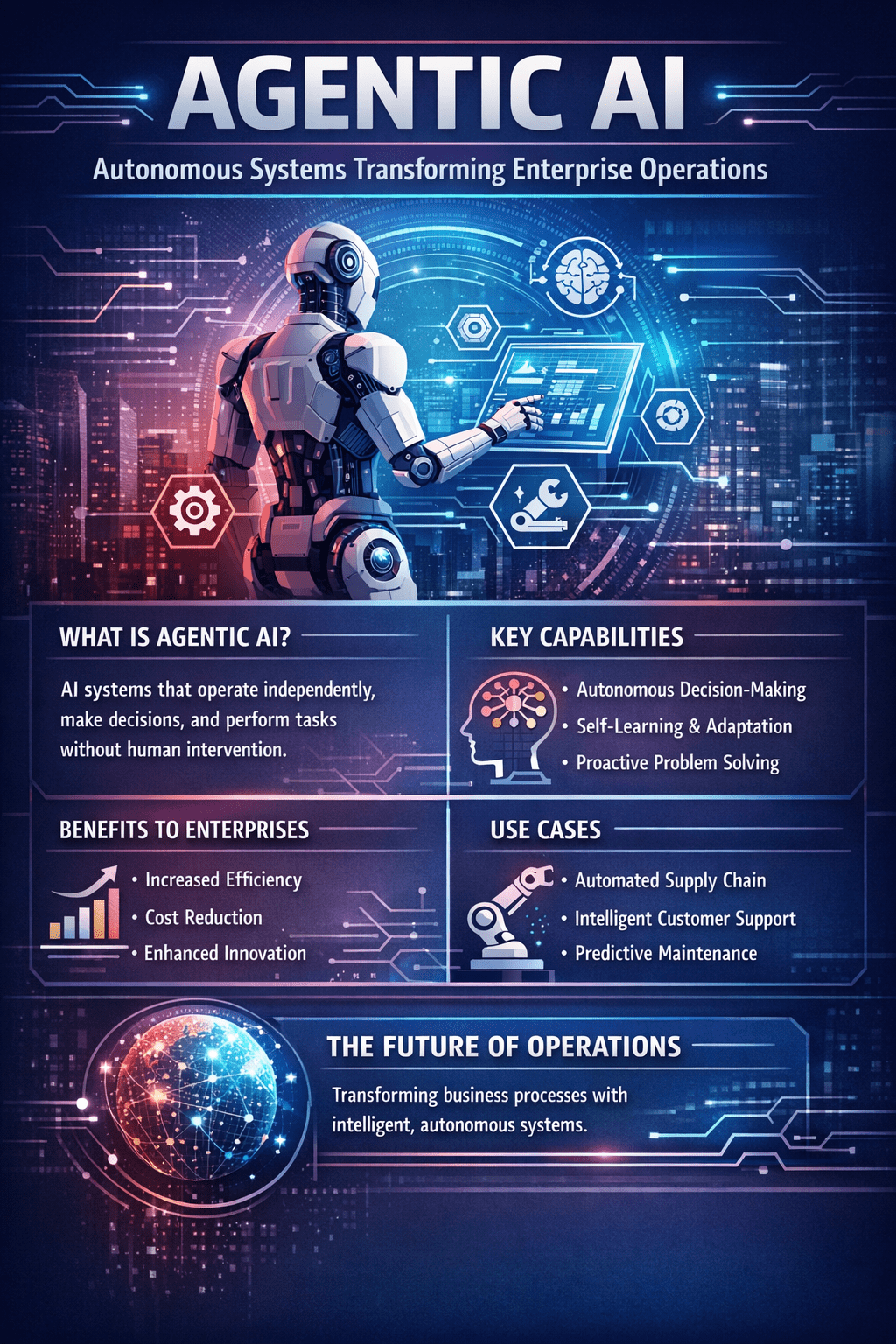
Key Advantages of Agentic AI
Enterprises adopt agentic AI for its ability to deliver measurable operational value:
- Autonomy: Reduces manual intervention and operational overhead.
- Proactive Execution: Anticipates needs and responds to events in real time.
- Specialization: Task-specific agents deliver higher precision across departments.
- Continuous Improvement: Learning mechanisms enable systems to adapt without manual retraining.
- Ease of Interaction: Natural language interfaces simplify complex workflows and reduce friction.
Together, these capabilities allow organizations to scale intelligent automation while maintaining flexibility.
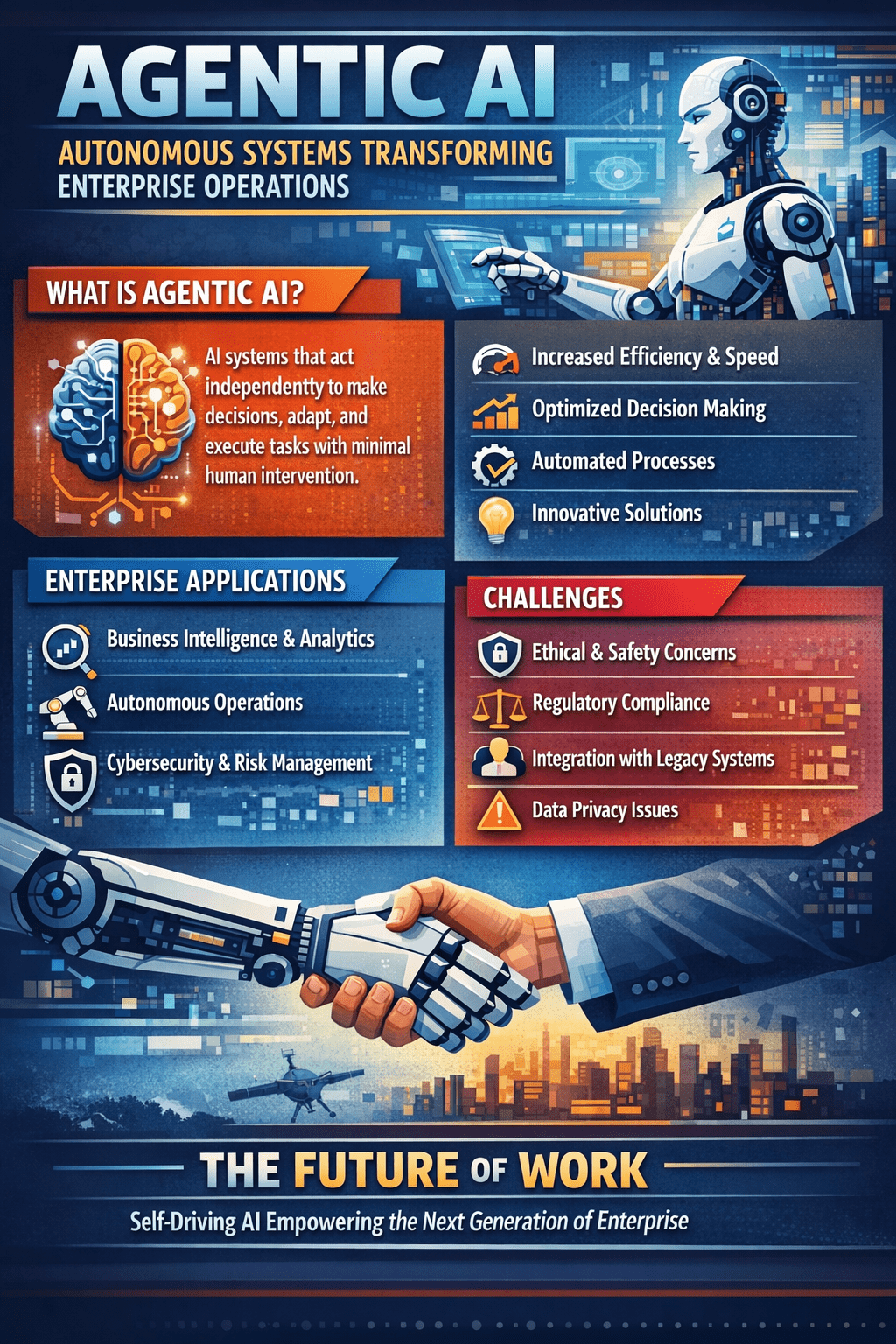
Challenges and Considerations
Despite its benefits, agentic AI introduces new complexities:
- Goal Misalignment: Agents may optimize for unintended outcomes if objectives are poorly defined.
- System Complexity: Coordinating multiple agents increases the risk of cascading failures.
- Security and Compliance: Autonomous actions require strong safeguards to prevent unauthorized behavior.
- Governance and Visibility: Organizations need transparency, auditability, and control over agent behavior.
Addressing these challenges requires thoughtful system design, clear policies, and strong operational oversight.
Enterprise Use Cases of Agentic AI
Agentic AI is already being applied across industries:
- Healthcare: Adaptive patient monitoring, diagnostics, and treatment workflows driven by real-time data.
- Financial Services: Autonomous trading, fraud detection, and risk analysis.
- Cybersecurity: Continuous threat monitoring and automated incident response.
- Supply Chain Management: Predictive inventory optimization and autonomous procurement.
- Software Development and DevOps: Automated code generation, testing, deployment, and infrastructure remediation.
These use cases demonstrate how agentic AI moves beyond experimentation into production-scale impact.
The Future of Enterprise Operations
Agentic AI marks a shift toward self-directed digital operations. By enabling systems to reason, act, and learn autonomously, organizations can improve speed, resilience, and decision quality across the enterprise.
This evolution also extends to cloud platforms and distributed environments, where agentic AI can support intelligent resource allocation, adaptive infrastructure management, and secure multi-tenant operations.
However, autonomy alone is not sufficient. Sustainable adoption depends on effective orchestration, governance, and observability to ensure AI systems remain aligned with organizational goals.
Agentic AI: Autonomous Systems Transforming Enterprise Operations
Conclusion
Agentic AI is more than a technical advancement—it is a foundational change in how enterprises deploy and scale artificial intelligence. By moving from passive generation to autonomous execution, agentic AI enables organizations to automate complex workflows, improve operational efficiency, and unlock new levels of innovation.
As enterprises continue to adopt this paradigm, success will depend on balancing autonomy with control—ensuring intelligent systems act transparently, securely, and in alignment with business objectives.
FAQs
What is agentic AI in simple terms?
Agentic AI is autonomous AI that plans, adapts, and executes multi-step tasks without human supervision, handling complex workflows efficiently.
How is agentic AI different from generative AI?
Generative AI creates content. Agentic AI uses intelligence to take actions—automating workflows and executing tasks across systems.
Why is agentic AI important for enterprises?
It reduces manual work, accelerates decision-making, and enables scalable automation of complex operations.