Introduction
What is Supernet? A Simple Guide to Network Aggregation
A supernet is a single, aggregated IP network formed from multiple contiguous smaller subnets. This technique reduces routing table size and simplifies network topology. In enterprise and service provider environments, understanding the supernet is essential for scalable architecture.
Network complexity expands as organizations adopt cloud services, IoT, and distributed workforces. Route aggregation is no longer optional—it is a fundamental requirement for operational efficiency. A properly implemented supernet delivers measurable improvements in router performance and administrative overhead.
The supernet concept addresses a persistent challenge: how to manage thousands of routes without overwhelming infrastructure. It consolidates address space logically rather than physically. This article explains what a supernet is, how it functions, and where it delivers practical value.
Core Definition and Terminolgy
What Is a Supernet?
A supernet, or supernetwork, is a block of contiguous IP subnets summarised under a single Classless Inter-Domain Routing prefix. The process of creating one is called supernetting, route aggregation, or route summarisation. Unlike subnetting—which divides networks—supernetting combines them.
What Supernetting Is Not
Supernetting does not create new IP addresses. It does not increase the total available address pool. It is not a substitute for proper subnet planning. It is an aggregation mechanism, not an expansion technique.
Key Terminology
CIDR (Classless Inter-Domain Routing) enables supernetting by eliminating rigid classful boundaries. The routing prefix defines the aggregate network address and its associated mask length. Route summarisation refers specifically to the advertisement of a single summary route instead of multiple specific routes.
Primary and Supporting Entities
The primary entity is the supernet itself—the aggregated network address block. Supporting entities include CIDR, subnet mask, routing table, IP address space, network prefix, routing protocol, and autonomous system. These entities form the operational framework for route aggregation.
What is Supernet? A Simple Guide to Network Aggregation
How Supernetting Works
The Aggregation Mechanism
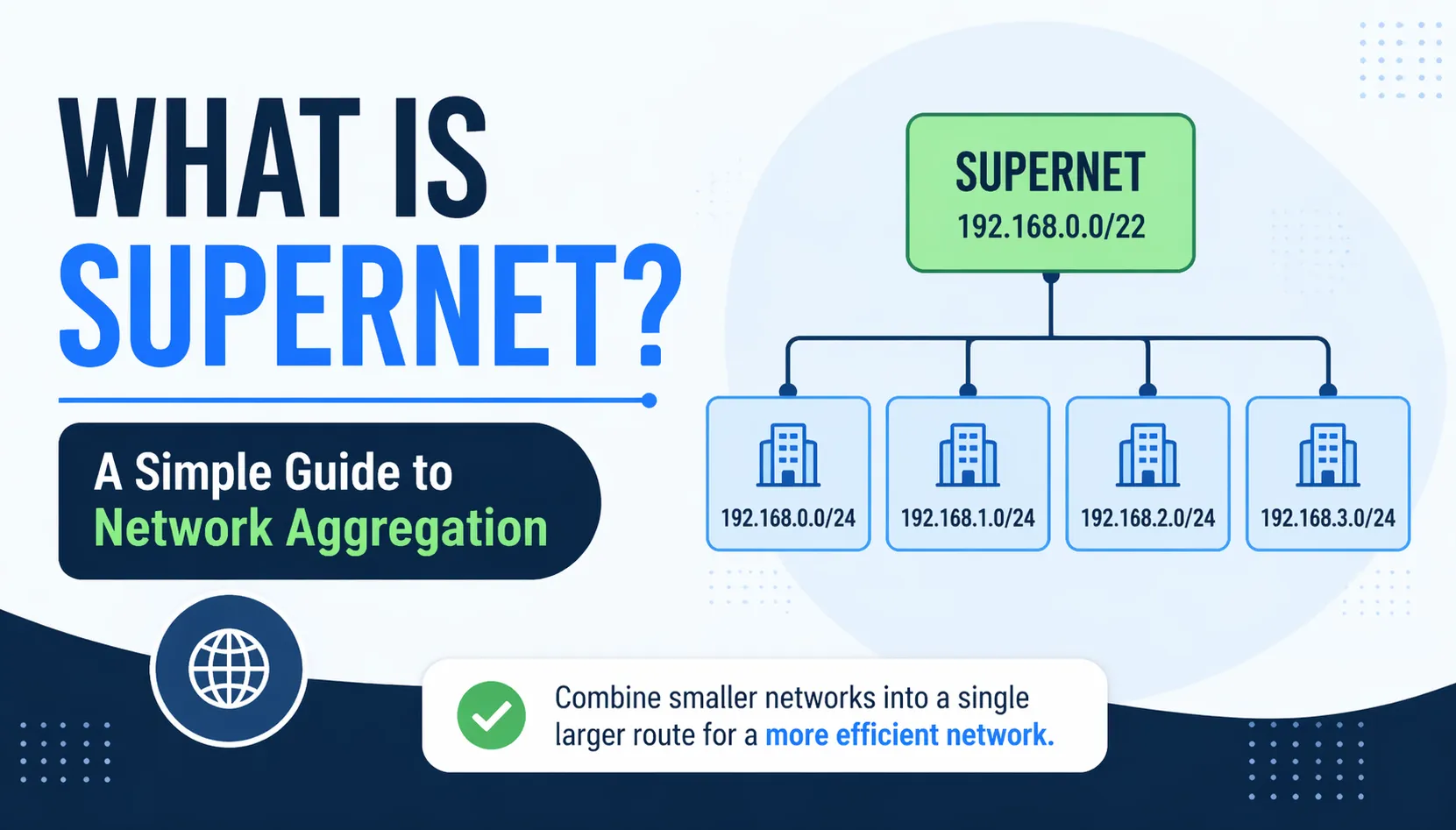
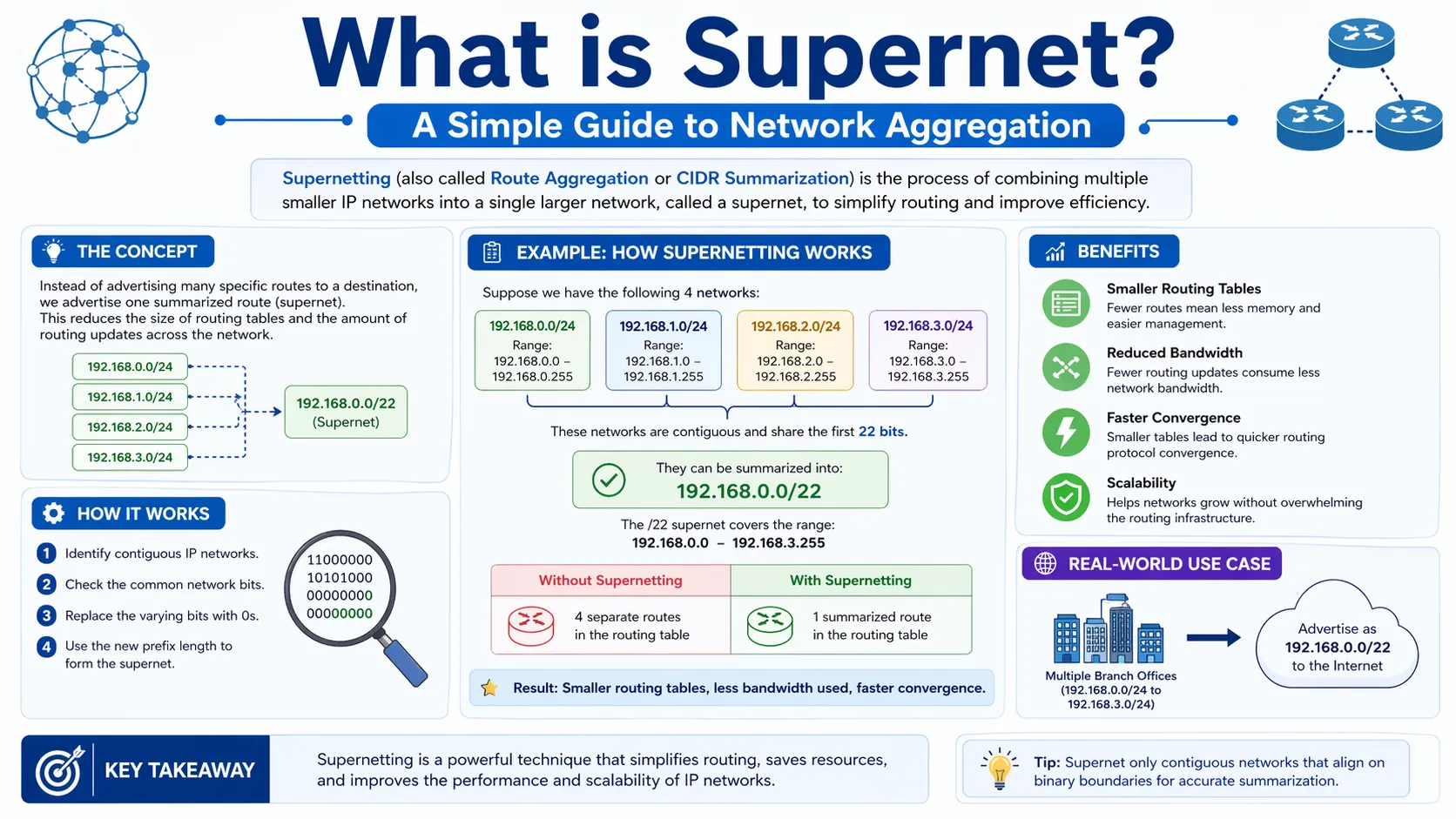
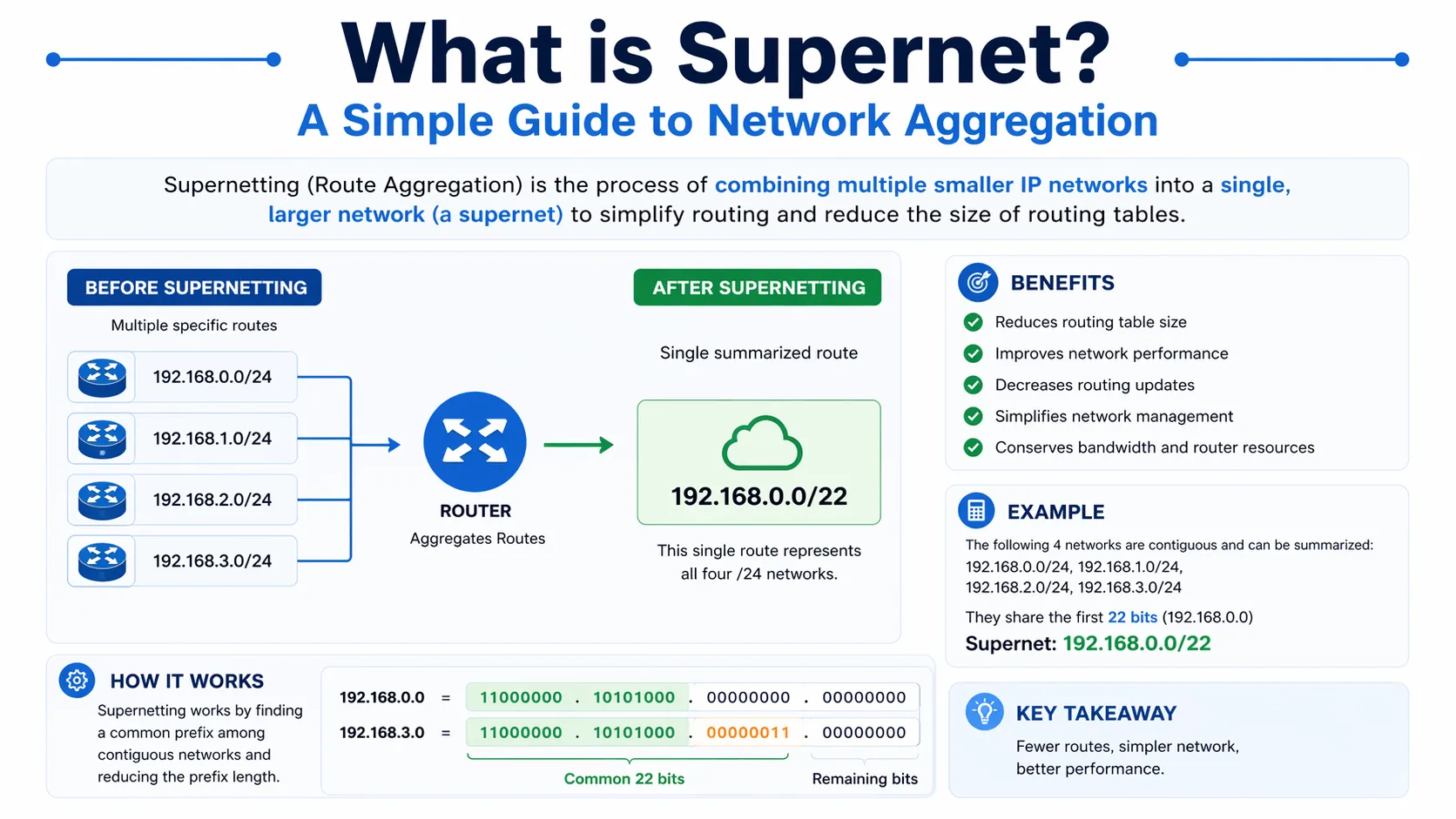
Supernetting reduces the network portion of an IP address by shortening the subnet mask. For example, four contiguous /24 networks become a single /22 supernet. The router then advertises one route instead of four.
Contiguity Requirement
Networks must be adjacent in address space to aggregate properly. You cannot combine 192.168.1.0/24 with 192.168.3.0/24 because the intervening 192.168.2.0/24 breaks continuity. This adjacency rule is non-negotiable.
Binary Alignment Rules
The starting network address must align with the supernet mask. For a /22 aggregation, the third octet of the first network must be divisible by four. Incorrect alignment produces invalid supernets that route traffic unpredictably.
Protocol Support Requirements
Classless routing protocols such as OSPF, EIGRP, IS-IS, and BGP support supernet advertisement. Legacy protocols like RIPv1 and IGRP do not carry subnet mask information and cannot participate in supernetting. Static routing also supports aggregation when configured correctly.
Real-World Scenario
Consider an ISP with five hundred customer /24 networks. Without aggregation, edge routers maintain five hundred individual route entries. With a supernet approach, a single /16 summary route covers all customers, dramatically reducing memory and CPU load.
Why Supernetting Matters
Routing Table Reduction
Every route entry consumes router memory and processing cycles. Large routing tables slow convergence and increase the risk of instability. Supernetting directly reduces entry count, improving overall network reliability.
Faster Convergence
When a link fails, routers must recalculate paths. Smaller routing tables accelerate this convergence process. Supernetting also localises topology changes—summary routes hide internal fluctuations from external peers.
Efficient Address Utilisation
Supernetting allows organisations to allocate address space in appropriately sized blocks. It avoids the waste inherent in classful addressing where a Class C network provides 254 hosts regardless of actual need. CIDR-based supernetting matches allocation to requirement.
Reduced Update Traffic
Routing updates consume bandwidth. Each network change triggers advertisements that propagate across the infrastructure. Summary routes reduce the volume and frequency of these updates, preserving bandwidth for user traffic.
Operational Simplification
Managing fewer route entries reduces configuration complexity. Troubleshooting becomes more straightforward when routing tables are compact. Supernetting supports hierarchical network design principles that scale with organisational growth.
Supernetting Versus Subnetting
Directional Difference
Subnetting extends the subnet mask to create smaller networks from larger ones. Supernetting shortens the mask to combine smaller networks into larger aggregates. These are complementary tools, not competing approaches.
Use Case Distinction
Subnetting applies within an organisation to segment traffic, isolate broadcast domains, and enforce security boundaries. Supernetting applies at aggregation points—WAN edges, ISP cores, and data centre interconnects—where route count reduction matters most.
Comparative Impact
Subnetting increases routing table entries. Supernetting decreases them. Subnetting adds granular control. Supernetting adds scalability. A well-architected network employs both techniques at appropriate boundaries.
Practical Example Comparison
A campus network with fifty VLANs uses subnetting to separate user, server, and management traffic. The WAN link advertising these fifty networks to a regional hub benefits from supernetting into a single summary route. Both techniques operate simultaneously.
Benefits and Limitations
Core Benefits
Supernetting delivers measurable advantages. Routing table size reduction is the primary benefit, directly lowering hardware requirements. Convergence acceleration improves network stability. Address allocation efficiency reduces waste.
Secondary Advantages
Administrative overhead decreases when fewer routes require documentation and troubleshooting. Bandwidth consumption for routing updates drops proportionally. Hierarchical network design becomes easier to implement and maintain.
Interoperability Risks
Legacy equipment running classful protocols cannot interpret supernet advertisements. Mixed environments require careful protocol selection or upgrade planning. This is a manageable but real consideration.
Suboptimal Routing Potential
Summary routes can mask more specific paths, occasionally directing traffic through suboptimal links. Careful planning mitigates this risk. The trade-off between route count reduction and path precision requires informed judgment.
Security Considerations
Aggregate routes expose a broader address range to routing advertisements. While this is generally acceptable, organisations with strict segmentation requirements should evaluate the impact. The supernet approach remains appropriate for most enterprise scenarios.
Best Practices For Implementation
Plan Address Space Hierarchically
Assign contiguous address blocks to regions, sites, or functions from the outset. This simplifies future aggregation. Retroactive supernetting is possible but more complex than planned allocation.
Verify Protocol Compatibility
Confirm that all routers participating in the aggregate run classless routing protocols. OSPF and EIGRP are suitable for internal use. BGP handles external aggregation. Replace or upgrade any RIPv1 or IGRP dependencies.
Validate Contiguity and Alignment
Check that aggregated networks are truly contiguous and that the starting address aligns with the proposed mask. Use CIDR calculators or reference charts to verify calculations. A misaligned supernet creates routing black holes.
Test in Staging First
Implement supernet advertisements in a controlled environment before production deployment. Verify that traffic flows correctly to all constituent subnets. Confirm that failover behaviour meets expectations.
Document the Aggregation Scheme
Maintain clear records of which subnets belong to each supernet. Include the rationale for mask selection. Documentation supports troubleshooting and future capacity planning. It also ensures continuity across team changes.
Monitor Routing Table Size
Establish baseline route counts and track changes over time. Unexpected increases may indicate aggregation failures or configuration drift. Monitoring validates that supernetting delivers intended benefits.
Real-World Applications
Internet Service Providers
ISPs use supernetting extensively to summarise customer routes. A regional provider aggregates hundreds of client networks into a single BGP advertisement. This reduces global routing table size and improves peering efficiency.
Enterprise WANs
Large organisations with multiple branch locations aggregate site networks at regional hubs. A single summary route per region replaces dozens of individual site advertisements. This simplifies core routing and accelerates convergence.
Data Centre Fabrics
Modern data centres employ spine-leaf architectures with route summarisation at the border. Supernetting reduces the route count advertised from leaf switches to spine switches. This scales fabric performance efficiently.
Cloud Interconnects
Organisations connecting on-premises networks to cloud providers benefit from route aggregation. Advertise a single supernet to the cloud gateway rather than multiple subnets. This simplifies both configuration and ongoing management.
VPN Concentrators
Site-to-site VPN deployments use supernetting to summarise remote network routes. The head-end concentrator maintains summary routes rather than individual tunnel destinations. This improves scalability for organisations with many remote sites.
What is Supernet? A Simple Guide to Network Aggregation
Conclusion
The supernet is a foundational concept in scalable IP networking. It addresses the persistent challenge of route table growth through logical aggregation rather than hardware expansion. As networks continue to expand—across campuses, clouds, and continents—supernetting remains an essential discipline for architects and engineers alike.
Route aggregation will only grow in importance as IPv6 adoption accelerates and hybrid architectures multiply.
Evaluate your current route aggregation strategy. Identify opportunities to consolidate. The effort invested in proper supernetting yields returns in performance, stability, and manageability for years to come.
FAQS
Can any networks be combined into a supernet?
No. Only contiguous address blocks with proper binary alignment can be aggregated. The starting address must be divisible by the number of networks being combined.
Does supernetting work with IPv6?
Yes. IPv6 was designed with aggregation in mind and supports supernetting natively. The same principles apply, though address space is vastly larger.
What happens if a router does not support supernetting?
Classful routers ignore the mask information and may route traffic incorrectly. All devices in the aggregate path must support classless routing protocols or static routing with explicit masks.