
Artificial Intelligence (AI): The Complete 2026 Guide
Introduction
In 2026, Artificial Intelligence (AI) has decisively moved from being a tool to becoming a collaborative partner that fundamentally restructures how we work, innovate, and compete. The central focus is no longer on building the largest models but on orchestrating systems of intelligence that deliver measurable, real-world impact. This guide synthesizes expert insights and data to navigate the most transformative Artificial Intelligence (AI) trends, strategies, and challenges defining the year.
For businesses and professionals, understanding this landscape is critical, as the emphasis shifts from pilot projects to tangible Return on Investment (ROI), making 2026 the definitive “show me the money” year for Artificial Intelligence (AI).
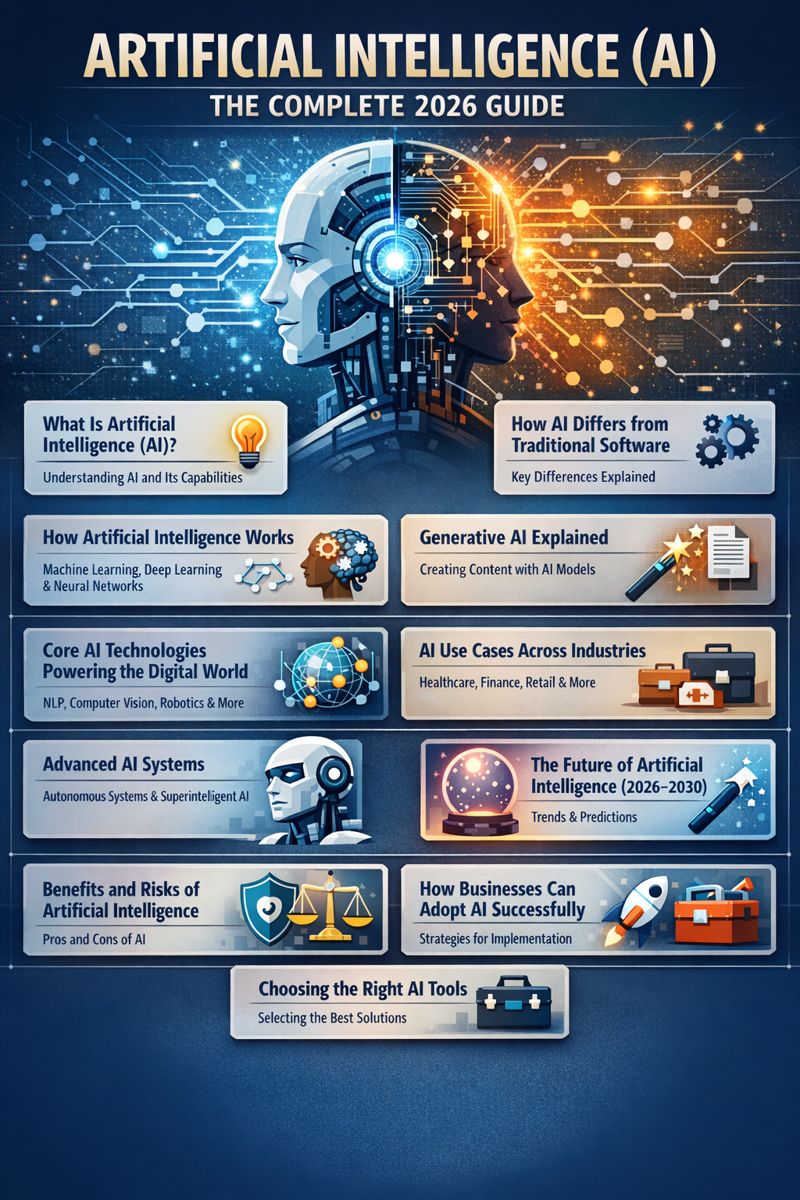
What Is Artificial Intelligence (AI)?
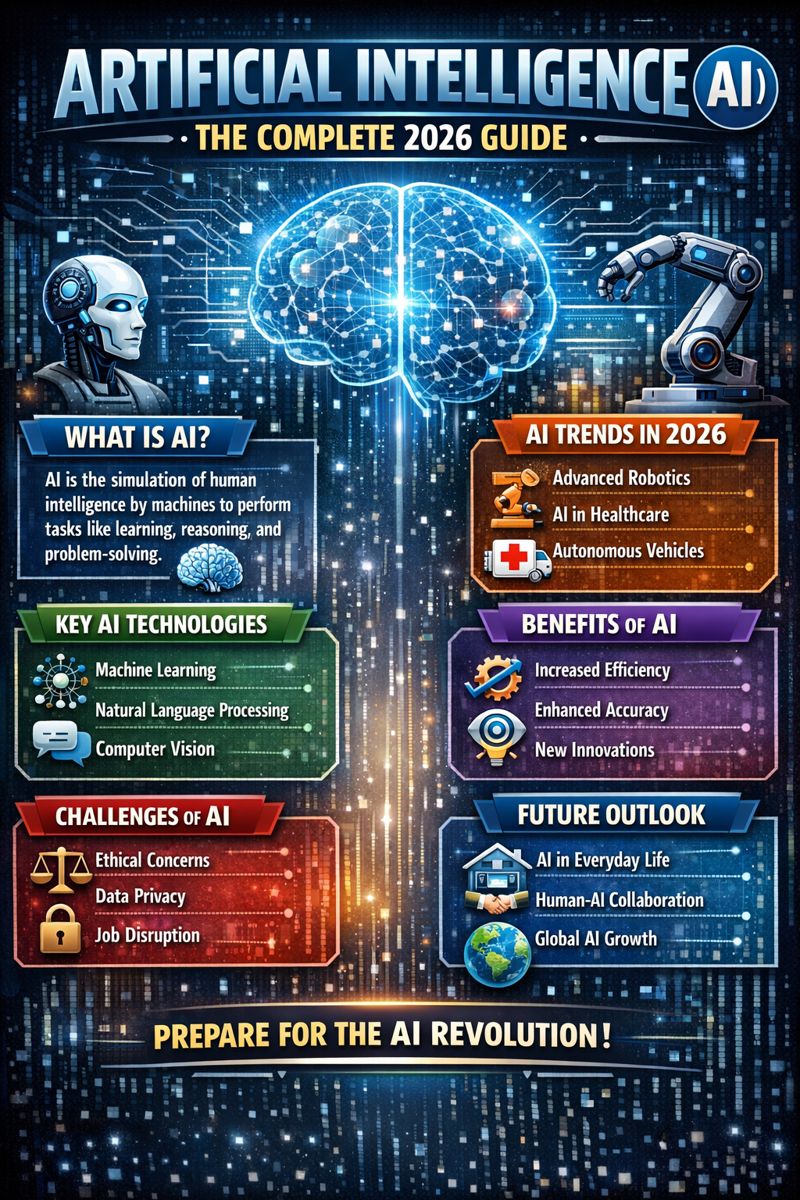
In 2026, Artificial Intelligence (AI) is understood as a constellation of technologies that enable systems to perform complex tasks, reason, and create, often acting as proactive collaborators rather than passive tools.
Simple Definition of AI
At its core, AI refers to computer systems designed to perceive, learn, reason, and act. If traditional software follows static instructions, AI systems adapt and make decisions based on data patterns and contextual understanding.
How AI Differs from Traditional Software
The paradigm has shifted from automation to augmentation. Unlike rigid traditional programs, advanced AI agents in 2026 can anticipate needs, plan multi-step workflows, and execute tasks with minimal prompting, moving from answering questions to proactively getting things done.
Artificial Intelligence (AI): The Complete 2026 Guide
How Artificial Intelligence Works
Modern AI functions through specialized subfields that enable understanding and interaction.
Machine Learning Explained
Machine Learning (ML) remains the engine, where algorithms learn from data. The 2026 evolution is towards more efficient, smaller models that can handle specific tasks cost-effectively, emphasizing “scaling efficiency” over sheer computational size.
Natural Language Processing (NLP)
NLP allows AI to comprehend and generate human language. Progress is now measured by a model’s ability to understand the deeper context and intent behind queries, not just the words themselves.
Computer Vision and Pattern Recognition
This enables AI to interpret visual data. By 2026, this capability will be central to “AI going physical,” powering autonomous robots in warehouses and factories, where machines navigate and optimize complex physical environments.
Generative AI Explained
What Is Generative AI?
Generative AI creates original content—text, images, code, or media—by learning the underlying patterns of its training data. It has evolved from a novelty to a core business tool for ideation and content creation.
How ChatGPT and LLMs Work
Models like ChatGPT are built on Large Language Models (LLMs). The frontier in 2026 is “reasoning models” that go beyond predicting text to logically working through problems, enabling more reliable and complex task execution.
Generative AI vs Traditional AI
Traditional (or discriminative) AI analyzes data to classify or predict. Generative AI synthesizes data to create new, original outputs. The former is used for detection and recommendation; the latter for creation and innovation.
Core AI Technologies Powering the Digital World
Cloud Computing & Edge Computing
The infrastructure strategy is maturing. While the cloud provides scale, Edge AI is moving from hype to reality, enabling faster, more private processing on local devices, which is crucial for real-time applications like autonomous systems.
AI and Quantum Computing
2026 is predicted to be a landmark year, with experts forecasting the first instance of a quantum computer outperforming a classical computer on a practical problem. This convergence promises breakthroughs in material science and complex optimization.
AI and 5G and 6G Networks
Next-generation networks provide the high-speed, low-latency connectivity required to manage distributed AI systems and the Internet of Things (IoT), enabling seamless real-time data flow for smart cities and connected devices.
AI Use Cases Across Industries
AI in Business & Marketing Automation
AI is orchestrating entire campaigns, handling data analysis and personalization. The focus is on “super agents” that operate across software environments, allowing small teams to achieve outcomes previously requiring large departments.
AI in Healthcare & Health Tech Innovations
AI is transitioning from advanced diagnostics to real-world care delivery, assisting with triage and treatment planning. It is seen as a critical tool to address global healthcare worker shortages by augmenting clinical capabilities.
AI in Cybersecurity & Data Privacy
As AI becomes a target for attacks, it also becomes the primary line of defense. Security models are evolving to be “ambient and autonomous,” with AI agents continuously monitoring for and responding to threats at machine speed.
AI in Smart Homes, IoT & Wearables
Intelligence is becoming embodied in the physical world. From million-robot fleets in logistics to smart home ecosystems, AI is optimizing environments and processes through real-time sensor data and autonomous decision-making.
AI in Finance, DeFi & Blockchain
In finance, AI agents are moving into high-value workflows like demand forecasting and hyper-personalization. They bring a new level of automation and insight to complex, data-intensive financial processes.
Advanced AI Systems
Digital Twins
These are virtual, AI-powered replicas of physical assets or systems. They use real-time data to simulate, predict, and optimize performance, enabling preventative maintenance and innovative scenario testing without real-world risk.
Robotic Process Automation (RPA)
RPA is evolving into intelligent automation. Infused with AI, software “bots” can now handle unstructured data and make contextual decisions, moving beyond rigid rule-following to manage more complex workflows.
Autonomous Vehicles & Robotics
AI integration is making physical systems more capable and independent. In manufacturing, AI coordinates entire fleets of autonomous vehicles and robots, improving operational efficiency and safety.
The Future of Artificial Intelligence (2026–2030)
AI + Metaverse, AR & VR
AI will be the engine for creating dynamic, interactive virtual worlds. It will generate intelligent environments and realistic avatars, making immersive experiences truly responsive and personalized.
Ethical AI & Governance
With rapid adoption, operationalizing Responsible AI (RAI) is a top priority. This involves implementing technical governance tools—like automated red teaming—and clear human oversight protocols to manage risks in agentic systems.
Sustainable AI Infrastructure
The massive compute demand is driving an industry-wide focus on efficiency. The race is toward “Green AI,” using specialized chips, novel architectures like chiplets, and quantum-assisted optimizers to reduce the environmental footprint.
Benefits and Risks of Artificial Intelligence
Key Advantages
The benefits are profound: AI amplifies human potential, enables small teams to tackle massive projects, accelerates scientific discovery, and drives unprecedented efficiency. It is the cornerstone of competitive advantage.
Challenges, Bias & Security Risks
Key challenges include the high failure rate of poorly planned agentic projects, the risk of deploying “lonely agents” that sit unused, algorithmic bias, and sophisticated AI-powered cyber threats. Success depends on strategic redesign, not just automation.
How Businesses Can Adopt AI Successfully
Step-by-Step AI Adoption Framework
- Lead with Problems, Not Technology: Executives must pinpoint a few high-value workflows where AI can drive transformational outcomes, not incremental gains.
- Redesign, Don’t Just Automate: Avoid simply applying AI to broken processes. Reimagine the workflow from first principles for an AI-native approach.
- Start with an “A-Team”: Deploy your best talent to these focused initiatives to ensure tight integration between business goals and technical execution.
- Measure Relentlessly: Move beyond tracking pilots and tokens. Define and measure hard metrics tied directly to business value and ROI.
Choosing the Right AI Tools
The competition is shifting from models to systems. The winners will be platforms that excel at orchestration—seamlessly routing tasks between specialized models and tools. Choose tools based on their ability to integrate into cohesive systems that understand context and “just work.”
Artificial Intelligence (AI): The Complete 2026 Guide
Conclusion
The story of Artificial Intelligence (AI) in 2026 is defined by integration, impact, and pragmatism. The era of fascination has given way to a disciplined march toward value, where success is measured in dollars, not just technological prowess. The organizations that will thrive are those that possess the courage to redesign processes fundamentally, the focus to execute deeply on a few strategic priorities, and the agility to orchestrate human-AI collaboration at scale. The future belongs not to those with the most AI, but to those who use it most intelligently.
FAQs
What’s the single biggest mistake companies make with AI in 2026?
The most common failure is crowdsourcing scattered pilot projects without a top-down strategic focus. This leads to wasted resources and “lonely agents” that never integrate into core operations or deliver measurable value.
Is traditional SEO dead because of AI Overviews and chatbots?
Not exactly—it has evolved. For informational searches, success is no longer defined solely by ranking at the top of traditional results. The priority is being referenced and surfaced within AI-generated responses.
How do we prepare our workforce for an AI-driven future?
Focus on cultivating AI generalists and orchestrators. As agents handle specialized tasks, demand grows for professionals who can manage these systems, align them with business goals, and focus on higher-level strategy, creativity, and human-centric tasks.


: The Complete 2026 Guide)