USA AI Strategy 2026: Building the Sovereign Engine of Global Power
Introduction
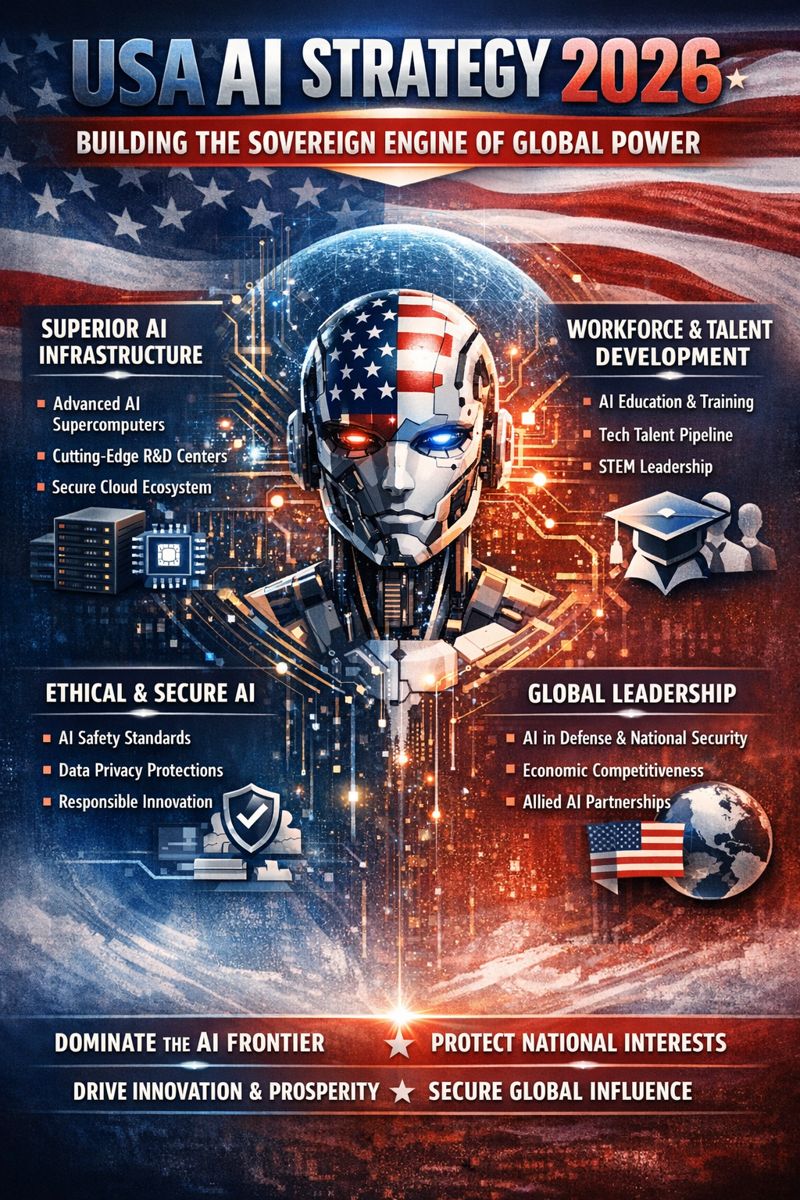
The United States has entered a decisive execution phase of its technological agenda, centered on a single, powerful objective: the USA AI Strategy. This comprehensive plan is focused on moving artificial intelligence from research labs into the very foundation of national power. The USA AI Strategy is not merely about building better algorithms; it is an industrial-scale project to construct sovereign intelligent infrastructure, achieve hardware independence, and establish global governance norms.
The successful implementation of the USA AI Strategy is what will determine the nation’s economic competitiveness and strategic autonomy for decades to come.
USA AI Strategy 2026: Building the Sovereign Engine of Global Power
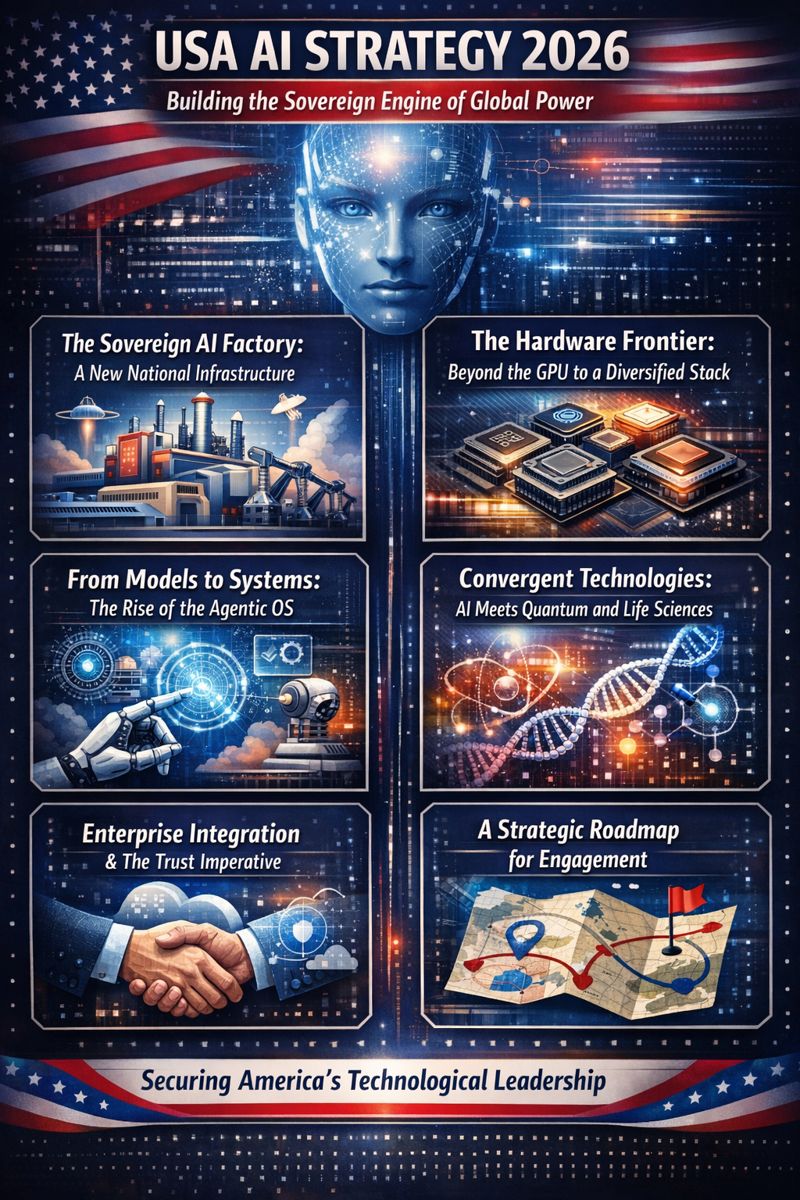
The Sovereign AI Factory: A New National Infrastructure
The core of the US strategy is the construction of advanced AI infrastructure, which executives have framed as “our generation’s Apollo moment.” This involves building massive, sovereign computational capacity. Landmark projects like the collaboration with the US Department of Energy are creating record-breaking supercomputers (e.g., the 100,000-GPU Solstice system) for scientific and national security research.
Private industry is executing a parallel, gigawatt-scale buildout. Companies like Lambda and xAI are constructing massive data centers in Missouri and Tennessee, housing tens of thousands of next-generation processors. These are not merely server farms; they are AI factories designed to generate intelligence as a strategic commodity.
- Mechanism: This infrastructure leverages a blueprint called Omniverse DSX, which integrates digital twin technology from partners like Siemens and Bechtel to optimize every aspect of design, power, and cooling.
- Impact: The outcome is a sovereign, high-performance foundation for the nation’s most critical workloads, from drug discovery at Eli Lilly to climate modeling at national labs, insulating US innovation from external dependencies.
The Hardware Frontier: Beyond the GPU to a Diversified Stack
Sovereignty in AI is impossible without control over the underlying hardware. The US strategy now emphasizes hardware efficiency and diversification beyond a single chip architecture. This shift from a pure “scale-up” approach to a combined “scale-up and scale-out” model is a key trend for 2026.
While NVIDIA’s GPUs remain foundational, the landscape is expanding. Alphabet leverages its decade-long lead with custom Tensor Processing Units (TPUs), giving it a structural cost advantage. Furthermore, the industry is exploring new chip classes, including ASIC-based accelerators, chiplets, and analog inference systems, especially for the emerging demands of agentic workloads.
- Mechanism: Strategic corporate maneuvers reinforce this. NVIDIA’s investments in companies like Groq aim to integrate specialized inference technology, broadening its platform’s capabilities for real-time applications.
- Impact: This diversified hardware strategy increases resilience, optimizes performance-per-watt for different AI tasks (from massive training to efficient edge inference), and reduces strategic bottlenecks.
From Models to Systems: The Rise of the Agentic OS
Leadership is shifting from who builds the best single model to who builds the most effective AI system. In 2026, AI models are becoming a commodity; the true differentiator is the orchestration layer that combines models, tools, and workflows into cohesive, autonomous systems.
This evolution is giving rise to the Agentic Operating System (AOS), a foundational software layer that standardizes how intelligent agents are orchestrated, secured, and governed. These systems move from being tools to active collaborators. Microsoft envisions AI agents as digital coworkers, enabling small teams to tackle global-scale projects by handling execution while humans steer strategy.
- Mechanism: Enterprises are moving beyond monolithic AI processing to agentic parsing, where a team of specialized AI agents collaboratively interpret complex documents or data, each handling the element it understands best.
- Impact: This transforms enterprise productivity and software development itself. The industry is evolving from “vibe coding” to an “Objective-Validation Protocol,” where humans define goals and autonomous agent swarms execute the steps to achieve them.
Convergent Technologies: AI Meets Quantum and Life Sciences
The US advantage is being amplified by the strategic convergence of AI with other frontier technologies. A primary example is the partnership between AI and quantum computing. Researchers are entering a “years, not decades” era where quantum advantage—solving problems beyond classical computers—is within reach.
The integration is creating a powerful new paradigm: hybrid computing. Here, AI identifies patterns, supercomputers run simulations, and quantum processors tackle specific, complex calculations with far greater accuracy, particularly in modeling molecules and advanced materials. This convergence is projected to unlock breakthroughs in drug development, financial optimization, and next-generation battery or solar cell design.
- Mechanism: Beyond quantum, AI is becoming central to the scientific process itself. In life sciences, it is transitioning from analyzing data to actively generating hypotheses and controlling lab equipment, acting as a true research partner.
- Impact: This positions the US to lead in high-value, foundational industries. The ability to simulate molecular interactions for new therapies or design superior materials for green technology represents both an economic and a strategic competitive edge.
Enterprise Integration and the Trust Imperative
For the strategy to succeed, AI must be effectively integrated into the core operations of the economy. The focus for 2026 is moving from spectacle to substance and widespread diffusion. Success requires moving beyond isolated pilots; studies show over 30% of generative AI projects are abandoned after proof-of-concept.
Building trust through governance is now a prerequisite for adoption. This involves implementing rigorous AI governance frameworks that ensure security, explainability, and ethical alignment. As AI agents join the workforce, security experts stress the need to give each agent a clear digital identity and strict access controls, treating them with the same seriousness as human employees to prevent them from becoming potential security risks.
- Mechanism: Leaders are urged to treat AI platforms as critical infrastructure, assessing dependency and resilience while prioritizing integration use cases that measurably reduce friction.
- Impact: Proper integration and governance unlock measurable ROI beyond cost savings, driving new revenue streams, enhancing customer trust, and enabling enterprises to become market disruptors rather than being disrupted.
A Strategic Roadmap for Engagement
For global businesses and policymakers, navigating this landscape requires a clear plan. The following table outlines a phased approach to engaging with the US-led AI ecosystem.
| Timeframe | Strategic Posture | Key Actions |
| Immediate (Now – 1 Year) | Assess & Pilot | Audit technological dependencies on US platforms. Pilot high-impact, low-risk AI use cases aligned with core business goals. Implement a foundational AI governance committee. |
| Medium-Term (1-3 Years) | Integrate & Scale | Formalize partnerships with key US cloud and AI platform providers. Embed AI agents into core business processes (e.g., supply chain, customer service). Develop in-house AI talent fusion teams. |
| Long-Term (3-5 Years+) | Co-create & Lead | Collaborate with US partners on convergent tech (e.g., quantum-AI for R&D). Develop new, AI-native business models and revenue streams. Advocate for and help shape interoperable global AI standards and ethics frameworks. |
USA AI Strategy 2026: Building the Sovereign Engine of Global Power
Conclusion: The Architecture of Leadership
The US strategy for AI is a masterclass in industrial policy for the digital age. It recognizes that technological sovereignty is built not through regulation alone, but through the concrete construction of intelligent infrastructure, the diversification of critical hardware, and the development of foundational software systems like the Agentic OS. This integrated approach ensures that the next wave of global inventions and economic value is generated within a US-anchored ecosystem. For international partners and competitors alike, the task is no longer to question if this shift is happening but to strategically determine how to engage with, build upon, or ethically counterbalance this new architectural reality of global power.
FAQs
What is the most critical component of the US AI strategy?
The build out of sovereign, gigawatt-scale AI factory infrastructure on US soil is the foundational physical component, as it anchors the entire ecosystem of innovation and application.
How is the focus of AI innovation changing in 2026?
The competition is shifting from building larger AI models to creating superior AI systems and agentic operating systems that orchestrate multiple models and tools to perform complex, autonomous workflows.
Can other regions compete with the US AI ecosystem?
Regions can compete in specific verticals or research areas, but the integrated scale of the US public-private infrastructure build out, talent concentration, and platform dominance creates a compounding advantage that is difficult to replicate in the near term.