AI Evolution: Shaping the Future of Intelligence
Introduction
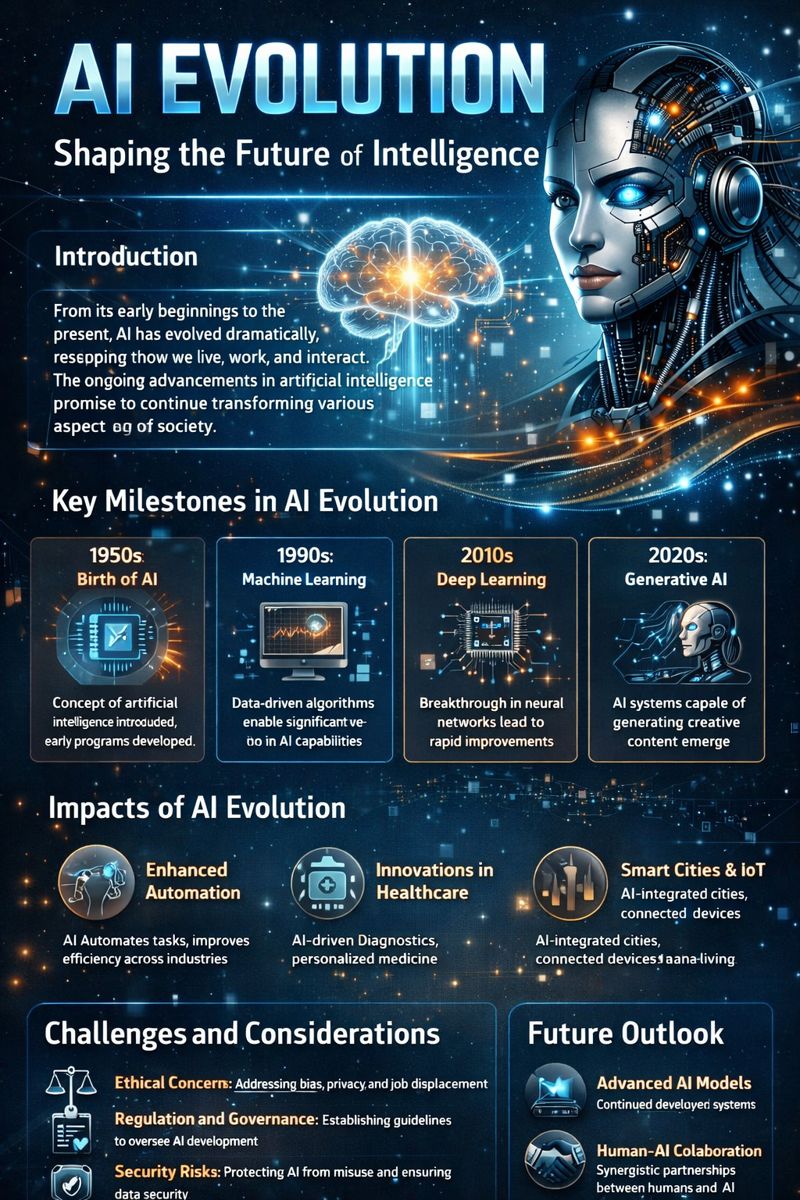
AI Evolution is redefining how businesses and individuals interact with technology. From generative AI and predictive analytics to autonomous systems, AI evolution is accelerating innovation, efficiency, and decision-making across industries. Companies leveraging machine learning and AI-powered automation gain a competitive edge by optimizing processes, reducing costs, and enhancing customer experiences.
AI Evolution also extends to smart infrastructure, including AI-powered edge devices, intelligent robotics, and cloud-based AI platforms, enabling real-time insights and adaptive operations. As the adoption of AI grows, organizations face challenges in ethics, bias, and governance, making responsible AI a critical focus.
Staying informed about AI Evolution allows businesses, developers, and consumers to harness emerging technologies safely and effectively. The future of AI is not just digital intelligence—it’s proactive, tangible, and integrated into everyday life, shaping smarter, faster, and more sustainable solutions.
AI Evolution: Shaping the Future of Intelligence
Agentic AI & Autonomous Work: Conversation to Execution
A defining transformation is the widespread shift from passive chatbots toward proactive, goal-driven AI agents. Unlike their predecessors, these agents can perceive a goal, reason about multi-step workflows, and execute actions across applications without constant human guidance.
- Mechanism: Modern AI agents, built on platforms like Google’s Agentic AI platform, combine sophisticated reasoning with the ability to use digital tools. They can access real-time data from connected systems—like calendars, inventory databases, or web browsers—to plan and complete tasks such as booking complex travel or conducting in-depth market research.
- Impact: The impact is profound. In e-commerce, agentic commerce is redefining the customer journey. AI shopping concierges act as hyper-personalized guides, understanding natural language requests like “I need an outfit for a rainy outdoor wedding” and instantly cross-referencing inventory, weather data, and style guides to suggest a perfect bundle. In business operations, multi-agent systems are beginning to orchestrate entire workflows, from supply chain logistics to IT infrastructure management, making proactive decisions to optimize performance. The question for leaders is no longer whether to use AI agents, but whether their competitors’ agents are already outperforming their human-only workflows.
High-Speed Reasoning Models: Intelligence at the Speed of Thought
The insatiable demand for real-time AI has driven a focus on high-speed reasoning models. The frontier is defined not by raw model size, but by achieving elite reasoning capabilities with minimal latency and cost.
- Mechanism: This is achieved through architectural innovations like small language models and efficiency-focused training. Models such as Gemini 3 Flash are engineered to deliver “frontier intelligence built for speed,” offering pro-grade reasoning at a fraction of the cost and latency. Developers can finely tune the thinking level parameter to balance reasoning depth with speed, enabling everything from simple chat to complex coding tasks. Furthermore, expanding context windows (up to one million tokens) allow these models to process and “remember” vast amounts of information in a single session, which is crucial for complex agentic tasks.
- Impact: This enables applications previously constrained by delay or cost. Developers can build near real-time, interactive AI for video game assistants or live design A/B testing. For consumers, it powers instantaneous, complex assistance in search and productivity apps, making AI a seamless and responsive extension of their thought process.
Scientific & Medical Breakthroughs: The AI Co-Scientist
AI has matured into a primary co-scientist in labs and clinics, moving beyond data analysis to active hypothesis generation and discovery.
- Mechanism: By applying advanced pattern recognition to massive, complex datasets—from genomic sequences to medical imagery—AI models can identify subtle correlations invisible to humans. In healthcare, this allows for the diagnosis of rare conditions from standard tests and the prediction of diseases like dementia with remarkable accuracy by analyzing biomarkers in EEG or X-ray data.
- Impact: The result is accelerated breakthroughs. In drug discovery, AI-designed molecules for oncology and rare diseases are now progressing through mid-to-late-stage clinical trials, potentially shortening development timelines from years to months. This trend is transforming healthcare into a more predictive and personalized field while simultaneously opening new frontiers in climate science and materials engineering.
Embodied AI & Hardware: Cognitive Systems Manifest Physically
The “Great Physical Breakout,” where AI escapes the confines of screens and gains embodied intelligence through robots and advanced hardware.
- Mechanism: The key enabler is the shift from Large Language Models (LLMs) to Large Action Models (LAMs). Trained in high-fidelity digital simulations, these models develop an intrinsic understanding of physics and 3D space, allowing them to translate digital reasoning into physical action. This is paired with a hardware renaissance: advancements in tactile sensing, dexterous manipulation, and efficient, specialized chips are finally providing capable “bodies” for AI “brains.”
- Impact: This convergence is triggering a productivity boom. In manufacturing and logistics, humanoid robots like Tesla Optimus are taking on repetitive, high-strain tasks, increasing throughput by 20-30%. In daily life, AI-powered wearables with “augmented hearing” can isolate a single voice in a crowd, while early “home helper” robots are beginning to manage unstructured chores. The global economy is beginning to address labor shortages by deploying physical AI for “dull, dirty, and dangerous” work.
Advanced Infrastructure: The Engine for an AI-First World
Supporting these advancements requires a radical rethinking of computing infrastructure. The focus has shifted from pure capacity to building holistic, intelligent, and sustainable ecosystems.
- Mechanism: Two parallel revolutions are underway. First, at the hardware level, modular chiplet designs and 3D integration are replacing monolithic chips, allowing for more powerful, efficient, and customizable AI accelerators. Second, data centers are evolving into AI-first. They are deploying autonomous IT management systems that self-optimize and predict failures and are exploring decentralized architectures powered by blockchain for greater security and resilience.
- Impact: This intelligent infrastructure is what makes scaling AI possible. It ensures the massive computational demands of training frontier models can be met reliably and sustainably. It also enables the efficient distribution of intelligence across cloud, edge, and physical devices, creating a seamless continuum where tasks are processed where it makes the most sense—whether in a central data center or on a robot in a factory.
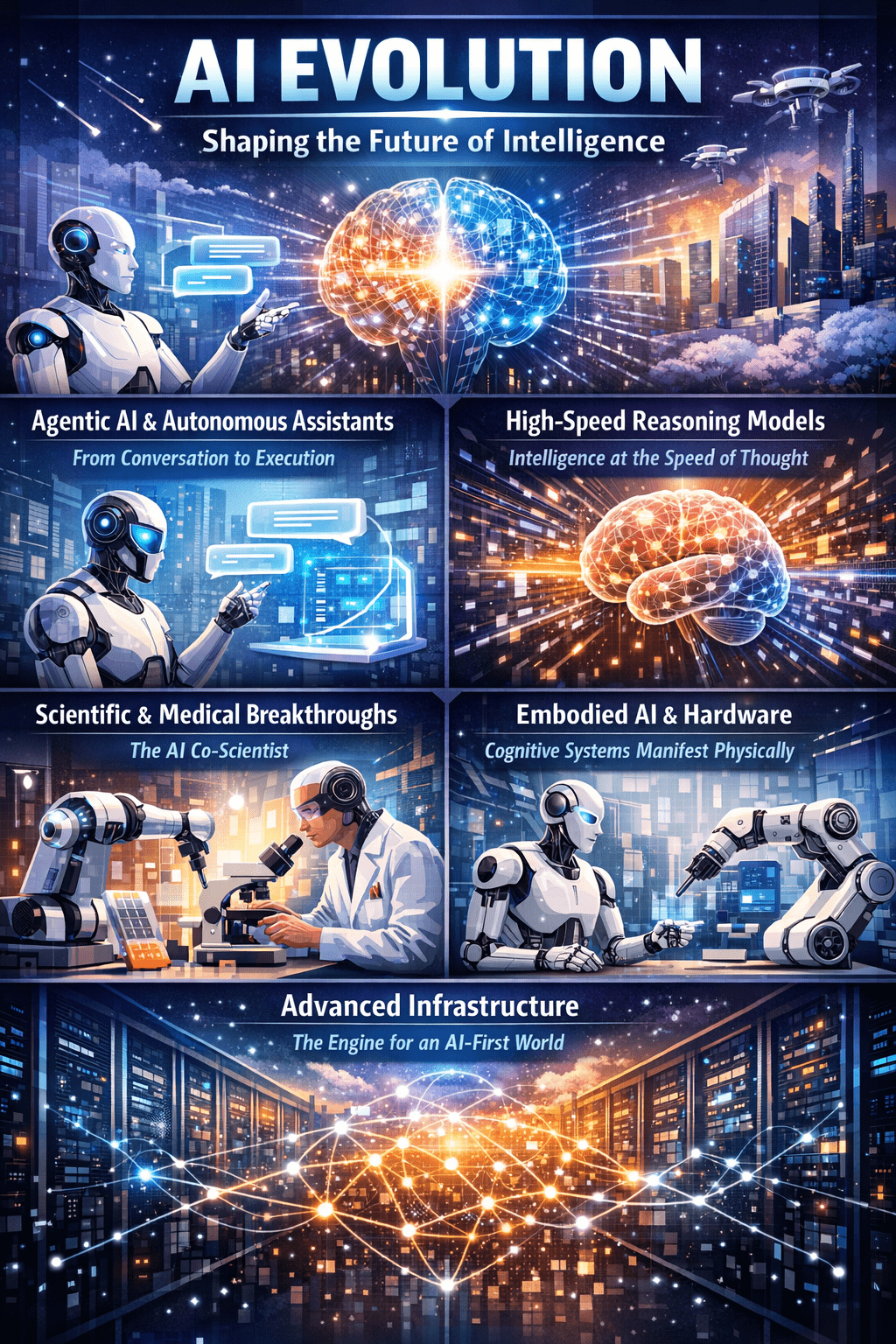
AI Evolution: Shaping the Future of Intelligence
Conclusion
AI is becoming agentic, embodied, and embedded. It is transitioning from a tool we use to a partner we collaborate with, one that can act in the digital and physical worlds with growing autonomy and intelligence. The implications for business productivity, scientific discovery, and daily life are profound. For organizations and individuals, the strategic imperative is to move beyond experimentation and focus on integrating these agentic, contextual, and physical AI systems into core operations and workflows. The era of passive AI is over; the age of the active AI partner has begun.
FAQs
What does AI evolution mean?
AI evolution refers to the shift toward smarter, autonomous, and multimodal systems. These systems learn faster, act proactively, and integrate seamlessly into real-world applications.
How is AI evolution impacting businesses?
AI enables automation, predictive insights, and personalized experiences at scale. Businesses use evolved AI to improve efficiency, reduce costs, and drive innovation.
What technologies are driving AI evolution today?
Generative AI, machine learning, AI accelerators, and edge computing are key drivers. Together, they enable faster processing, real-time intelligence, and scalable deployment.