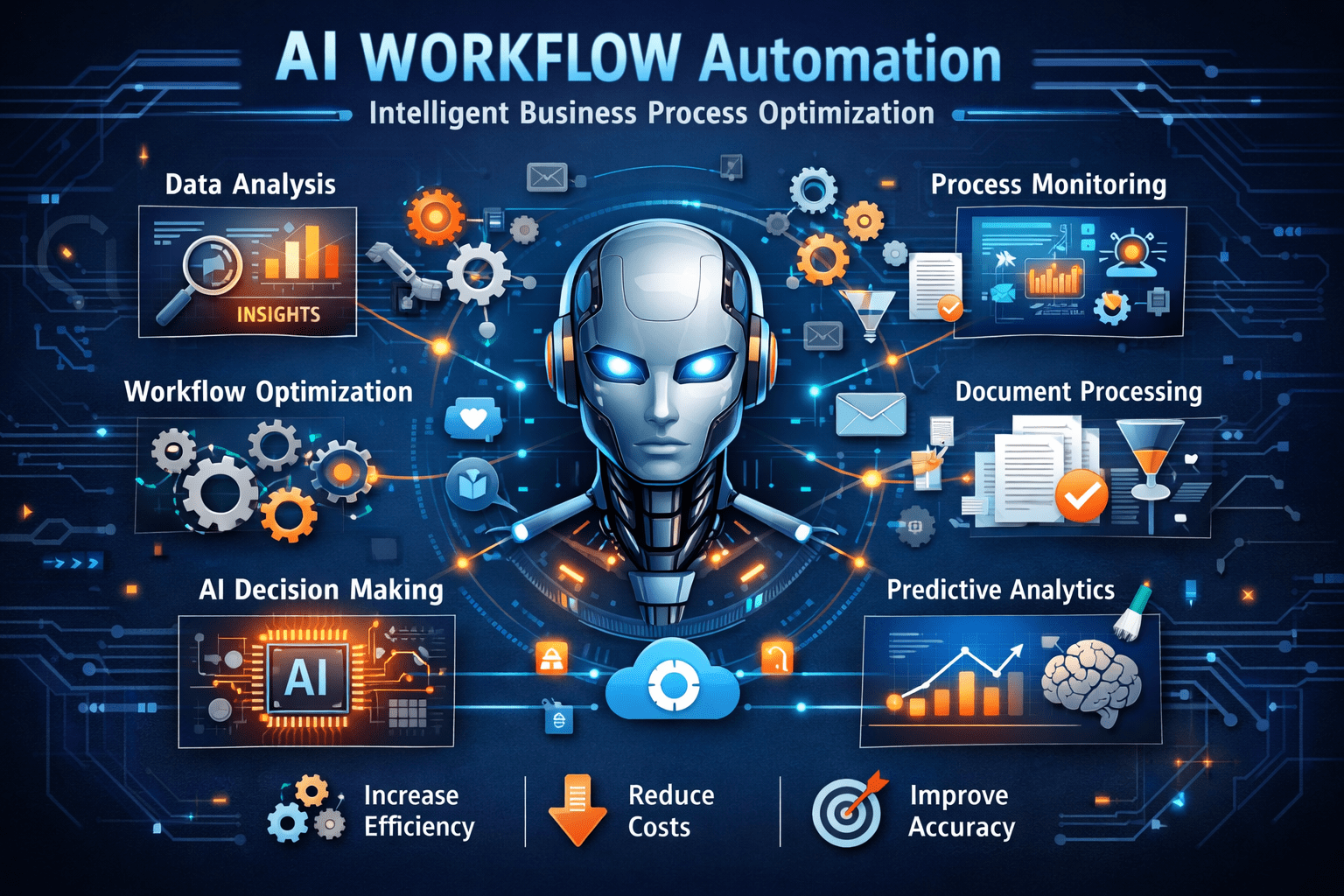
AI Workflow Automation: Intelligent Business Process Optimization
Introduction
AI Workflow Automation combines artificial intelligence, business process automation, and intelligent decision-making to create systems that perform complex tasks, adapt to changing conditions, and make autonomous decisions without constant human intervention. Unlike traditional rule‑based automation, which follows rigid if‑then logic, AI Workflow Automation uses machine learning models, natural language processing (NLP), predictive analytics, and AI‑enhanced robotic process automation (RPA) to understand context, handle ambiguity, and continuously improve outcomes.
AI Workflow Automation transcends conventional automation by processing structured and unstructured data, recognizing patterns, learning from outcomes, and optimizing business processes in real time—enabling organizations to increase operational efficiency, reduce errors, and scale performance.
Core Technologies Powering AI Workflow Automation
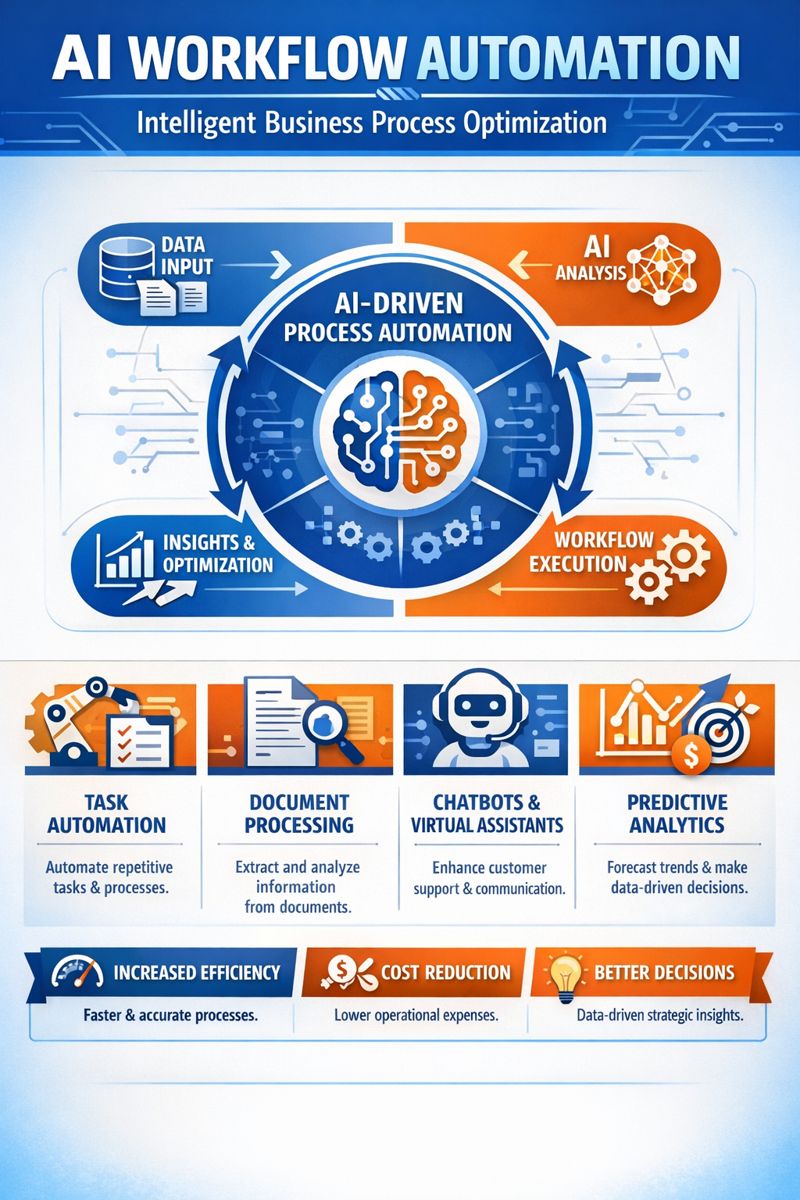
AI Workflow Automation: Intelligent Business Process Optimization
Machine Learning and Predictive Models
Machine learning algorithms leverage both historical and real-time data to identify meaningful patterns and make accurate predictions. These models continuously improve with new examples, enabling workflows that forecast outcomes, anticipate delays, and recommend optimal actions across dynamic business conditions.
Natural Language Processing (NLP)
NLP enables AI workflows to interpret and act on human language embedded in emails, documents, customer inquiries, and support tickets. By extracting meaning, sentiment, and intent, NLP automates document classification, routing, and response generation, replacing previously manual routines.
AI‑Enhanced Robotic Process Automation (RPA)
Traditional RPA follows fixed scripts to execute repetitive tasks such as data entry or form filling. When combined with AI, RPA becomes adaptive and contextual, capable of handling exceptions, responding to interface changes, and making decisions that previously required human judgment.
Intelligent Document Processing (IDP)
IDP integrates optical character recognition (OCR) with machine learning to extract structured data from diverse formats such as invoices, contracts, and forms. This approach eliminates the need for template‑based configurations, automating document‑heavy workflows in finance, legal, healthcare, and supply chain management.
Predictive Analytics and Optimization
Predictive analytics continuously monitors workflow performance, identifying bottlenecks and recommending proactive adjustments. By forecasting potential issues before they occur, organizations can avoid operational disruptions and optimize outcomes with data‑driven decision support.
How AI Workflow Automation Differs from Traditional
Adaptability vs. Static Rules
Traditional automation depends on predetermined rules and explicit programming for every scenario. AI workflow automation, in contrast, learns appropriate responses from data, enabling workflows to handle unanticipated situations without manual reprogramming.
Context Awareness
Where traditional systems treat every transaction the same, AI workflows analyze multiple contextual factors—such as customer sentiment, history, and urgency—to tailor actions and prioritize outcomes effectively.
Intelligent Error Handling
AI workflows recognize anomalies, adapt behavior, and either attempt alternate solutions or escalate issues for human review. This resilience prevents the brittle failures common in rule‑based systems.
Continuous Improvement
With each processed transaction, AI models update and refine themselves. Over time, workflows become more accurate, efficient, and reliable without requiring frequent human intervention or code changes.
Business Benefits and Impact
Operational Efficiency and Time Savings
AI workflows operate continuously without fatigue, delivering consistent performance and significant time savings on routine tasks—typically improving efficiencies by 30–40%.
Error Reduction and Quality Control
Automated systems execute processes uniformly, reducing error rates by 25–30% compared to manual execution. In regulated industries, this translates into compliance improvements and reduced risk.
Faster Decision‑Making
Real‑time insights from predictive models accelerate decision processes across departments. Supply chain optimization, customer support triage, and financial forecasting all benefit from data‑driven recommendations.
Scalability and Cost Savings
AI workflow automation scales operations without proportional increases in staffing, enabling businesses to handle growth or seasonal peaks efficiently. Cost savings from automation range from 10% to 50%, compounded over time as systems improve.
Common Use Cases across Industries
Customer Service
AI chatbots, intelligent ticket routing, and sentiment analysis tools streamline support operations, reducing volume, directing complex issues to specialists, and prioritizing urgent cases.
Finance and Banking
AI workflows automate loan processing, fraud detection, and compliance monitoring, extracting relevant data, verifying information, and flagging risks in real time.
Healthcare
Automation in patient scheduling, claims processing, medical record handling, and diagnostics reduces administrative burden and improves care coordination.
Manufacturing
Predictive maintenance monitors equipment conditions to forecast failures, while computer vision systems perform automated quality inspections at scale.
Marketing and Sales
AI workflows deliver audience segmentation, content personalization, campaign optimization, and lead scoring—integrating touch points for holistic customer engagement.
Implementation Best Practices
Start with Pilot Projects
Identify high‑volume, repetitive processes with clear success metrics. Initial pilots (e.g., email routing, invoice processing) help establish value and build organizational experience.
Map Existing Processes
Document current workflows to identify bottlenecks, decision points, and automation targets. Distinguishing simple rule‑based tasks from those needing AI ensures the right automation strategy.
Ensure Data Quality
Machine learning thrives on quality data. Perform data audits to ensure completeness, consistency, relevance, and readiness before deploying AI workflows.
Select the Right Tools
Evaluate platforms based on integration capabilities, governance features, and scalability. Options range from user‑friendly tools like n8n, Make, and Zapier to enterprise solutions like IBM watsonx Orchestrate and Salesforce Agentforce.
Manage Change and Adoption
Communicate clearly that AI augments, not replaces, human roles. Train users early, involve them in design, and celebrate early wins to build trust and momentum.
Establish Governance and Monitoring
Define policies for data access, audit logging, and decision accountability. Track key performance indicators (KPIs), monitor error rates, and refine models as business conditions evolve.
Future Trends and Emerging Capabilities
Agentic AI Workflows
The next evolution involves autonomous agents that coordinate complex multi‑step processes, adapt strategies based on outcomes, and collaborate across systems with minimal human guidance.
Generative AI Integration
Integrating generative models expands capabilities beyond automation to content creation, design generation, and problem resolution embedded within workflows.
Neural Networks for Unstructured Data
Deep learning models extend automation to handle images, audio, video, and free‑form text—tasks that previously required human perception.
Reinforcement Learning Optimization
Workflows increasingly self‑optimize by testing strategies, measuring outcomes, and adjusting behavior through reinforcement learning.
IoT and Real‑Time Analytics
Connected sensors and edge computing enable workflows to adjust instantly to real‑world conditions—such as equipment performance, logistics delays, or customer behavior shifts.
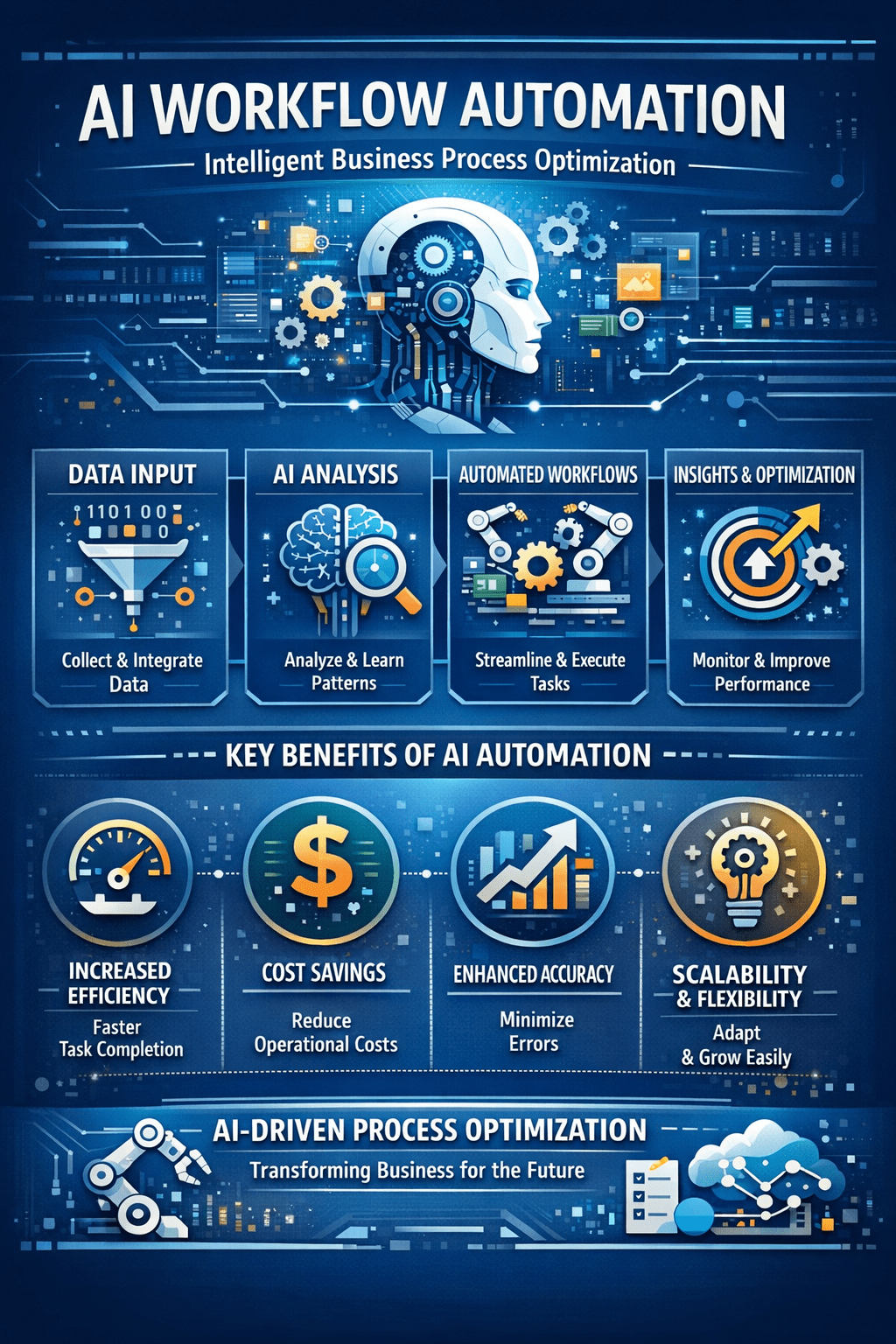
AI Workflow Automation: Intelligent Business Process Optimization
Conclusion
AI workflow automation has matured into a business imperative for organizations seeking improved speed, accuracy, and scalability. By integrating intelligent technologies into workflow management, businesses transform isolated processes into adaptive systems that learn, optimize continually, and deliver measurable value.
Success requires strategic planning, quality data, user adoption, and robust governance. As automation evolves through agentic AI, generative models, and real‑time optimization, organizations that implement AI workflows effectively gain lasting competitive advantages—delivering faster service, better decisions, and superior customer experiences.
FAQS
What is AI workflow automation?
AI workflow automation uses AI to streamline tasks, reduce errors, and speed up business processes.
Which processes benefit most?
Repetitive or data-heavy tasks like invoicing, customer support, inventory, and HR onboarding see the biggest gains.
How is its impact measured?
Impact is measured through time saved, error reduction, cost savings, and improved productivity.