Introduction
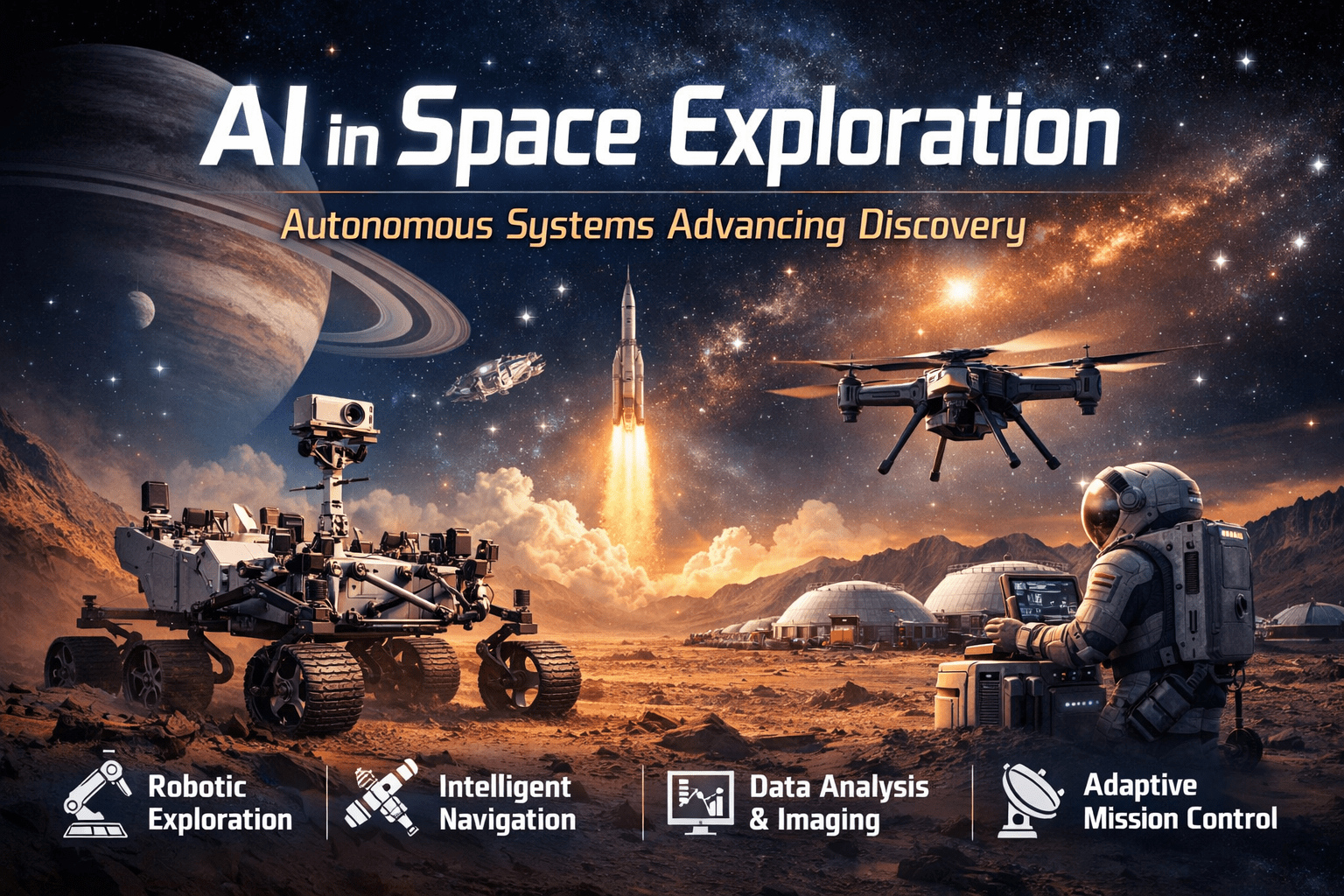
AI in Space Exploration is transforming how missions are planned, executed, and analyzed across the cosmos. By integrating AI in Space Exploration systems, space agencies improve autonomous navigation, spacecraft health monitoring, and real-time data analysis from distant planets. The growing role of AI in Space Exploration enables smarter satellites, robotic explorers, and faster scientific discoveries while reducing mission risks and costs.
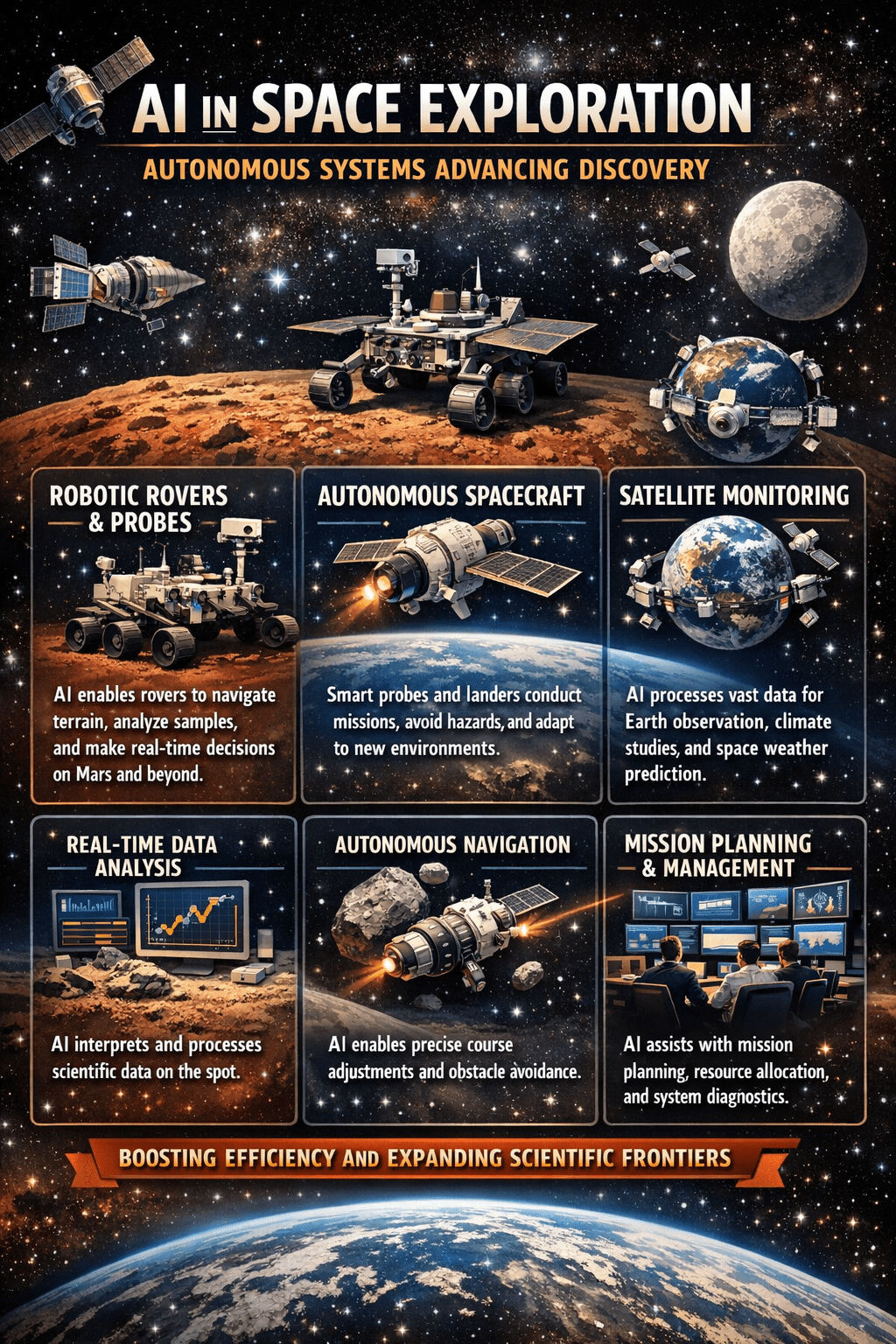
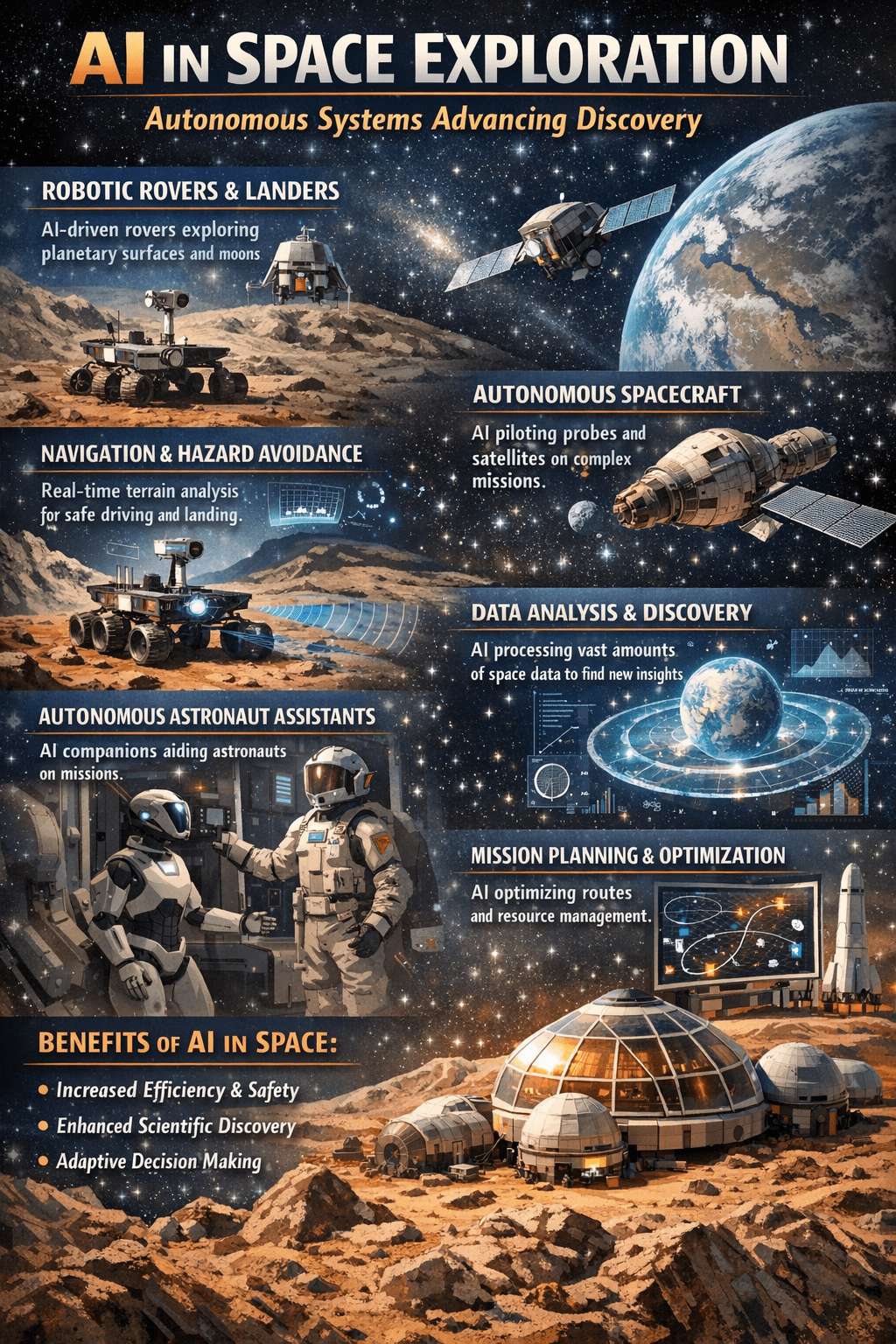
AI in Space Exploration enables spacecraft, rovers, and satellites to operate autonomously across vast distances, where communication delays, massive data volumes, and uncharted terrain prevent real-time human control. By integrating machine learning, neural networks, autonomous navigation algorithms, and predictive analytics, AI transforms mission operations, hazard avoidance, scientific discovery, and astronaut support into scalable, self-directed processes.
AI Overview—Optimized Summary
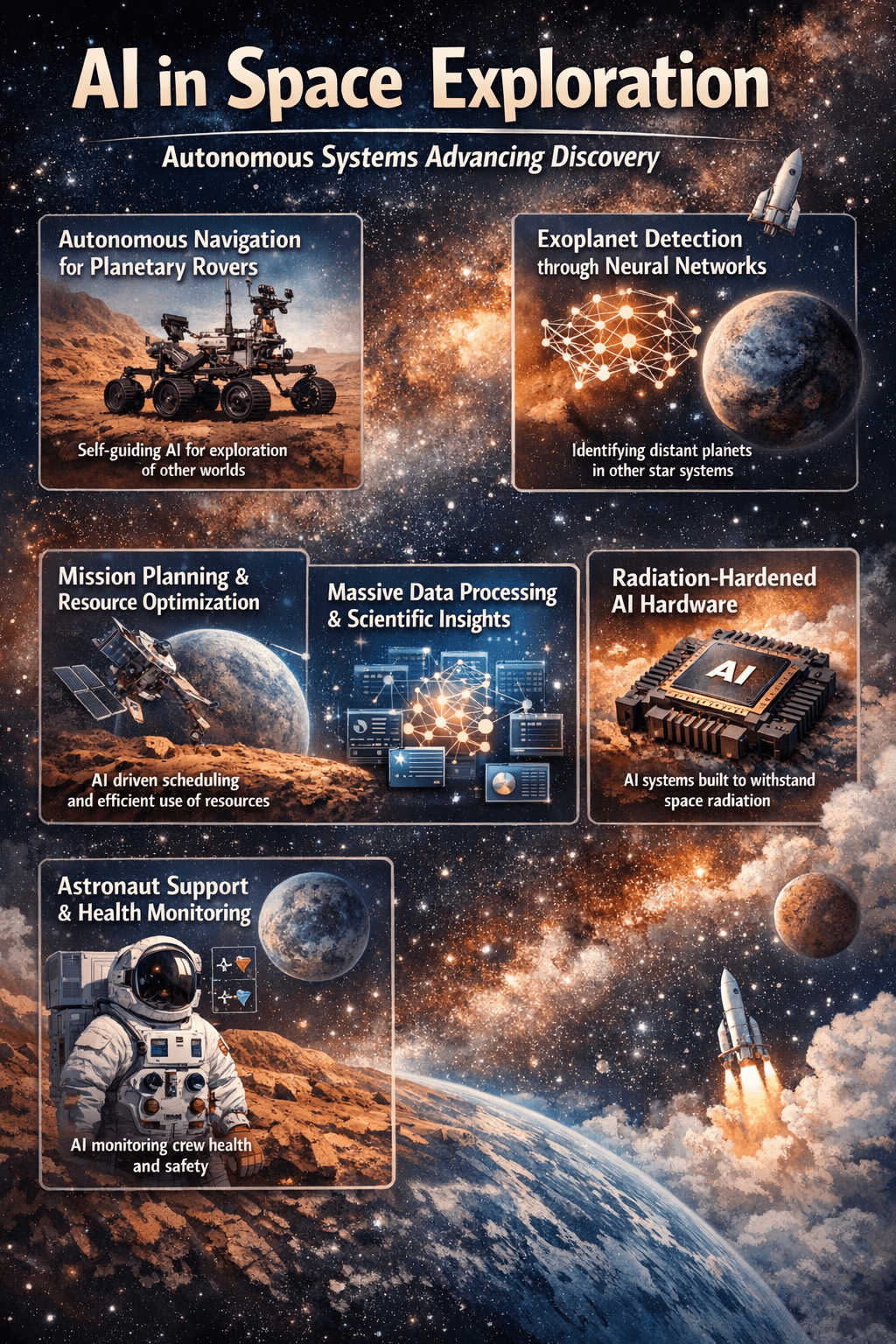
AI in space exploration empowers autonomous navigation, exoplanet detection, mission planning, and astronaut support. By combining machine learning, neural networks, and predictive analytics, AI overcomes communication latency, massive data volumes, and harsh space conditions. Autonomous systems extend human reach across the solar system, enabling rapid scientific discovery and operational efficiency while ensuring crew safety. Transparent, radiation-hardened AI is essential for fully autonomous deep-space missions.
Autonomous Navigation for Planetary Rovers
Mars rovers encounter obstacles and hazards that human controllers cannot respond to in real time due to communication latency exceeding 24 minutes. AI enables autonomous mobility by:
- Computer vision for real-time terrain analysis
- Construction of 3D maps for obstacle avoidance
- Machine learning algorithms like Enhanced AutoNav to classify rocks, slopes, and sand
The Perseverance rover drives autonomously for 88% of daily operations, increasing distance traveled fivefold and protecting critical hardware from collisions. Autonomous navigation exemplifies AI-driven decision-making in remote and hazardous environments.
Exoplanet Detection through Neural Networks
Modern telescopes produce enormous datasets that human analysts cannot fully process. AI accelerates discovery by:
- Identifying planetary transits in noisy light curves
- Distinguishing real exoplanets from false positives with 96% accuracy
- Detecting previously overlooked planets, such as Kepler-90i, in archived data
Systems like NASA’s ExoMiner and Google AI collaborations reduce analysis times from decades to weeks, demonstrating AI as a scalable tool for astronomical discovery.
Mission Planning and Resource Optimization
Spacecraft operations involve hundreds of instruments, power constraints, and competing objectives. AI-based planners such as ASPEN and CLASP optimize mission schedules by:
- Predicting energy usage and communication windows
- Balancing thermal and power budgets
- Enabling opportunistic observations when conditions are favorable
This autonomous mission planning increases scientific productivity and operational efficiency across multi-instrument platforms.
Massive Data Processing and Scientific Insights
Satellites and telescopes generate petabytes of data daily. AI processes this data at scale to identify phenomena like
- Methane emissions and deforestation patterns
- Wildfire propagation
- Water resource distribution and precision agriculture metrics
ESA’s PhiSat-1 filters irrelevant images onboard, while Copernicus program satellites employ neural networks for Earth observation. Space-based AI not only supports interplanetary missions but also delivers actionable insights for terrestrial applications.
Radiation-Hardened AI Hardware
Deep-space environments expose processors to cosmic rays and high-energy particles, causing bit flips and hardware failures. Reliable AI in space requires:
- Radiation-hardened components combined with tested commercial processors
- High-performance FPGAs (e.g., SpaceCube) with watchdog and voltage regulation systems
- Mobile AI accelerators like Google Coral Edge TPU, evaluated under simulated radiation
Hybrid hardware architectures enable high-speed AI processing with operational reliability in extreme space conditions.
Astronaut Support and Health Monitoring
Long-duration missions introduce psychological and physiological challenges. AI assists crews through:
- Conversational interfaces like CIMON for task guidance
- Predictive health analytics monitoring heart rate, sleep, and exercise
- Personalized recommendations using multi-modal sensor data
This approach ensures crew safety, well-being, and operational readiness during extended missions.
Conclusion
AI fundamentally expands space mission capabilities beyond what humans alone can achieve. Autonomous systems process enormous datasets, navigate uncharted terrain, optimize operations, and monitor astronaut health, all while managing constraints imposed by distance and radiation. Agencies investing in reliable, explainable, and hardware-resilient AI today lay the foundation for fully autonomous interplanetary exploration, where human oversight is supplemented rather than required.
Strategic Recommendations
Space agencies should:
- Prioritize radiation-hardened AI hardware for deep space deployment
- Use synthetic data to train models for rare mission scenarios
- Focus AI on tasks where communication delays prevent Earth-based control
- Implement validation frameworks and explainable AI for mission-critical decisions
- Collaborate across agencies to standardize datasets and evaluation metrics
AI must be transparent, reliable, and mission-validated to enable full autonomy in space operations.
FAQs
How does AI help Mars rovers navigate autonomously?
AI processes terrain images in real time to identify obstacles and calculate safe paths, enabling the Perseverance rover to drive autonomously 88 percent of the time despite 24-minute communication delays with Earth.
What is ExoMiner, and how many exoplanets has it discovered?
ExoMiner is NASA’s deep learning system that analyzes telescope light curves to detect planetary transits, successfully identifying 301 new exoplanets with 96 percent accuracy by recognizing patterns human analysts missed.
Why can’t regular computer processors work in space?
Cosmic rays and high-energy protons cause bit flips and hardware failures in standard processors, requiring radiation-hardened components or hybrid systems combining protected and upscreened commercial hardware for reliable space operations.