AI in Archaeology: Transforming Site Discovery and Cultural Heritage Preservation
Introduction
AI in Archaeology is revolutionizing the way researchers discover, document, and preserve cultural heritage. By leveraging advanced machine learning, computer vision, and data analytics, AI in Archaeology enhances site discovery, artifact analysis, and historical reconstruction with unprecedented accuracy. AI in Archaeology enables archaeologists to process vast datasets, detect hidden structures, and predict excavation hotspots, reducing time and resource constraints. Moreover, AI in Archaeology supports preservation efforts by monitoring environmental impacts and digitally reconstructing endangered sites. Integrating AI in Archaeology with modern SEO strategies ensures content visibility, relevance, and engagement while highlighting the transformative role of artificial intelligence in cultural heritage research.
By processing LiDAR data, satellite imagery, aerial photography, and ground-penetrating radar (GPR), AI systems reduce site discovery timelines from years to weeks and achieve accuracy rates exceeding 90% in documented studies. These capabilities are critical for heritage conservation, particularly as urban expansion, climate change, and looting threaten irreplaceable archaeological resources.
AI Overview—Optimized Summary
AI in archaeology uses machine learning, LiDAR, satellite imagery, and geophysical data to rapidly identify and preserve cultural heritage sites. These technologies improve detection accuracy, scale research across vast regions, and protect endangered archaeological resources. Success depends on high-quality data, ethical governance, and interdisciplinary collaboration.
Archeology Deeply Overview
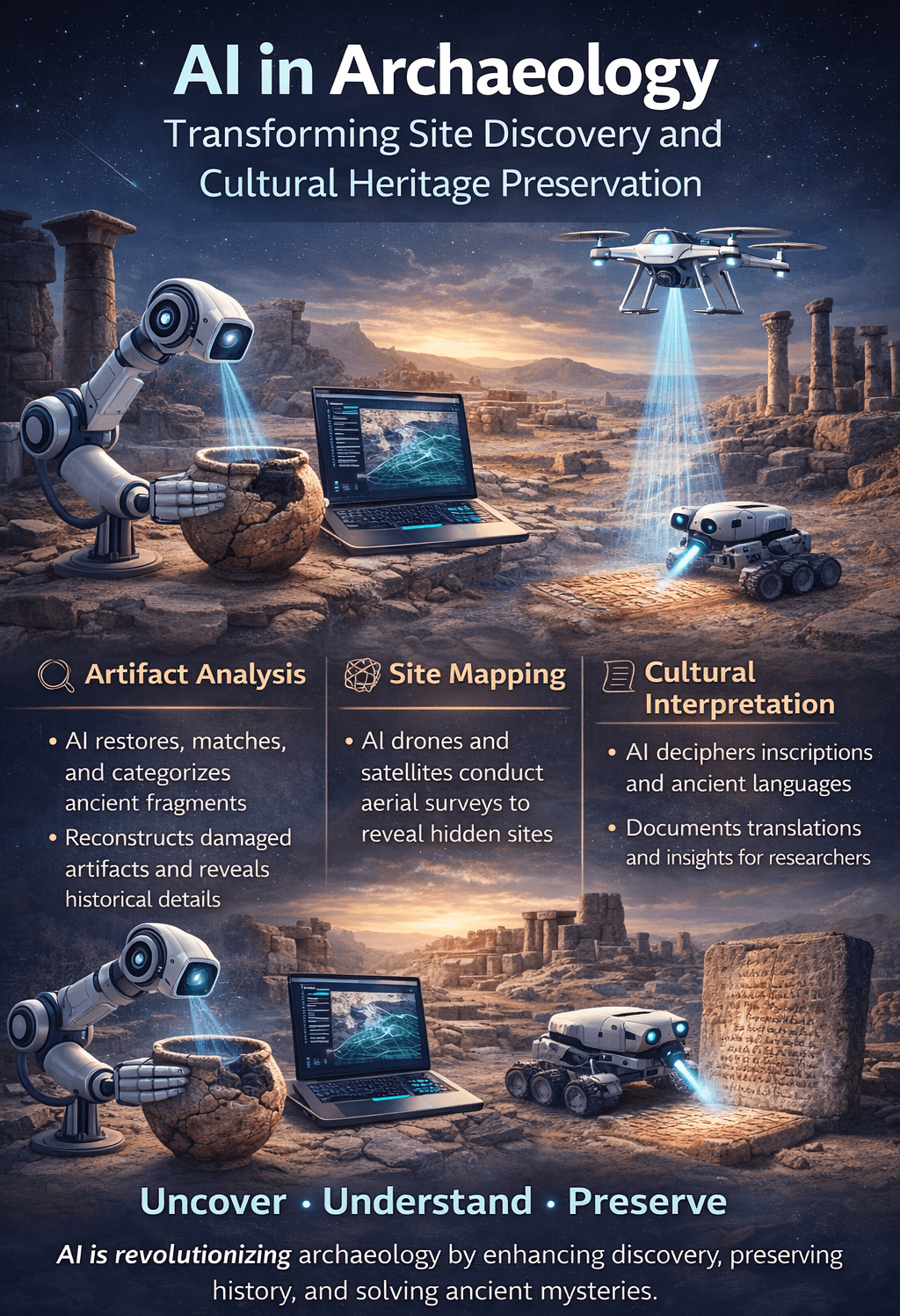
AI in Archaeology: Transforming Site Discovery and Cultural Heritage Preservation
LiDAR and Deep Learning for Archaeological Site Detection
LiDAR (Light Detection and Ranging) is one of the most impactful technologies in digital archaeology. It generates high-resolution digital elevation models (DEMs) that penetrate dense vegetation, revealing hidden structures such as ancient roads, terraces, burial mounds, and settlement layouts.
Convolutional neural networks (CNNs) automatically analyze LiDAR-derived terrain data, identifying anthropogenic features by recognizing subtle topographic patterns that distinguish cultural landscapes from natural formations. Research in Europe and Mesoamerica demonstrates that AI-driven LiDAR analysis outperforms manual interpretation, enabling:
- Multi-class site classification
- Faster processing of large spatial datasets
- Improved detection beneath forest canopy
These methods are now central to landscape archaeology, predictive modeling, and spatial archaeology.
Satellite Imagery, Remote Sensing, and Predictive Archaeology
Satellite imagery analysis enables archaeological research at a continental scale, especially in remote, politically unstable, or environmentally hostile regions. Machine learning models trained on known site characteristics detect spectral signatures, soil marks, vegetation anomalies, and geometric patterns invisible to the human eye.
High-impact projects using multispectral and hyperspectral imagery have:
- Identified new archaeological zones in Mesopotamia with ~80% accuracy
- Accelerated Nazca Lines discovery through AI-assisted aerial analysis
- Supported cultural resource management (CRM) and heritage monitoring
These techniques are foundational to predictive archaeology, allowing researchers to estimate where undiscovered sites are likely located.
Ground-Penetrating Radar and AI-Based Geophysical Interpretation
Subsurface archaeological prospection generates complex geophysical datasets that are difficult to interpret manually. AI enhances ground-penetrating radar (GPR), magnetometry, and electrical resistivity surveys by applying self-organizing maps and unsupervised learning.
These models:
- Reduce signal noise
- Detect buried walls, foundations, and infrastructure
- Improve confidence in multi-sensor data integration
AI does not replace archaeologists but functions as an expert decision-support system, improving interpretive accuracy and excavation planning.
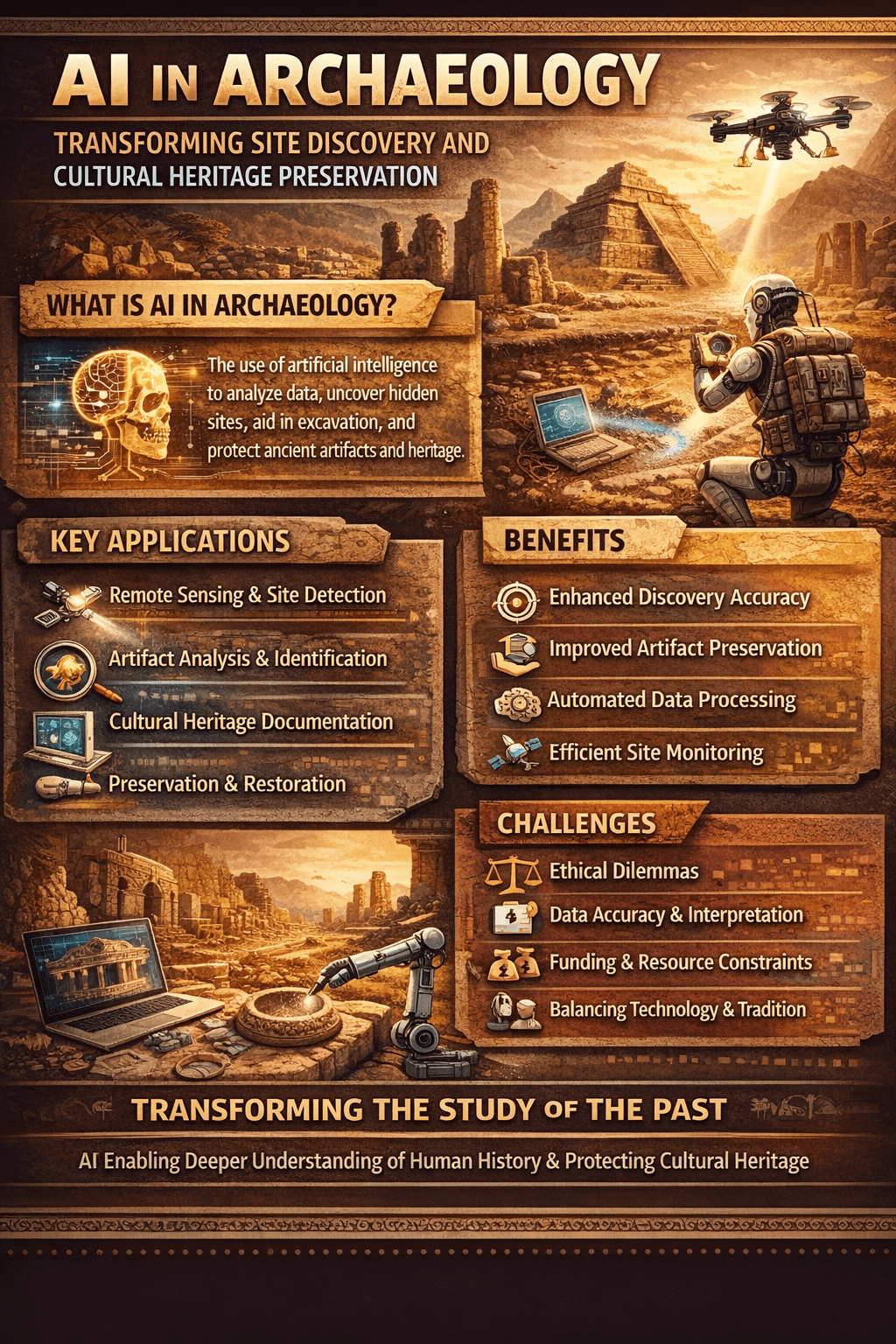
AI in Archaeology: Transforming Site Discovery and Cultural Heritage Preservation
AI and Ancient Text Translation
AI also expands archaeology beyond physical sites into digital epigraphy and philology. Neural machine translation (NMT) models now process ancient scripts such as Akkadian cuneiform, converting them into modern languages with accuracy exceeding earlier rule-based systems.
Projects like the Babylonian Engine demonstrate how AI:
- Accelerates translation workflows
- Increases accessibility to historical archives
- Supports digital humanities research
Human expertise remains essential for contextual interpretation, but AI dramatically reduces linguistic bottlenecks.
Archaeological Big Data, FAIR Principles, and Infrastructure
One of the most critical challenges in AI-driven archaeology is data readiness. Archaeological datasets are often fragmented, inconsistent, and poorly structured, limiting machine learning effectiveness.
Leading initiatives emphasize FAIR data principles:
- Findable
- Accessible
- Interoperable
- Reusable
The MAIA (Machine Learning in Archaeology) network coordinates international efforts to standardize archaeological data, develop training datasets, and address algorithmic bias. Research growth in AI archaeology has accelerated rapidly, but data curation and metadata quality remain more important than model sophistication.
Ethical AI, Indigenous Knowledge, and Cultural Heritage
Responsible AI use in archaeology requires addressing:
- Data sovereignty
- Indigenous and local community rights
- Algorithmic transparency
- Bias inherited from colonial-era datasets
Ethical AI frameworks ensure that digital heritage technologies support inclusive, community-centered archaeology rather than extractive research practices.
- Establish ethical review and governance processes
- Invest in interdisciplinary training between archaeologists, GIS specialists, and data scientists

AI in Archaeology: Transforming Site Discovery and Cultural Heritage Preservation
Conclusion
AI transforms archaeology from localized, labor-intensive excavation into scalable, data-driven heritage science. When combined with standardized data practices and ethical oversight, AI enables proactive site protection, deeper historical insight, and global access to humanity’s past. Institutions that invest in data infrastructure and responsible AI today will shape the future of archaeological research and cultural heritage preservation.
Strategic Recommendations
To effectively implement AI in archaeology, institutions should:
- Prioritize FAIR-compliant data infrastructure
- Begin with mature applications such as LiDAR-based site detection
- Develop archaeology-specific AI evaluation metrics
FAQs
How accurate is AI at detecting archaeological sites?
AI systems achieve over 90 percent accuracy in documented studies when trained on quality datasets, though performance varies by site type, terrain conditions, and data resolution.
What is LiDAR, and why does it matter for archaeology?
LiDAR uses laser pulses to create three-dimensional terrain maps that penetrate vegetation, revealing hidden structures beneath forest canopy that traditional methods cannot detect.
Can AI translate ancient languages automatically?
Neural machine translation models process ancient texts like Akkadian cuneiform with accuracy exceeding traditional computational methods, though expert validation remains necessary for scholarly work.