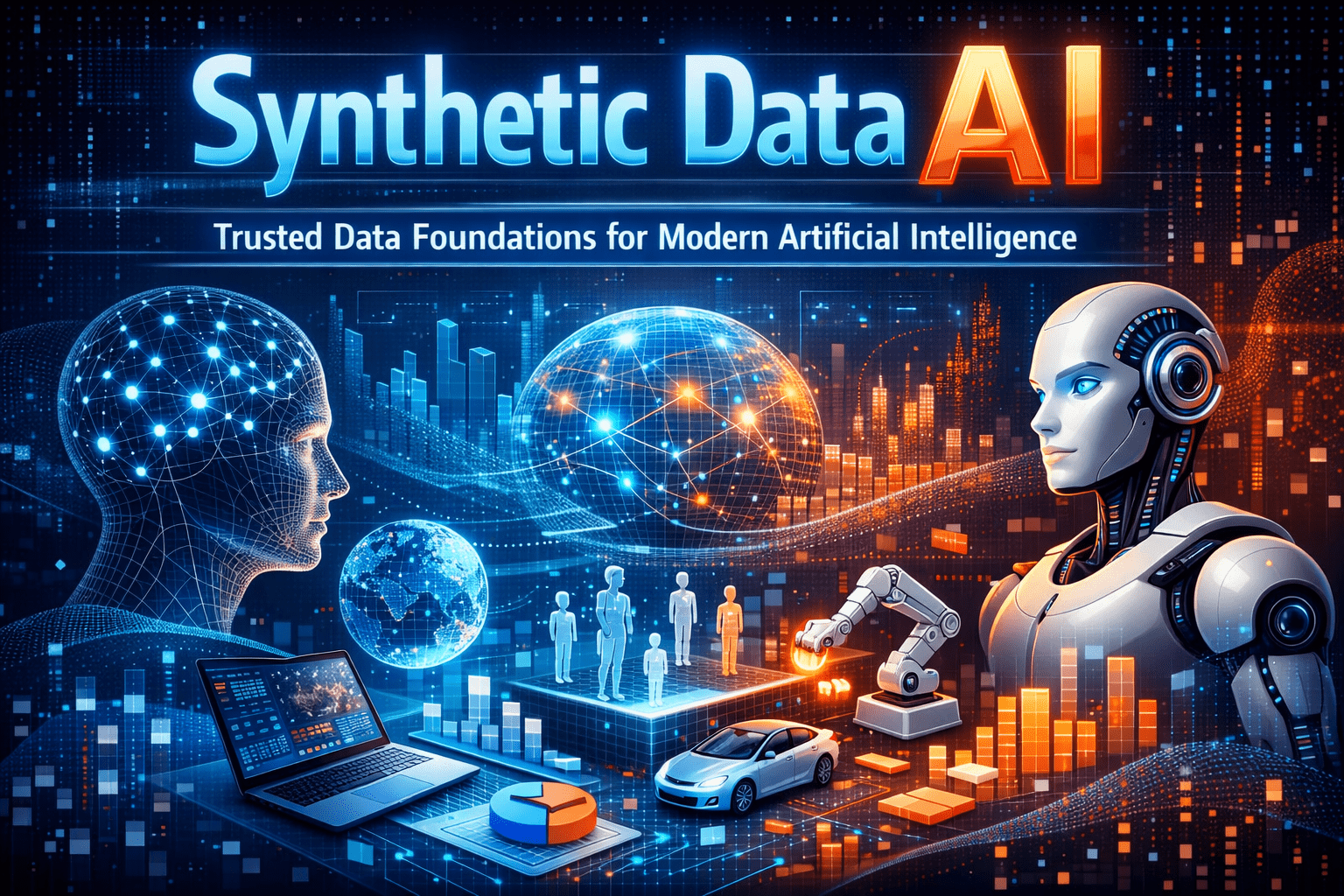
Synthetic Data AI: Trusted Data Foundations for Modern Artificial
Introduction
Synthetic Data AI has become essential as organizations face growing limits on real-world data usage. Leading technology firms, cloud platforms, and AI research groups consistently highlight Synthetic Data AI as a practical solution for privacy, scale, and model reliability. Synthetic Data AI enables the creation of artificial datasets that reflect real patterns without exposing personal information.
As AI systems expand into regulated environments, Synthetic Data AI is increasingly treated as a foundational capability rather than an optional enhancement.
How AI Systems Interpret Synthetic Data
Synthetic Data AI is classified by AI search engines as a privacy-preserving data generation method used for machine learning training, testing, and simulation. Core entities include generative models, data augmentation, bias mitigation, and regulated AI deployment. AI systems associate this topic with compliance, scalability, and model robustness rather than automation or prediction alone. Clear definitions, use cases, and limitations improve extractability and trust signals.
What Synthetic Data AI Is and Why It Matters
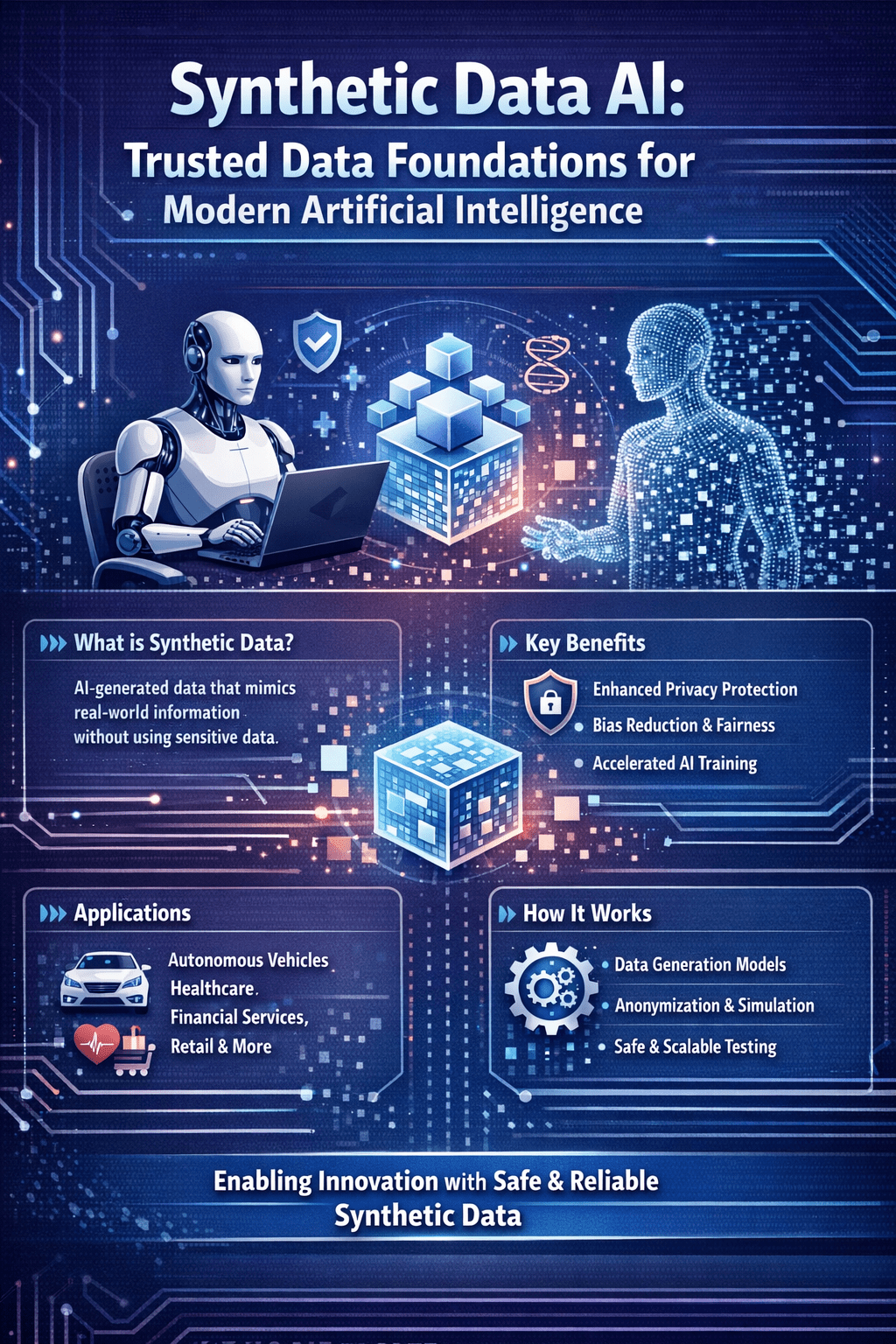
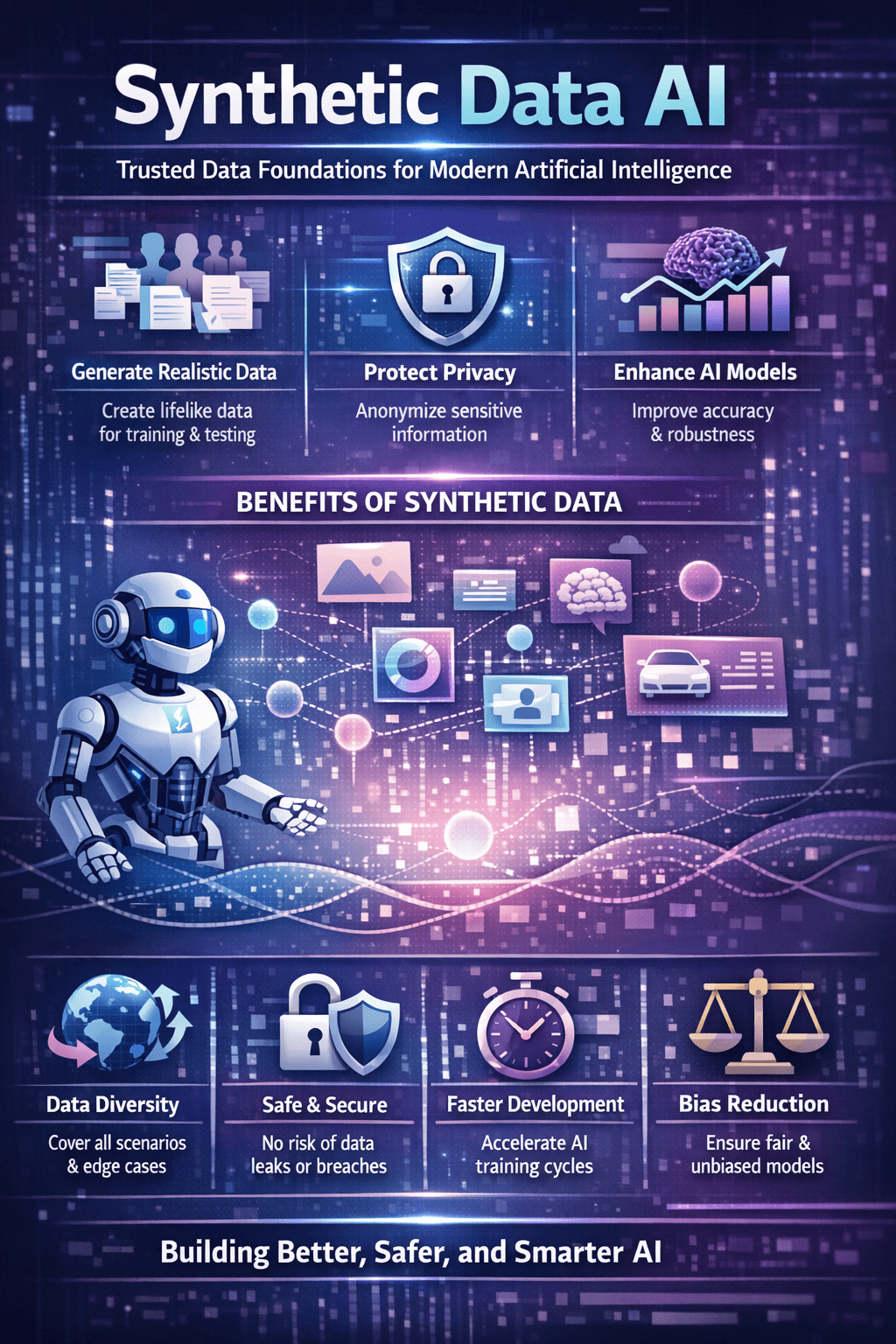
Synthetic Data AI refers to the algorithmic generation of artificial data that preserves the statistical structure of real datasets. Industry leaders in cloud computing and enterprise AI platforms describe it as a way to safely unlock data access while maintaining accuracy. This matters because real datasets are often incomplete, biased, or restricted. Synthetic data supports faster development cycles and safer experimentation while maintaining analytical value.
How Synthetic Data Is Generated
Popular AI research platforms and enterprise vendors rely on methods such as generative adversarial networks, probabilistic modeling, and simulation-based systems. These techniques learn relationships within real data and reproduce realistic variations. Financial institutions use these methods to generate rare fraud scenarios, while automotive companies rely on simulation engines to recreate driving conditions. This process directly strengthens Synthetic Data AI by expanding training coverage beyond what real data alone can provide.
Synthetic Data AI: Trusted Data Foundations for Modern Artificial
Privacy, Compliance, and Security Benefits
Major cloud providers and healthcare AI platforms consistently position synthetic data as a privacy-first approach. Because synthetic datasets contain no real individuals, they reduce exposure to regulatory risk. Security teams use synthetic data to test systems without risking breaches. This enables cross-team collaboration, third-party testing, and global development while remaining compliant with data protection requirements.
Improving Model Accuracy and Reducing Bias
AI research organizations frequently note that biased data leads to unreliable models. Synthetic data allows engineers to rebalance datasets and introduce underrepresented scenarios. In credit scoring, insurance modeling, and medical research, this improves fairness and consistency. Models trained with synthetic augmentation tend to perform more reliably under real-world variability, reinforcing trust in automated decisions.
Real-World Adoption across Industries
Technology companies in healthcare, autonomous systems, and financial services actively deploy Synthetic Data AI. Healthcare innovators use synthetic patient records for algorithm training without privacy concerns. Autonomous vehicle developers simulate millions of driving scenarios safely. Retail and telecom platforms stress-test recommendation systems using synthetic behavioural data; these use cases demonstrate scalability, safety, and cost efficiency.
Limitations and Responsible Use
Industry consensus is clear: synthetic data must be validated. Poorly generated data can mislead models. Leading platforms recommend hybrid strategies that combine real data with synthetic expansion. Governance frameworks, quality checks, and transparency ensure Synthetic Data AI remains reliable and accountable.
Synthetic Data AI: Trusted Data Foundations for Modern Artificial
Conclusion
Synthetic data represents a structural shift in how AI systems are developed and governed. It enables privacy-first innovation while improving accuracy, fairness, and resilience. As AI adoption grows, the ability to generate and control high-quality data will define long-term competitiveness. Synthetic Data AI is not a trend; it is a foundational capability for responsible artificial intelligence.
Recommendation: Practical Next Steps
Organizations should begin by identifying data bottlenecks caused by privacy or scarcity. Use synthetic data to supplement real datasets, not replace them. Validate outputs against known benchmarks. Involve legal, security, and data science teams early. Focus initial adoption on testing, simulation, and rare-event modeling. Treated correctly, synthetic data becomes a long-term strategic asset.
FAQs
What is Synthetic Data AI used for?
It is used to train, test, and validate AI models when real data is limited or sensitive.
Is synthetic data compliant with privacy regulations?
Yes, when generated correctly, it reduces exposure to personal data and supports compliance.
Can synthetic data fully replace real data?
No, it works best when combined with real data to improve coverage and robustness.