Dash Camera: Your Silent Witness on the Road
Introduction
A Dash Camera, or dash cam, is a small, continuous-recording video camera mounted inside a vehicle, designed to capture a driver’s perspective of the road. This technology has evolved from a niche gadget into mainstream automotive equipment, serving as a silent witness that can provide crucial, unbiased evidence in the event of an incident. The primary entity of this discussion is the Dash Camera, a device whose value is no longer theoretical but is now proven daily by millions of drivers.
For informed, tech-aware readers in the UK and USA, understanding the functionality, benefits, and considerations of Dash Camera is essential for making a practical decision about this increasingly standard piece of safety gear.
The Mainstream Adoption of Dash Cameras
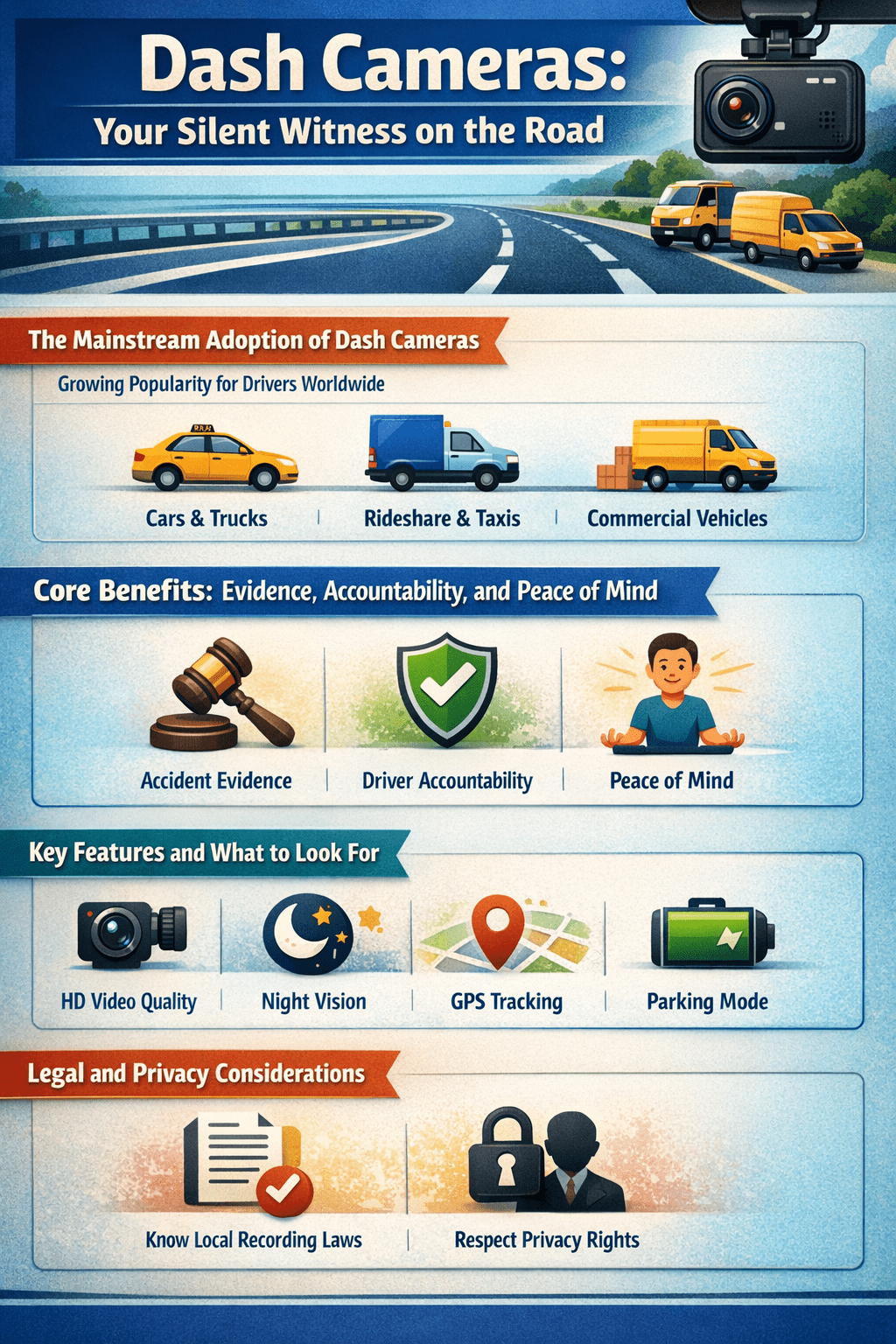
Dash camera usage has seen explosive growth, moving from online curiosities to standard equipment for a significant portion of the driving public. Recent surveys indicate that 30% of all U.S. drivers—approximately 69 million Americans—now use a dash cam. In the UK, the market is robust and growing, projected to reach a value of $331.7 million by 2030. This adoption is not uniform; it is led by those who spend the most time on the road or face the greatest risks. Urban drivers and gig economy workers, such as rideshare and delivery drivers, are among the most likely to install cameras, with adoption rates around 40-53%, roughly double that of rural drivers.
This trend is supported by a clear demographic shift. Younger generations, particularly Gen Z and Millennials, are both the most likely to own a dash cam and the most likely to purchase one in the near future. A powerful 70% of all drivers believe dash cams should be factory-installed in all new vehicles, a sentiment that automakers like Tesla, BMW, and Mercedes-Benz are already addressing by integrating recording capabilities into their advanced driver-assistance systems.
Dash Camera: Your Silent Witness on the Road
Core Benefits: Evidence, Accountability, and Peace of Mind
The fundamental value of a dash camera lies in its ability to provide objective evidence. This utility is not hypothetical; 40% of dash cam owners have captured a crash or traffic incident on video. Of those, half have used the footage for insurance claims or other legal matters. Attorneys note that this video evidence can be indispensable for establishing fault, documenting road conditions, and providing context that witness statements or memory might miss.
Beyond dispute resolution, the presence of a dash cam can influence driver behavior, promoting greater accountability and focus on the road. This often translates into tangible psychological benefits, with 48% of owners reporting reduced stress levels since installing one. As one driver noted, the device provides “legal protection against wrongful accusations” and removes the worry of fraudulent claims, lifting a significant mental burden.
Key Features and What to Look For
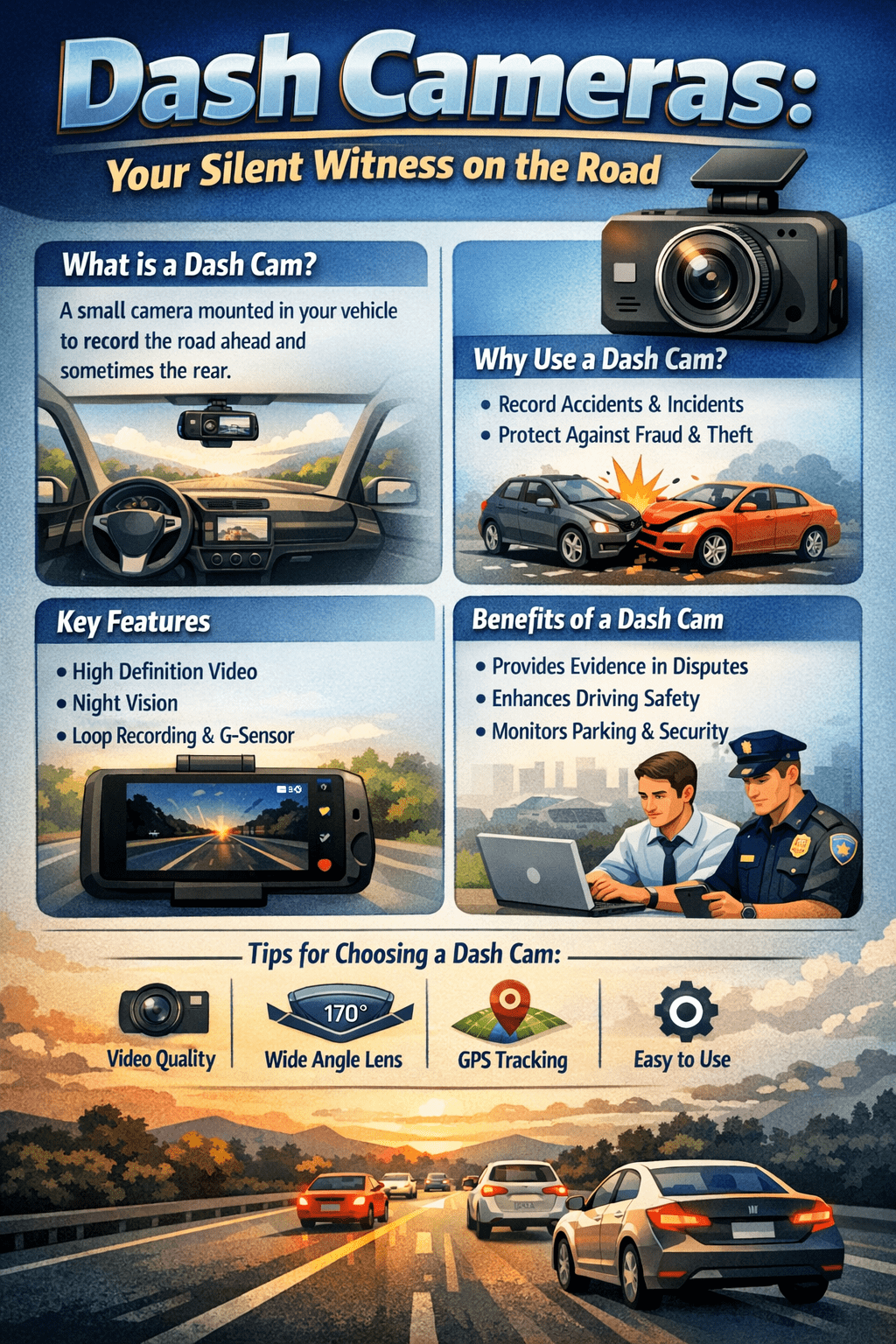
When selecting a dash cam, understanding core features is crucial to ensure it will perform when needed. Based on expert testing and reviews, here are the non-negotiable specifications to consider:
- Video Resolution and Sensor: For clear footage where license plates and details are legible, 4K resolution (or a minimum of 2K) is now the standard for front-facing cameras. The quality of the image sensor is equally important; many top-performing models utilize Sony Starvis 2 sensors, which excel in low-light conditions.
- Field of View (FOV): A very wide angle can distort images. An optimal FOV is between 140 and 160 degrees, which is sufficient to capture multi-lane action without significant fisheye distortion.
- Power Supply: In hot climates, supercapacitors are preferred over lithium-ion batteries, as they are more resilient to high temperatures and have a longer lifespan.
- Parking Mode: This feature allows the camera to monitor your vehicle while it’s parked and off, recording if an impact or motion is detected. Activating it typically requires hardwiring the dash cam to the vehicle’s fuse box.
- Multi-Channel Setups: While a single front-facing camera is most common (used by 90% of owners), adding lenses expands coverage. Over half of users add a rear-facing camera, and nearly a third use an interior-facing camera, which is particularly valuable for rideshare drivers.
Legal and Privacy Considerations
Operating a dash cam comes with a responsibility to respect privacy, especially for business users. In the UK, the Information Commissioner’s Office (ICO) provides clear guidelines under UK GDPR. If you use a dash cam for business purposes—even in a personal vehicle used for work—you likely need to:
- Complete registration with the ICO and submit the required data protection fee.
- Inform people they are being recorded, typically with a visible sticker on the vehicle.
- Securely store footage and delete it when
- It is no longer needed (e.g., after a week if no incident occurred).
- Switch off audio recording by default, as it is highly intrusive and requires strong justification.
Even for personal use, it’s wise to be mindful. While dash cam footage is generally admissible as evidence, its weight can vary by jurisdiction.
Price Table
| Model | Key Features | Resolution | Storage Support | Warranty | Price |
|---|---|---|---|---|---|
| Basic Dash Cam | Loop recording, G-sensor, night vision | Full HD 1080p | Up to 64 GB | 1 Year | $49 |
| Standard Dash Cam | Wide-angle lens, night vision, G-sensor, parking mode | Full HD 1080p | Up to 128 GB | 1 Year | $79 |
| Advanced Dash Cam | Front & rear cameras, GPS, Wi-Fi, parking mode, night vision | 4K + 1080p | Up to 256 GB | 2 Years | $129 |
| Premium Dash Cam | AI collision alerts, cloud support, GPS tracking, Wi-Fi, parking mode | 4K Ultra HD | Up to 512 GB | 2 Years | $199 |
Dash Camera: Your Silent Witness on the Road
Recommendations for Different Needs
Choosing the right model depends on your primary use case, driving habits, and budget. The following table synthesizes expert recommendations from rigorous testing rounds.
| Use Case | Recommended Model | Key Rationale |
| Overall Excellence & Evidence Clarity | Viofo A229 Pro or A329[S] | Consistently tops expert reviews for crisp 4K video day and night, reliable build, and features like GPS and parking mode. The A329S variant offers three-channel (front, rear, and interior) coverage. |
| Best Value & Simplicity | Miofive S1 / S1 Ultra | Offers impressive dual 4K resolution and core features at a highly competitive price. The S1 is a superb single-channel option, while the S1 Ultra adds a rear camera. |
| Professional/Commercial Drivers | Multi-channel system (e.g., Viofo A329S) or Mirror Dash Cam (e.g., Miofive Mirror 1) | Maximum coverage (front, rear, cabin) is crucial for liability protection. Mirror cams provide a large display and can double as a reversing aid. |
| Integrated Safety Features | Garmin Dash Cam Live | Adds driver-assist alerts like forward collision and lane departure warnings, which are valuable for vehicles not equipped with such systems. |
Frequently Asked Questions
Does having a dash cam lower my insurance premium?
While not yet widespread, it is becoming more common. Some insurers offer discounts for commercial fleets with telematics and cameras. For personal policies, a few providers offer discounts, but the primary financial benefit is using footage to successfully dispute a non-fault claim, protecting your no-claims bonus.
Is dash cam footage legally admissible in court?
Yes, dash cam footage can be used as evidence in insurance disputes and legal proceedings. However, its specific influence and admissibility can depend on the circumstances and local jurisdiction. It is best to consult with legal counsel if relying on footage for a case.
How long should I keep dash cam footage?
For personal use, if no incident occurs, footage is typically overwritten in a loop every few days or weeks, depending on your memory card size. For business users complying with UK GDPR, the ICO advises deleting footage after a short period (e.g., a week) if there is no specific reason to keep it.