6G Network: Core Architecture, Key Technologies, and Strategic Roadmap
Introduction
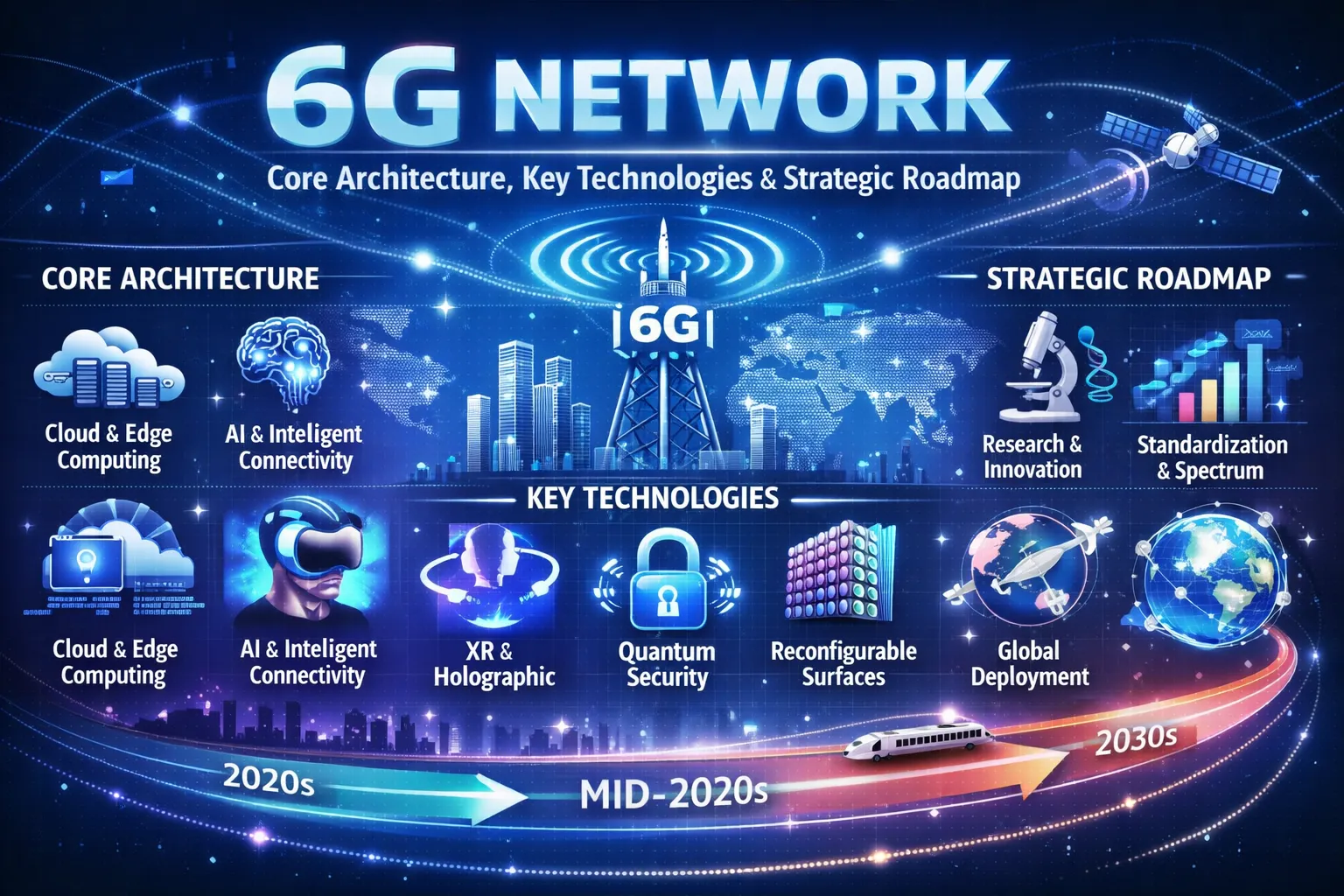
The 6G network represents the sixth generation of mobile communication systems, expected to standardize by 2028 and reach commercial availability around 2030. Unlike previous generational shifts that focused primarily on consumer bandwidth, the 6G network integrates three foundational capabilities: extreme connectivity, native artificial intelligence, and integrated sensing. According to the IEEE Communications Society, 6G networks are expected to support real-time human/cyber/physical system interactions while pursuing global coverage across space, air, ground, and water domains. This is not simply 5G with higher speeds. It is a fundamental architectural transformation designed for the data-driven, AI-based society emerging this decade.
6G Network: Core Architecture, Key Technologies, and Strategic Roadmap
The Six Core Vision Pillars of 6G
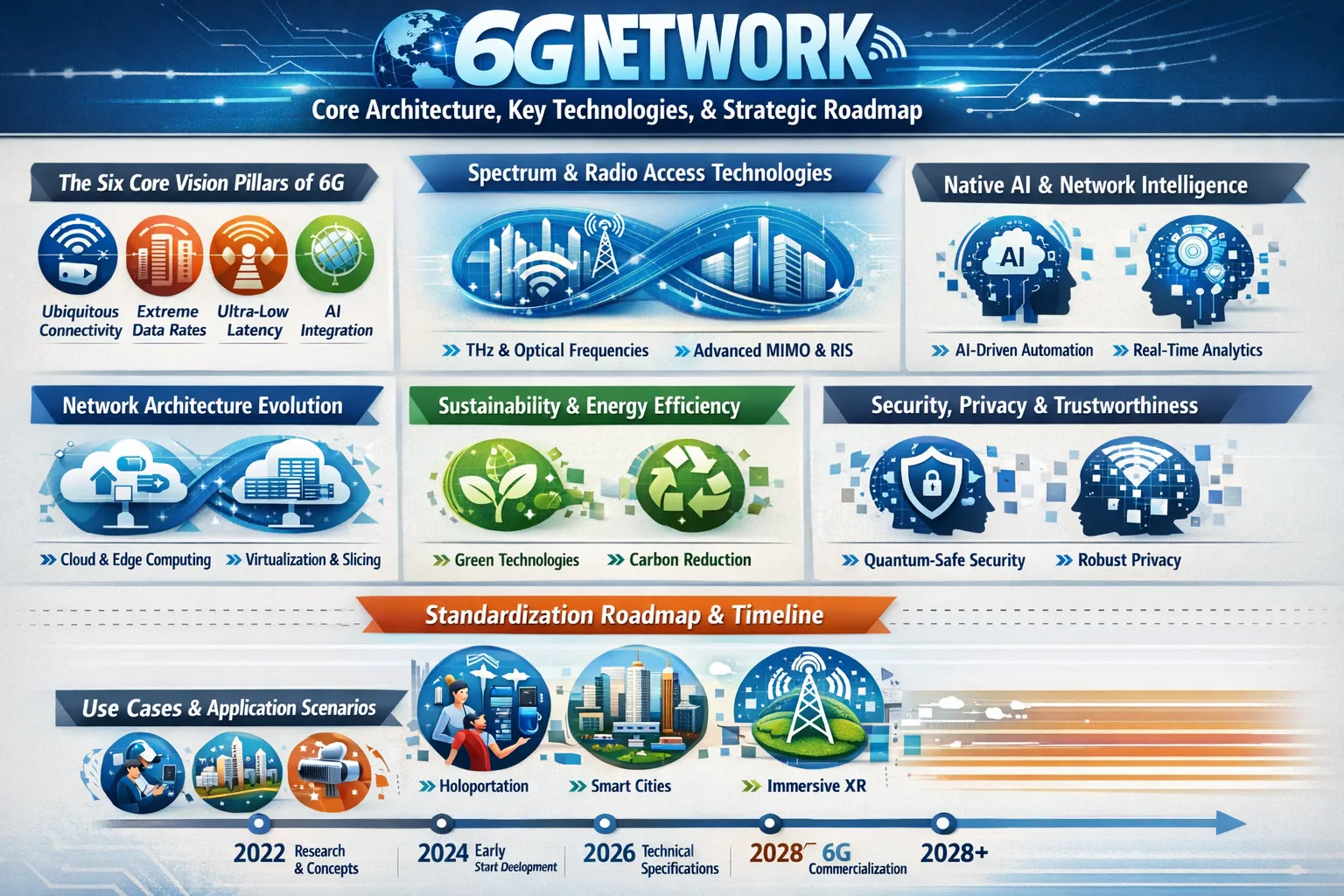
Industry consortium one6G has identified twelve core enabling technologies forming the 6G ecosystem, which can be synthesized into six primary vision pillars. These pillars define what the 6G network delivers beyond traditional connectivity metrics.
Intelligent Connectivity integrates distributed AI across the network fabric, enabling autonomous optimization and predictive resource allocation. Deep Connectivity extends coverage to previously unreachable environments, including underwater and subterranean deployments. Holographic Connectivity delivers immersive extended reality experiences through terabit-per-second data rates. Ubiquitous Connectivity ensures seamless service across terrestrial, aerial, satellite, and maritime networks.
The Korea University research team emphasizes that 6G enables transformational applications, including extended reality, collaborative robotics (cobots), smart grid 2.0, autonomous vehicles, and intelligent healthcare systems.
Spectrum and Radio Access Technologies
Terahertz Communications
The 6G network will operate in terahertz frequency bands between 100 GHz and 300 GHz, unlocking bandwidth previously unavailable for commercial wireless use. This enables maximum data speeds of over 1 terabit per second. The trade-off includes limited propagation range and poor building penetration, requiring ultra-dense small cell deployments.
Next-Generation MIMO and Reconfigurable Intelligent Surfaces
Extremely large aperture arrays and distributed MIMO architectures enable near-field beam forming and spatial multiplexing. Reconfigurable intelligent surfaces transform the physical environment into programmable radio wave reflectors, directing signals precisely where needed rather than relying solely on base station transmissions.
Integrated Sensing and Communication (ISAC)
One of the most significant 6G innovations is ISAC, where the same radio signal performs both data transmission and high-precision environmental sensing. This enables centimeter-level positioning, object detection, and environmental mapping without dedicated sensor infrastructure.
Native AI and Network Intelligence
AI-Native Air Interface
Unlike 5G, which added AI through overlay architectures, 6G integrates machine learning directly into the protocol stack. The network uses AI for spectrum management, interference mitigation, beamforming optimization, and predictive resource allocation. This means the network learns usage patterns and adapts in real time.
Distributed and Federated AI
The 6G network supports distributed machine learning across edge nodes, preserving data privacy while enabling collaborative model training. For organizations deploying AI applications, this shifts the optimal processing location from the centralized cloud to the network edge.
AI-Enabled Core Network
According to DOCOMO Euro-Labs research published in IEEE Communications Standards Magazine, the 6G Core Network incorporates AI capabilities natively, with 3GPP System Architecture Working Group 2 currently evaluating architectural frameworks for AI integration.
Network Architecture Evolution
Network Disaggregation and Softwarization
The 6G network moves beyond monolithic infrastructure toward disaggregated architectures where hardware and software functions separate. Intelligent network softwarization enables flexible, programmable infrastructures that support dynamic service deployment.
Space-Air-Ground-Water Integrated Networks
Global coverage requires integrating terrestrial networks with non-terrestrial components, including low-earth-orbit satellites, high-altitude platform stations, and unmanned aerial vehicles. This integrated architecture ensures connectivity in maritime regions, high-latitude areas, and disaster zones.
Deterministic Networking
For industrial automation and manufacturing applications, 6G introduces deterministic networking capabilities with guaranteed latency and jitter measured in microseconds. This reliability is essential for Industry 4.0 and wireless industrial control systems.
Sustainability and Energy Efficiency
Despite higher data rates and increased complexity, the 6G network aims for a tenfold improvement in energy efficiency compared to 5G. This is achieved through AI-driven sleep modes, dynamic resource allocation, and advanced hardware design. The one 6G white paper emphasizes that 6G must serve as foundational technology for a sustainable society, with high energy efficiency and a low carbon footprint as core requirements.
Green networking principles, including energy-aware routing and renewable-powered infrastructure, are being designed into the architecture from the outset rather than retrofitted.
Security, Privacy, and Trustworthiness
The 6G Architecture White Paper from the Smart Networks and Services Joint Undertaking emphasizes that security, privacy, and trustworthiness must be natively embedded in the architecture rather than retroactively incorporated. This represents a fundamental shift from perimeter-based security models to identity-centric frameworks that authenticate both devices and AI agents.
Network security challenges identified in IEEE research include AI model poisoning, sensing data manipulation, and reconfigurable surface exploitation. Blockchain-based solutions are being explored for trust management and decentralized identity verification.
Use Cases and Application Scenarios
Immersive Extended Reality
Holographic telepresence and immersive XR require the combination of terabit-per-second throughput and sub-millisecond latency that only 6G can deliver.
Collaborative Robotics and Industrial Automation
Manufacturing and logistics operations will use 6G for real-time coordination of autonomous vehicles, drones, and robotic systems, with ISAC eliminating the need for dedicated sensor infrastructure.
Digital Inclusion and Bridging the Divide
The ITU IMT-2030 framework emphasizes digital inclusion as a core requirement, with 6G designed to connect underserved communities through integrated terrestrial and non-terrestrial networks.
Connected Autonomous Vehicles
V2X (vehicle-to-everything) communications require ultra-reliable low-latency links with high mobility support, enabling cooperative automated driving and traffic management.
Standardization Roadmap and Timeline
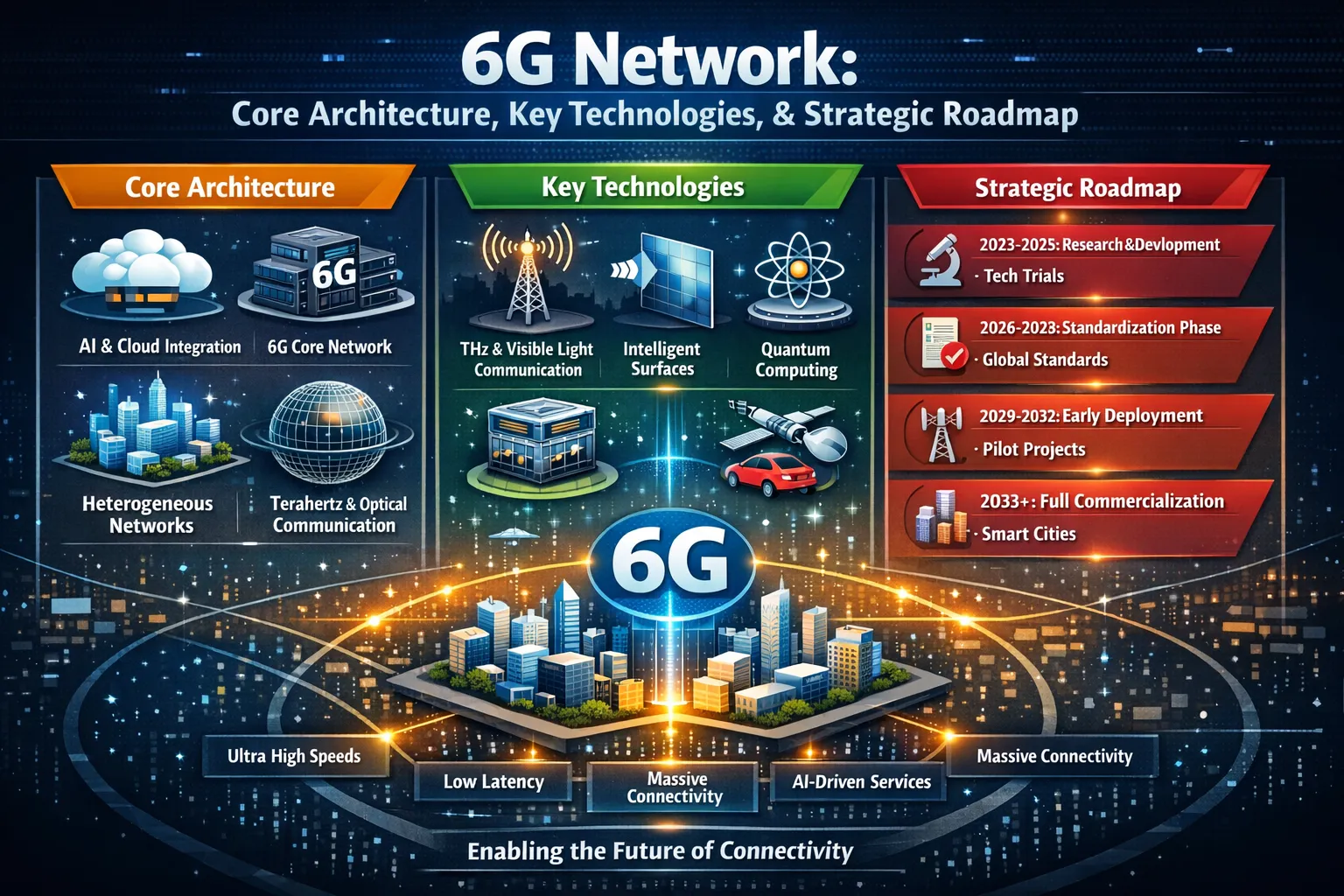
3GPP Release 21 is expected to include the first formal 6G specifications, with ratification targeted for 2028. Commercial deployments typically begin two to three years after standardization, placing initial network availability around 2030.
The IEEE Communications Society notes that as 6G standardization is expected to start not before 2025, the current period represents the pivotal moment to plan and evolve mobile network architectures.
6G Network: Core Architecture, Key Technologies, and Strategic Roadmap
Conclusion
The 6G network marks a departure from connectivity-focused generational upgrades toward an integrated intelligence platform. By embedding AI, sensing, and computation directly into network infrastructure, it transforms mobile communications from a utility into a distributed computing fabric. The standardization window is open. Organizations that understand this shift now will influence the requirements that shape 6G deployment and develop applications that leverage its full capabilities. The choices made in the next three years will determine who leads in the 6G era.
FAQs
What is the expected timeline for 6G network deployment?
Commercial deployment is expected around 2030, with standardization in 3GPP Release 21 targeted for 2028 and early trials already operational.
What are the key enabling technologies for 6G?
The twelve core technologies include terahertz frequencies, next-generation MIMO, integrated sensing and communication, non-terrestrial networks, and distributed federated AI.
How does 6G differ from 5G in terms of architecture?
6G natively integrates AI across the protocol stack, incorporates sensing capabilities into radio signals, and supports space-air-ground-water integrated networks, representing a fundamental architectural shift rather than an incremental improvement.